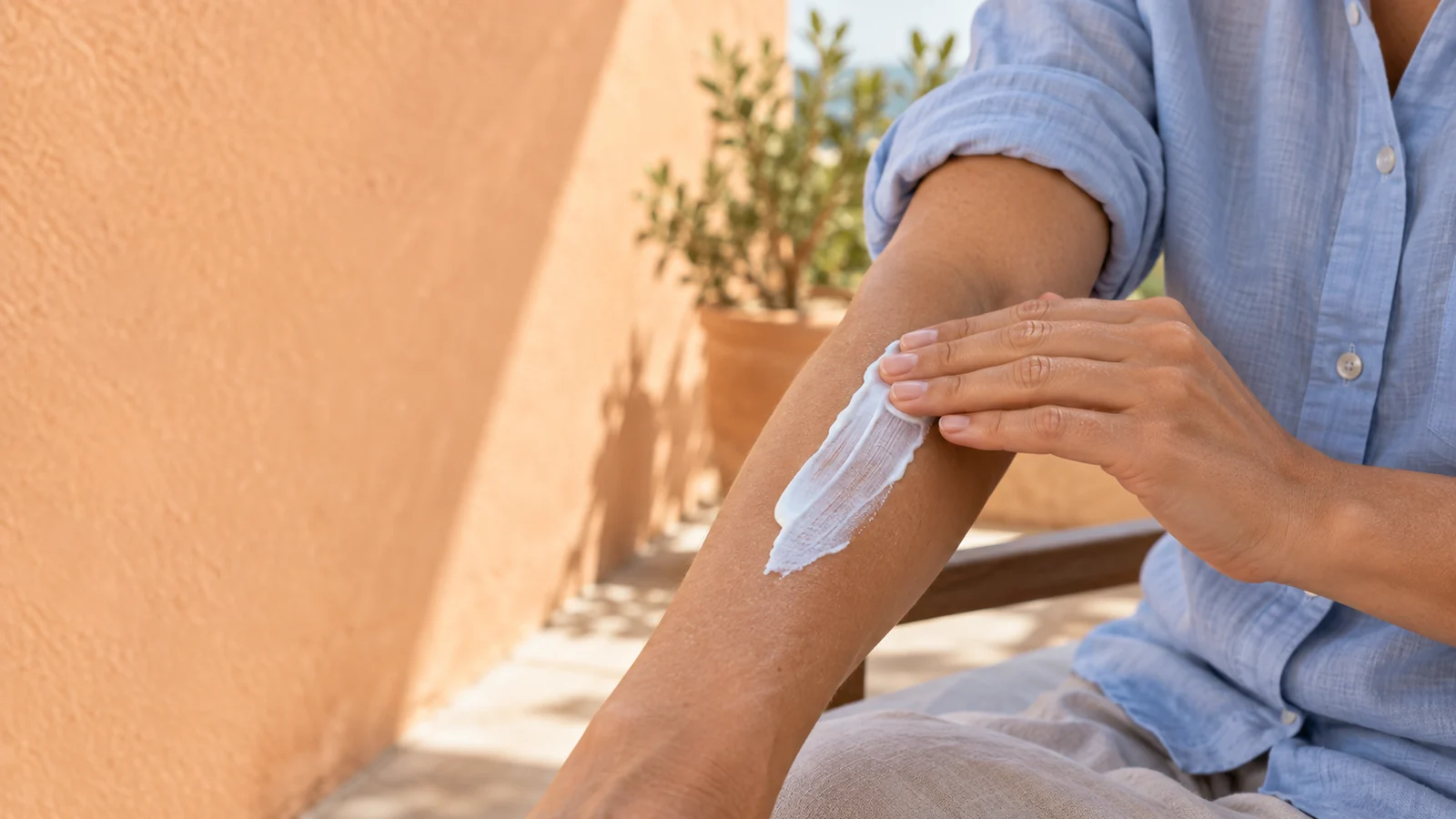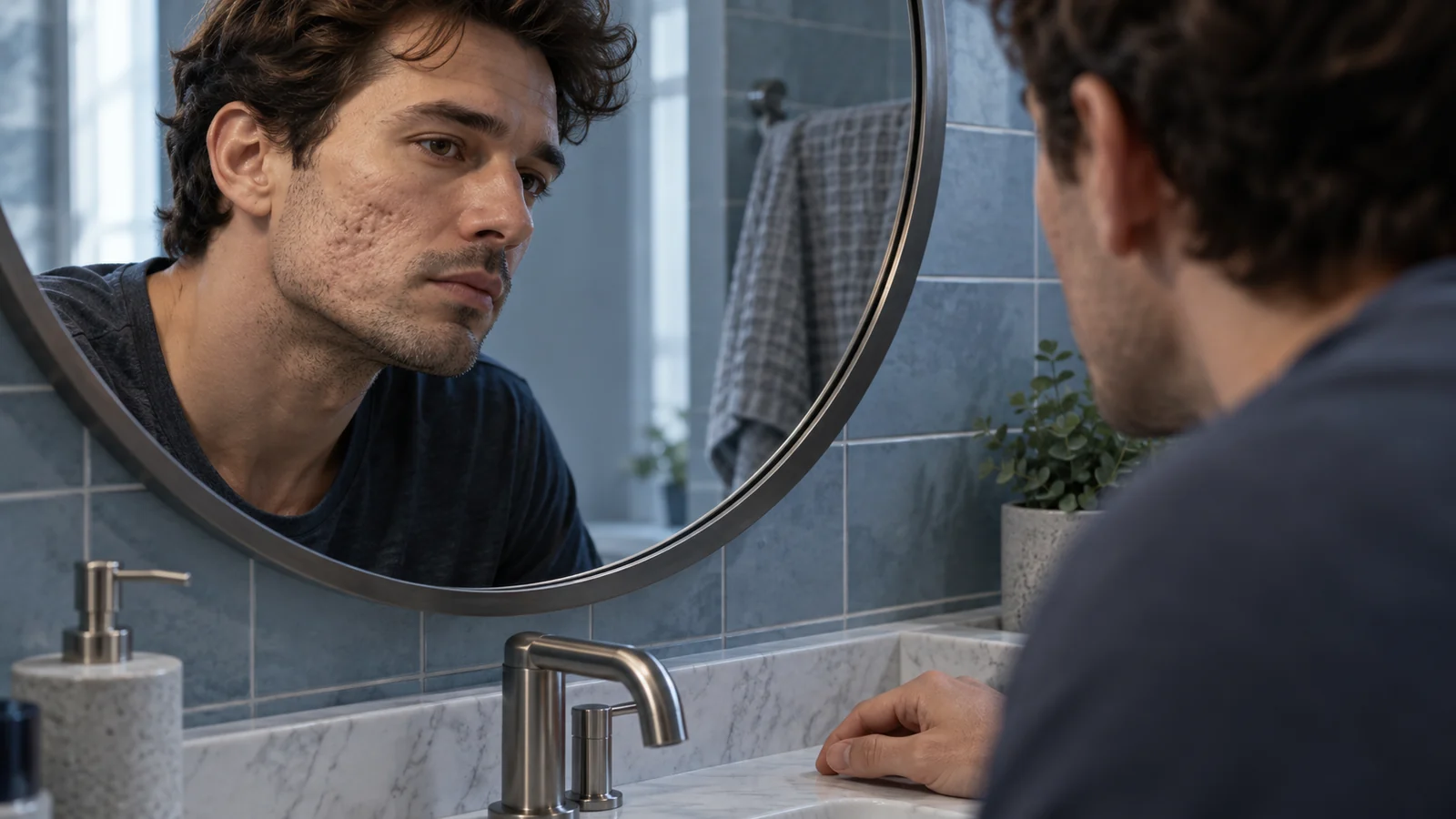
What helps with acne scars depends on which kind you have. Flat brown or red marks are color changes that can fade, helped by sun protection and some topical ingredients. [1, 2] Pitted or raised scars change the skin’s texture and rarely disappear on their own; no cream fills them in, and a dermatologist assesses procedures by scar type. [3, 4, 5]
In this article
- Acne scars vs acne marks: what is the difference?
- Why do some people get acne scars?
- Do acne scars go away?
- What helps with acne scars and marks at home?
- How to get rid of acne scars with professional treatment
- Can you prevent new acne scars?
- When should you see a dermatologist?
- Frequently asked questions
- References
Acne scars vs acne marks: what is the difference?
Acne scars and acne marks are different problems. Scars are changes in the skin’s texture, either sunken or raised, and they tend to last. Marks are flat patches of brown or red color left after a spot heals. Knowing which one you have is the first step, because the options differ. [4, 1]
Scarring is common and can develop even when acne is treated effectively. People living with scars often carry a real psychological burden, including depression and suicidal thoughts. Measuring scars and identifying the subtype, textural or pigmented, lets a dermatologist tailor the approach. [4]
What types of pitted acne scars are there?
Sunken scars are called atrophic scars. A common classification groups them into three types. [6]
| Type | What it looks like |
|---|---|
| Icepick | Narrow, deep pits, like a small puncture |
| Rolling | Wide, shallow dips that make the surface look wavy |
| Boxcar | Round or oval pits with sharper edges |
The descriptions in the table are practical, not diagnostic. Many people have more than one type, and the mix affects which procedures a dermatologist may suggest.
Raised scars
Raised scars are less common. In a study of 416 patients with acne scars, 98.56% had atrophic (pitted) scars, 12.74% had keloid scars and 11.06% had papular scars, which are small, raised, skin-colored bumps, mostly on the chin and back. Papular scars were more common in people who also had keloids, and both types showed fibrosis (thickened scar tissue). [7] That was a single-center, retrospective study of dermatology patients in Korea.
Brown and red acne marks
Acne marks are color changes rather than texture changes. Inflammation can trigger extra melanin and cause post-inflammatory hyperpigmentation (brown or dark marks), or post-inflammatory erythema (red or pink marks) in any skin tone. Brown marks are more common in darker skin and red marks in lighter skin. [1]
Post-inflammatory hyperpigmentation is a reactive process: after inflammation, a procedure or another trigger, melanin increases or is redistributed. Far fewer studies look at it directly than at melasma. [8] These marks can last a long time, and they often bother people more than the active acne did. [1] The dark spots guide covers pigment more broadly.
Why do some people get acne scars?
Scars are common, and your risk depends on how severe your acne is, your family history and your sex. A meta-analysis of 37 studies and 24,649 people with acne found scars in 47%. Men had higher risk (OR 1.58), as did people with a family history of acne (OR 2.73) and those with moderate (OR 2.34) or severe acne (OR 5.51). [9]
These are pooled observational data, and the studies differed widely in their patients and ages. The authors stressed early attention and effective acne treatment, but this design cannot prove that early treatment prevents scars. [9]
How long a spot lasts may matter too. In a study that mapped acne lesions in 32 people for six months, the chance that any single lesion left a scar was 5.7%. Nearly all scars (83%) grew out of red or brown flat marks, and 16% came directly from papules or pustules. The longer a papule lasted, the higher its scar risk. [3] The group was small and limited to people with moderate acne and existing scars.
Do acne scars go away?
Some new scars fade, but most last. In the six-month mapping study, new pitted scars kept forming, and 66.2% of them were still present at six months; the rest were temporary. Of the scars still present at six months, 81.7% remained at the two-year follow-up. [3] So a fresh dent may soften, but an established scar tends to stay.
Color marks behave differently. Brown and red marks can last a long time. [1] In one trial, brown marks faded significantly in both the treatment and the inactive gel groups over 12 weeks, which suggests part of the improvement came from natural fading over time. [10]
Our sources give no number of weeks or months for a mark to fade, so we will not invent one. In practice, the useful question is not “when will it disappear?” but “is this a color change or a change in texture?” If you are unsure, a dermatologist can tell you.
What helps with acne scars and marks at home?
At home, the realistic goal is to fade marks and protect against new ones, not to fill in pitted scars. For brown and red marks, some topical ingredients have evidence and daily sun protection matters. [2] For pitted scars, no cosmetic cream has been shown to work; texture changes need professional assessment. [5]
Which ingredients have evidence for acne marks?
A systematic review of 47 studies on post-inflammatory hyperpigmentation, including marks after acne, found high-quality studies for retinoids, hydroxy acids and niacinamide. Retinoids, hydroxy acids and broad-spectrum sunscreens had the most support. Common side effects included peeling, burning, stinging, dryness and itching. [2] The studies used different ways of measuring results.
For red marks, azelaic acid has one small trial. In 72 people with mild to moderate acne (60 finished), a 15% azelaic acid gel used twice a day for 12 weeks reduced red mark scores significantly compared with an inactive gel at weeks 8 and 12. Brown marks faded in both groups, and melanin in the marks dropped significantly in the azelaic acid group at week 12. [10] It was a small, single-country study, and 15% is medicine strength in many places.
An expert consensus noted that large randomized trials for acne-related pigmentation are lacking. The panel suggested that lightening agents, azelaic acid, chemical peels or antioxidants can be added to effective acne treatment, with peels as a second-line option. [11] That is expert opinion, not proof. The retinol guide, niacinamide guide and salicylic acid guide cover how to introduce those ingredients.
In practice, introduce one active at a time and give it several weeks. Irritation is one of the triggers that can leave new marks, so a gentler routine you keep using usually beats a strong one you stop. [8]
Can creams fill in pitted scars?
No cosmetic cream has been shown to fill in pitted acne scars. A Cochrane review of 24 trials found no high-quality evidence for any acne scar treatment, and none of its evidence involved over-the-counter creams. [5] Pitted scars are a structural change in the skin, and assessment of the scar subtype guides treatment. [4]
Products that promise to remove scars go beyond what any study in our sources shows. Some can make skin look smoother or more even for a while, but that is not the same as rebuilding lost tissue.
Why does sun protection matter?
Sunlight can make pimples look better for a while, but it can also trigger inflammation, scar-tissue responses and new brown or red marks. Only four relevant studies on sun protection in acne were found, so the evidence is thin. Sunscreens may support treatment and help prevent new marks, and tinted ones can offer some coverage. [12]
Nearly every study in the pigmentation review recommended SPF 30 or higher. [2] A review of nine publications also supported protection covering UVA, UVB and visible light for pigment problems, since both UV and visible light can make them worse. [13] Sunscreen alone does not remove marks, but it may help keep them from darkening further. The sunscreen guide covers coverage and texture.
How to get rid of acne scars with professional treatment
Pitted and raised scars are treated in a clinic, not at home, and no single method is best for everyone. Options include lasers, chemical peels, microneedling, fillers, subcision (releasing scar bands under the skin) and other surgical techniques. A dermatologist chooses based on your scar type, skin tone and goals. [6]
The evidence behind these options is mixed:
- A Cochrane review of 24 trials with 789 adults found no high-quality evidence for any scar treatment. Comparisons of lasers, peels and microneedling rested on very low-quality evidence; fillers had moderate-quality evidence (RR 1.84 against placebo at 24 weeks, 147 participants). No method was supported as the first choice. [5]
- A newer network meta-analysis of 68 trials with 4,480 patients ranked lasers combined with platelet-rich plasma or fillers highest for reducing scar severity, and lasers with chemical peels highest for satisfaction. Microneedling was the best tolerated for pain. No method clearly lowered the risk of redness or new pigmentation. [14] These rankings are probabilities, not proof of large differences.
- Comparing studies is hard, because they use different severity scales and often do not name the scar type. [6]
In practice, ask a dermatologist which scar types you have, what a realistic improvement looks like and what side effects to expect, especially if your skin tends to darken after irritation.
Can you prevent new acne scars?
The most practical way to limit new scars is to get acne under control early. In a small split-face trial of 31 adults with moderate acne and existing scars, one side received a prescription acne gel and the other an inactive vehicle for six months. Scar counts stayed stable on the treated side but rose by about 25% on the vehicle side (11.58 vs 13.55). [15]
That trial was small and industry-sponsored, and it tested a prescription product that only a clinician can decide on. [15] An expert consensus also recommends treating acne early and effectively to reduce marks. [11] Since severity raises scar risk and long-lasting spots are more likely to scar, not waiting for acne to “run its course” makes sense. [9, 3] The acne guide covers everyday care and when to seek help.
When should you see a dermatologist?
See a dermatologist if you have pitted or raised scars, if new scars keep appearing, or if marks do not fade over months. Also get checked if a dark spot changes, grows, bleeds or does not seem linked to acne. Pigment can come from several causes, and some need a closer look. [16]
Common causes of dark patches include post-inflammatory pigmentation, melasma, sun spots and freckles. A careful history, skin examination and, when needed, a biopsy help rule out melanoma and its precursors. [16] Treating active acne early and effectively is also part of limiting new marks and scars. [11]
For the clinical evidence and its limits, see the azelaic acid guide.
Frequently asked questions
Can acne scars go away in a week?
No. Established pitted scars mostly persist; in one study, 81.7% of scars present at six months were still there two years later. [3] Brown and red marks can last a long time, and our sources give no timeline for them to fade. [1] Be wary of any product or method that promises results within days.
Does popping pimples cause scars?
We found no study that directly measured whether popping leads to scars. What one study did show is that the longer an inflamed papule lasts, the higher its risk of turning into a scar. [3] In practice, leaving spots alone, or letting a clinician deal with large, painful lesions, is the cautious choice.
Is vitamin C good for acne marks?
We found no randomized trial testing vitamin C specifically on marks after acne. An expert consensus says antioxidants can be added to acne treatment for pigmentation, but that is opinion rather than trial evidence. [11] The vitamin C guide covers what it has been studied for and how to keep it stable.
Why are some acne marks brown and others red?
They come from different responses to inflammation. Brown marks come from extra or displaced melanin and are more common in darker skin; red marks reflect lasting redness and are more common in lighter skin, though both can occur in anyone. [1] Many studies on acne marks borrow findings from general pigment research. [1]
References
- Elbuluk N, Grimes P, Chien A, et al. The Pathogenesis and Management of Acne-Induced Post-inflammatory Hyperpigmentation. Am J Clin Dermatol. 2021;22(6):829-836. PubMed · DOI
- Tan MG, Kim WB, Jo CE, Nabieva K, Kirshen C, Ortiz AE. Topical treatment for postinflammatory hyperpigmentation: a systematic review. J Dermatolog Treat. 2022;33(5):2518-2526. PubMed · DOI
- Tan J, Bourdès V, Bissonnette R, et al. Prospective Study of Pathogenesis of Atrophic Acne Scars and Role of Macular Erythema. J Drugs Dermatol. 2017;16(6):566-572. PubMed
- Jennings T, Duffy R, McLarney M, et al. Acne scarring-pathophysiology, diagnosis, prevention and education: Part I. J Am Acad Dermatol. 2024;90(6):1123-1134. PubMed · DOI
- Abdel Hay R, Shalaby K, Zaher H, et al. Interventions for acne scars. Cochrane Database Syst Rev. 2016;4(4):CD011946. PubMed · DOI
- Boen M, Jacob C. A Review and Update of Treatment Options Using the Acne Scar Classification System. Dermatol Surg. 2019;45(3):411-422. PubMed · DOI
- Lee YJ, Lee CY, Shin MK. A Neglected Acne Scar Type: Papular Acne Scars and Their Correlations With Keloid Scars. Dermatol Surg. 2021;47(10):1347-1351. PubMed · DOI
- Shenoy A, Madan R. Post-Inflammatory Hyperpigmentation: A Review of Treatment Strategies. J Drugs Dermatol. 2020;19(8):763-768. PubMed · DOI
- Liu L, Xue Y, Chen Y, et al. Prevalence and risk factors of acne scars in patients with acne vulgaris. Skin Res Technol. 2023;29(6):e13386. PubMed · DOI
- Shucheng H, Zhou X, Du D, Li J, Yu C, Jiang X. Effects of 15% Azelaic Acid Gel in the Management of Post-Inflammatory Erythema and Post-Inflammatory Hyperpigmentation in Acne Vulgaris. Dermatol Ther (Heidelb). 2024;14(5):1293-1314. PubMed · DOI
- Taylor S, Elbuluk N, Grimes P, et al. Treatment recommendations for acne-associated hyperpigmentation: Results of the Delphi consensus process and a literature review. J Am Acad Dermatol. 2023;89(2):316-323. PubMed · DOI
- Piquero-Casals J, Morgado-Carrasco D, Rozas-Muñoz E, et al. Sun exposure, a relevant exposome factor in acne patients and how photoprotection can improve outcomes. J Cosmet Dermatol. 2023;22(6):1919-1928. PubMed · DOI
- Fatima S, Braunberger T, Mohammad TF, Kohli I, Hamzavi IH. The Role of Sunscreen in Melasma and Postinflammatory Hyperpigmentation. Indian J Dermatol. 2020;65(1):5-10. PubMed · DOI
- Wu B, Gao M, Zhang Y, Bai X. Optimal treatment options for acne scars in patients with historic acne: a systematic review and network meta-analysis. PeerJ. 2025;13:e19938. PubMed · DOI
- Dreno B, Tan J, Rivier M, Martel P, Bissonnette R. Adapalene 0.1%/benzoyl peroxide 2.5% gel reduces the risk of atrophic scar formation in moderate inflammatory acne: a split-face randomized controlled trial. J Eur Acad Dermatol Venereol. 2017;31(4):737-742. PubMed · DOI
- Plensdorf S, Livieratos M, Dada N. Pigmentation Disorders: Diagnosis and Management. Am Fam Physician. 2017;96(12):797-804. PubMed