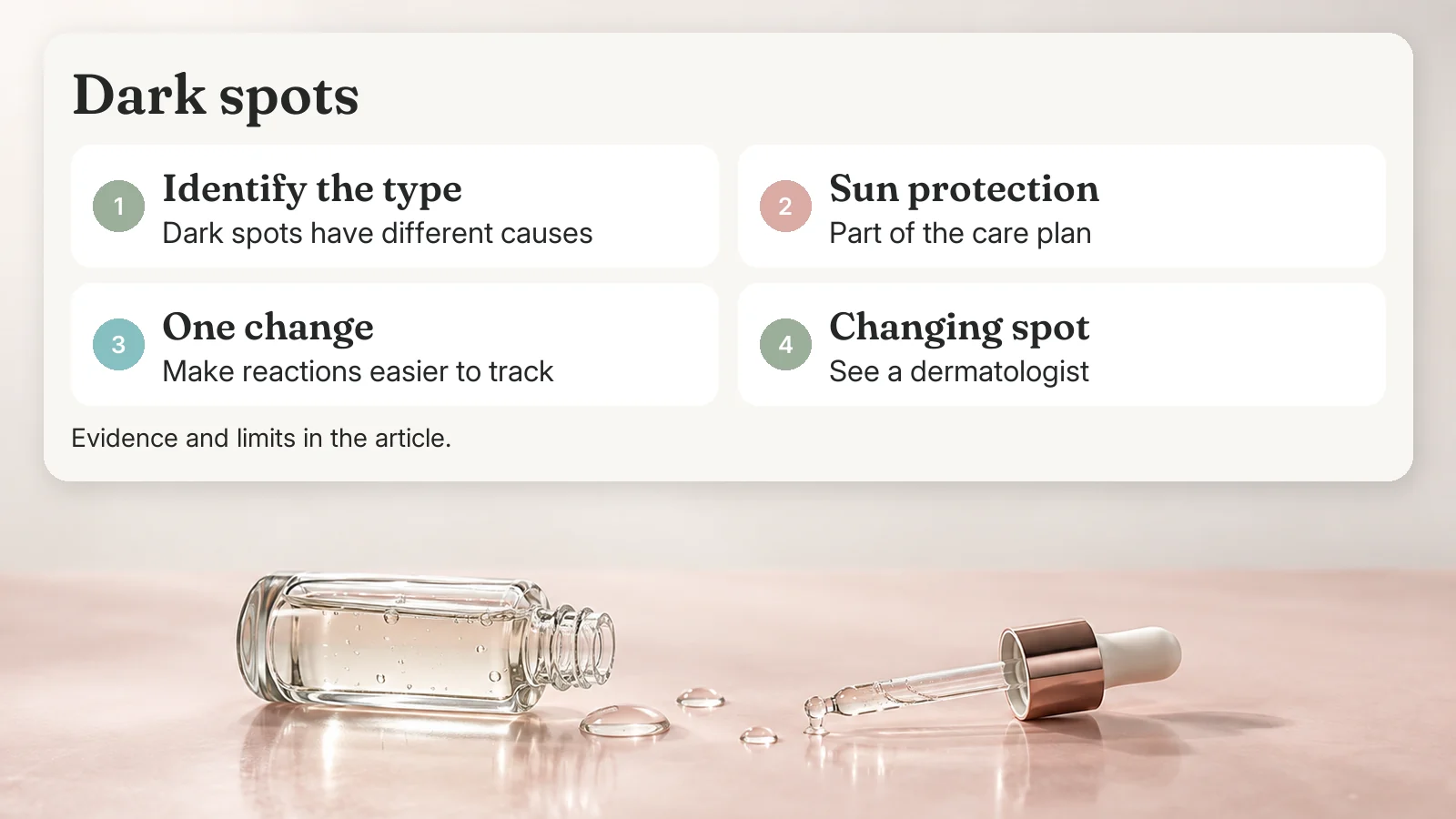
Dark spots are not a single condition. Darkening after acne or irritation, melasma and sun-related lentigines are assessed differently, so one serum is not expected to do the same thing for all of them. The first step is understanding the cause, organizing light protection and showing a dermatologist any mark you cannot explain or that is changing. [1, 2]
In this article
What kind of dark spot are you dealing with?
Darker patches can arise through different processes. Post-inflammatory pigment changes, melasma, solar lentigines and freckles are common examples, and they are not assessed the same way. Instead of diagnosing yourself from color or a photograph, consider when it started, what else you notice and how it has changed. [1]
Pigment is a general word for the substances that give skin its color; this guide is mainly about melanin-related darkening. In post-inflammatory pigmentation, the amount or distribution of melanin can change. A color difference appearing after a breakout or irritation may fall under this heading, but not every mark forms through the same mechanism. [5]
In melasma, genetics, hormones and sun exposure can act together. Reducing that to a single missing vitamin or a single wrong product does not explain it. When a pigment concern is new, both your skincare history and your medical history matter. [6]
Before changing anything, the sunscreen guide is worth reading. Choosing a serum is a separate decision here: swapping active ingredients without looking at light exposure leaves out a significant part of the picture. [2]
How are the types told apart?
When the mark appeared and what happened just before can help, though neither settles a diagnosis. Post-acne color change, long-standing melasma and a solar lentigo cannot be explained by the same research. A dermatologist uses examination and, where needed, further assessment; the table below is only meant to prepare that conversation. [1, 5]
| Possible heading | What matters in assessment | What not to assume at home |
|---|---|---|
| Post-inflammatory pigmentation | Whether acne, irritation or a procedure came first | That every acne mark is pigment alone |
| Melasma | Onset, recurrence and relation to light | That one product will settle it for good |
| Solar lentigo or freckle | Appearance, distribution and change over time | That every brown area is harmless |
| Unidentified mark | Growth, shape or color change | That it should be trialed with an acid |
Post-inflammatory pigmentation is not limited to acne; it can follow certain dermatological procedures and external triggers too. That is a reason not to dismiss the irritation you create while trying to lighten a mark with harsher applications. If your skin is clearly uncomfortable after use, review the routine. [5]
Pale patches, red marks and changes that come with a dent or a raised surface are not the same as the darker pigment this guide addresses. Grouping them under “spots” and pointing them at the same serum is not appropriate. An examination helps separate a pigment process from something else. [1]
Darkness under the eyes has its own causes and types; the dark circles guide covers it separately.
What does the research actually show?
Cosmetic ingredients such as niacinamide and vitamin C do have clinical findings, but the evidence varies by spot type and by the formulation studied. Data on post-inflammatory pigmentation should not be generalized to melasma, nor a small cream study to every serum. When choosing, read who was studied and how it was measured, not only the positive conclusion. [3, 4]
Why light protection comes first
Melasma and post-inflammatory pigmentation can worsen with UV and with visible light, so protection is not a detail reserved for a summer beach day. Reviews support protection that covers a broad range of light as a helpful approach; sunscreen alone is not a product that clears every spot. [2]
The systematic review of post-inflammatory hyperpigmentation reports that broad-spectrum sunscreens are among the well-studied approaches and that SPF 30 or higher was recommended in nearly every study. That is a concrete reason to look at your daily habit before comparing serum percentages. [3]
Visible light matters in melasma as well. Some pigments in tinted products may contribute additional protection, but the word “mineral” on a package does not by itself indicate that contribution. Which coverage suits your own type of spot is worth discussing with a dermatologist. [6, 7]
What niacinamide may offer
Niacinamide is a form of vitamin B3. Research includes mechanism findings about pigment transfer between cells and clinical results reporting reduced spotting after four weeks. That the participants were Japanese women and that the authors had manufacturer ties limits how far the result travels. [8]
In the post-inflammatory pigmentation review, niacinamide appears among agents with higher-quality studies. The melasma review, however, did not give niacinamide a strong general recommendation. So “good for spots” cannot be separated from the question of which spot. The niacinamide guide has the detail. [3, 4]
What vitamin C may offer
A systematic review of topical vitamin C assessed seven publications with 139 volunteers in total and reported improvement in objective pigment measurements. The studies were small and the ideal concentration is unsettled. Visible change may take a long period of use, which is not the same as giving everyone a date. [9]
In another study, 16 women with melasma applied ascorbic acid to one half of the face and a comparator cream to the other for 16 weeks, with daily sunscreen. Patient assessment favored the comparator while color measurements showed no significant difference. A study this small does not make a vitamin C serum a substitute for melasma treatment. The vitamin C guide covers use in detail. [10]
Alpha arbutin is another common dark spot ingredient; our alpha arbutin guide sets out what its small studies show and where they stop.
Do you need retinol or an acid?
The post-inflammatory pigmentation review also includes studies of retinoids and hydroxy acids. Data under those broad headings do not show that every cosmetic retinol or acid product produces the same effect. The review also reports peeling, burning, stinging and dryness as common side effects. [3]
The retinol guide, salicylic acid guide and glycolic acid guide are separate decisions. Starting two or more active products at once is not a required path for pigment care. Discuss medical treatments and professional procedures with a dermatologist; this guide gives no prescription doses or at-home peel recipes.
How can you build a practical routine?
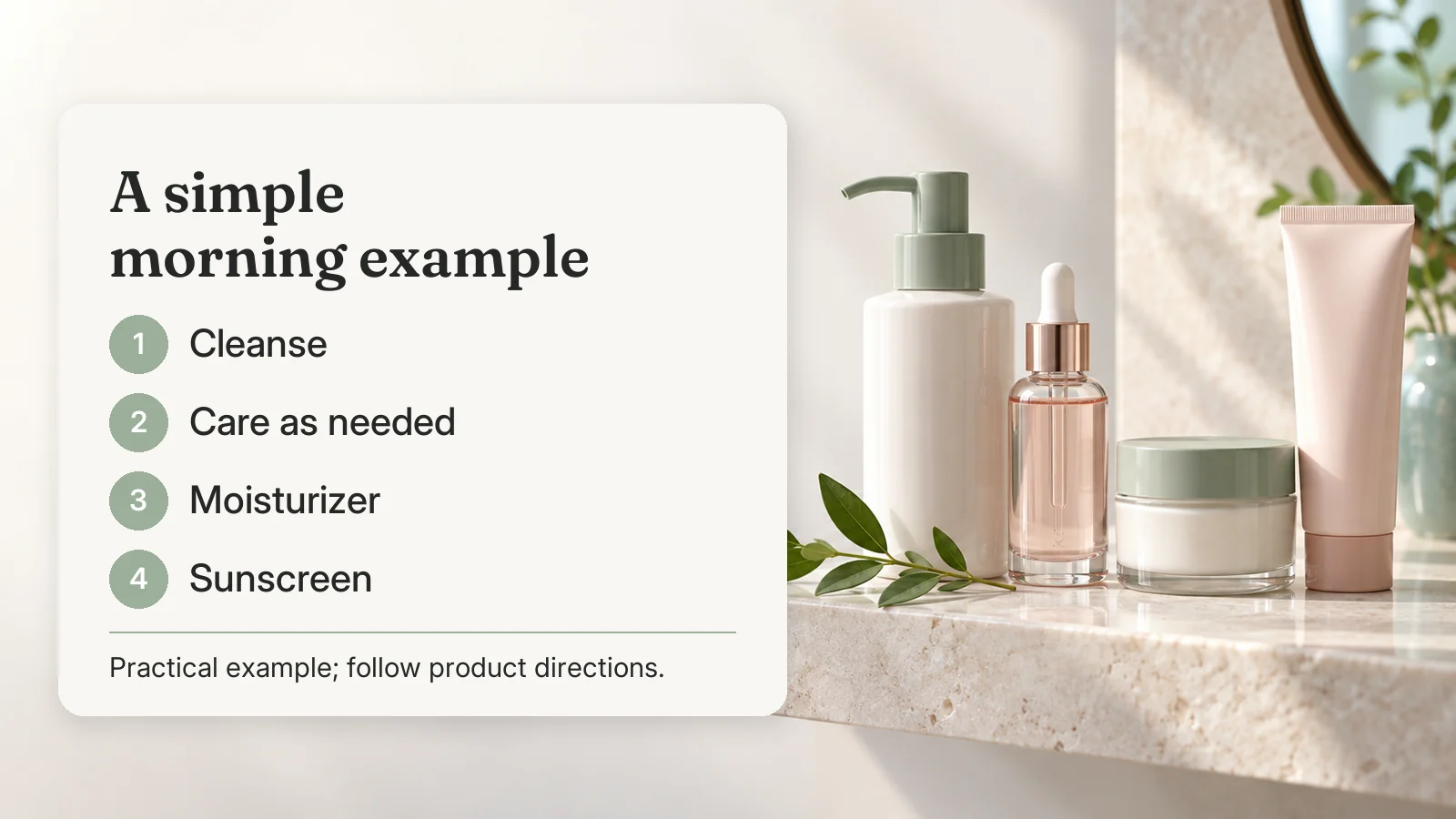
Start by clarifying what you want to change and whether the type of spot has been assessed at all. Then settle a daily protection habit and, if needed, add a single new care product. Separating changes rather than starting several products on the same day makes it easier to tell which step feels comfortable.
| Step | Practical purpose |
|---|---|
| Write down current products | See how many actives you already use |
| Review your protection habit | Include amount and reapplication in the plan |
| Choose one change | Tell a new product’s effects apart more clearly |
| Observe consistently | Use similar lighting for photos and short notes |
| Ask when unsure | Do not turn an unidentified mark into a test area |
If you already use niacinamide, the next assessment is not automatically adding vitamin C. Are you comfortable with the current product, how long have you used it, is your protection habit consistent? If you are weighing both ingredients, the niacinamide and vitamin C guide addresses that separate question.
Morning and evening do not have to hold the same number of products. If the routine has become complex enough that you keep skipping protection or moisturizer, choose fewer steps. This practical suggestion does not claim that shorter routines are clinically superior for everyone; it aims at something you can actually keep up.
What should you expect over the weeks?
Judging a lasting result over a few days is not realistic; the studies reviewed ran for weeks. Their duration is not a personal recovery timetable either. Outcomes shift with the type of spot, the formulation applied and the protection alongside it. When something persists or worsens, waiting is not the answer. [8, 10]
| Period | What to look at |
|---|---|
| First days | Tolerance, burning or marked redness |
| First weeks | Keeping up the routine and light protection |
| Four weeks and beyond | Measurement points in some studies; not a personal promise |
| Later months | Assessment with a dermatologist, based on spot type and plan |
The niacinamide study assessed results at four weeks; the small ascorbic acid study ran 16 weeks. These are not two stages of the same product: the participants, ingredients and measurements differed. One study being shorter does not rank ingredients by speed. [8, 10]
In chronic conditions such as melasma, darkening can return and long-term management can be difficult. When that happens, reviewing the plan with a dermatologist is more useful than blaming yourself or reaching for harsher products. Tolerance deserves as much tracking as effect. [11]
Which other products need consideration?
One of the most common errors is treating every darker area as the same spot and looking for one product to solve it. Another is treating irritation as a necessary stage. Because pigment changes are associated with inflammation and external triggers, dismissing clear discomfort is not a sound approach to pigment care. [1, 5]
In practice, avoid mixing concentrated acids at home, decanting different products into one bottle, and treating social media before-and-after photos as your own timeline. Without knowing the lighting, the other treatments or the person’s diagnosis, you cannot compare your result with theirs.
When you read that an ingredient has “strong evidence,” look closer: was it a human study, how many people, which type of spot, a single ingredient or a mixture? Seeing the limits of the evidence does not mean care is pointless; it describes more accurately what you can expect.
Who should seek medical advice?
Dermatological assessment matters for spots you cannot explain, that are new, or that are changing over time. History, examination and further investigation where needed help separate pigment changes from other skin findings. Trying a care product should never be a reason to postpone having a changing area looked at. [1]
For the appointment, it helps to note when it started, earlier photographs, the products you use and any accompanying itching or bleeding. Mention any procedure done in the same area, or a change that began after a new product. This record does not make a diagnosis; it makes the conversation more useful.
During pregnancy and breastfeeding, review the full ingredient list with your clinician before starting new pigment products. The cosmetic studies in this guide do not establish that every formulation is safe in those periods. Decisions about medication, peels or device treatments belong with a dermatologist.
For its research limits, see the bakuchiol guide.
Frequently asked questions
Is every acne mark a dark spot?
Not every change left after a breakout is pigment alone. If there is a dent, a raised area or another difference alongside the color, the same product expectation may not apply. Research on post-inflammatory pigmentation does not examine every kind of textural scar. When you are unsure what changed, an assessment also makes the product choice more meaningful. [5]
Do dark spots go away completely?
No single promise covers all types. Melasma in particular can be chronic and may need long-term management. An improvement in a pigment measurement in a study does not mean everyone’s spot disappeared for good. Set your expectations together with your diagnosis, the method used and a follow-up plan. [11]
Niacinamide or vitamin C?
The evidence here does not compare these two ingredients directly across all spot types and name a winner for everyone. Separate studies examined different participants and formulations. The type of spot, your current routine and your tolerance matter. You do not have to buy both; first decide what you are aiming at. [8, 9]
Is sunscreen enough on its own?
Light protection is an important part of a helpful approach in melasma and post-inflammatory pigmentation, but it cannot be said to remove every spot on its own. The underlying cause and any accompanying condition still need assessment. If the problem continues despite protection, discuss your plan with a dermatologist instead of cycling through new serums. [2, 1]
References
- Plensdorf S, Livieratos M, Dada N. Pigmentation Disorders: Diagnosis and Management. Am Fam Physician. 2017;96(12):797-804. PubMed
- Fatima S, Braunberger T, Mohammad TF, Kohli I, Hamzavi IH. The Role of Sunscreen in Melasma and Postinflammatory Hyperpigmentation. Indian J Dermatol. 2020;65(1):5-10. PubMed · DOI
- Tan MG, Kim WB, Jo CE, Nabieva K, Kirshen C, Ortiz AE. Topical treatment for postinflammatory hyperpigmentation: a systematic review. J Dermatolog Treat. 2022;33(5):2518-2526. PubMed · DOI
- Austin E, Nguyen JK, Jagdeo J. Topical Treatments for Melasma: A Systematic Review of Randomized Controlled Trials. J Drugs Dermatol. 2019;18(11):1156-1171. PubMed
- Shenoy A, Madan R. Post-Inflammatory Hyperpigmentation: A Review of Treatment Strategies. J Drugs Dermatol. 2020;19(8):763-768. PubMed · DOI
- Morgado-Carrasco D, Piquero-Casals J, Granger C, Trullàs C, Passeron T. Melasma: The need for tailored photoprotection to improve clinical outcomes. Photodermatol Photoimmunol Photomed. 2022;38(6):515-521. PubMed · DOI
- Lyons AB, Trullas C, Kohli I, Hamzavi IH, Lim HW. Photoprotection beyond ultraviolet radiation: A review of tinted sunscreens. J Am Acad Dermatol. 2021;84(5):1393-1397. PubMed · DOI
- Hakozaki T, Minwalla L, Zhuang J, et al. The effect of niacinamide on reducing cutaneous pigmentation and suppression of melanosome transfer. Br J Dermatol. 2002;147(1):20-31. PubMed · DOI
- Correia G, Magina S. Efficacy of topical vitamin C in melasma and photoaging: A systematic review. J Cosmet Dermatol. 2023;22(7):1938-1945. PubMed · DOI
- Espinal-Perez LE, Moncada B, Castanedo-Cazares JP. A double-blind randomized trial of 5% ascorbic acid vs. 4% hydroquinone in melasma. Int J Dermatol. 2004;43(8):604-607. PubMed · DOI
- Gan C, Rodrigues M. An Update on New and Existing Treatments for the Management of Melasma. Am J Clin Dermatol. 2024;25(5):717-733. PubMed · DOI