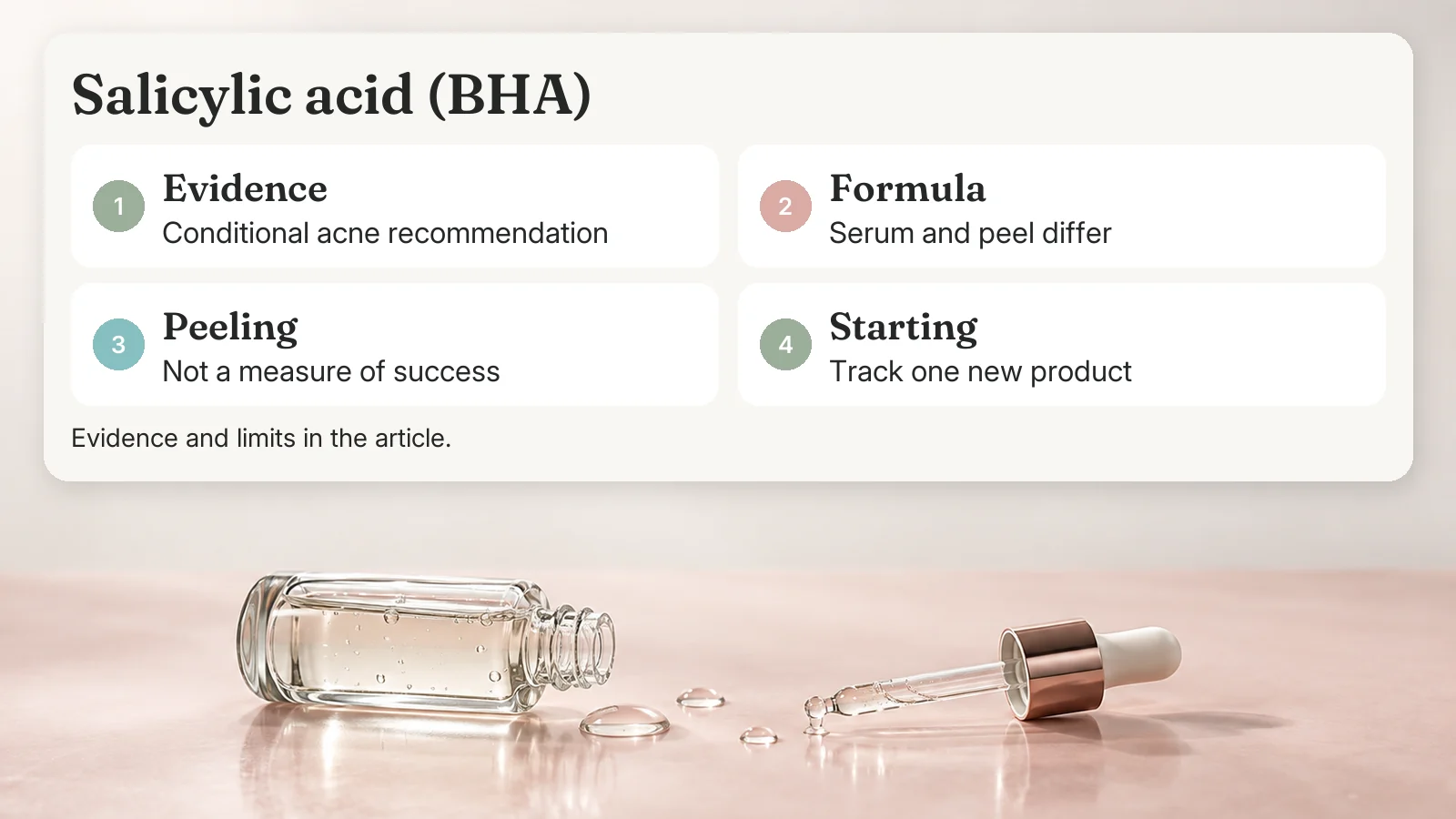
Salicylic acid, often called BHA in skincare, affects connections between cells in the outer skin layer. Its use for comedones has been studied, while the acne guideline recommendation is conditional. An everyday serum and a clinical peel are different applications. The practical goal is a tolerable routine, not deliberately producing visible peeling. [1, 2]
In this article
What is salicylic acid?
Salicylic acid helps cells in the outermost skin layer separate through effects on their connections. A review discusses this action and its use for comedones, the plugs associated with blocked follicular openings. Much of that discussion concerns peeling procedures, so the mechanism must be distinguished from evidence for a particular everyday cosmetic. [1]
BHA is a common skincare label for salicylic acid products. It does not make all ingredients called acids interchangeable. The hyaluronic acid guide, for example, focuses on hydration rather than the same exfoliating goal. Similar names should not determine how you use two different products.
This guide concerns home cosmetic care. Professional peels, concentrated procedures and prescription acne management require separate assessment. A positive study result does not mean the procedure can be copied at home or that a different bottle reproduces the experiment.
Check whether your product is a cleanser, toner, serum or moisturizer. Leaving on a formula intended to be rinsed off is not justified because another product with the same ingredient stays on the skin. Start with the actual purpose and instructions of your own product.
What does the evidence support?
Salicylic acid has been studied in acne-prone skin, but confidence in the findings varies by method and formulation. The 2024 acne guideline gives it a conditional recommendation. The earlier Cochrane review reported low or very low certainty in relevant comparisons. This is evidence to interpret carefully, not a basis for promising a particular cosmetic outcome. [2, 4]
Blackheads and comedones
The peel review discusses activity against comedones, helping explain why salicylic acid appears in conversations about clogged pores. A mechanism, however, does not prove that every daily serum removes every blackhead. The application method and the tested formulation still matter. [1]
Define what you are monitoring: the course of new clogged areas, an existing appearance concern or an oily surface feel. These are not identical goals. If you are unsure what a visible mark represents, a dermatologist can assess it rather than treating every small dot as something to remove with acid.
Studies of daily formulations
A trial with 500 participants compared a 2% supramolecular salicylic acid hydrogel with an acne medication. Marked-improvement rates at week 12 did not differ significantly. This was a particular hydrogel, so the result cannot be transferred to every serum displaying the same percentage. [3]
A smaller split-face study had 31 completers. Lesion counts decreased on both sides over 28 days, but the study was open label: participants knew the applications. A short, small comparison without a significant difference does not by itself prove equivalence to medication. [5]
Cleansers and moisturizers
An exploratory study of a cleanser containing salicylic acid and other ingredients reported improvement in truncal acne. There was no control group, and 35 of 51 participants completed the study. Other ingredients, dropout and the body application limit what can be inferred about a facial serum. [6]
Another study found benefit from a multi-ingredient moisturizer during acne maintenance. Participants had already responded to treatment. The result therefore concerns the whole formula in that context, not salicylic acid alone controlling every person’s acne without a treatment plan. [7]
How can you use a salicylic acid product?
Identify whether the formula should be rinsed off or left on, then follow its directions. Keeping other steps familiar when introducing one new product is a practical way to observe your experience. No single frequency fits all salicylic acid products, and a study schedule does not replace the instructions for your own bottle.
- List existing products. Check whether cleanser, serum and moisturizer already share this ingredient.
- Choose one change. Avoid introducing another exfoliant at the same time if you want clearer observations.
- Confirm the method. Rinse a rinse-off formula as directed rather than guessing a leave-on use.
- Watch tolerance. Do not try to overcome marked burning or redness by applying more often.
- Plan daytime protection. The sunscreen guide explains application and coverage.
Must it be used every day?
Some product trials used daily application. That does not mean every different formula should be started on that schedule. Other active products and product-specific directions matter. Follow your label and any dermatologist advice rather than copying the frequency from a trial of another formulation. [3]
A simple beginning can make reactions easier to follow. Doubling tomorrow’s amount because you missed today is not a catch-up rule established by these studies. Assess whether the schedule is manageable and your original concern is changing instead of making more application the main objective.
Does a stronger percentage work better?
These daily-care studies did not compare every concentration in an otherwise identical formula to identify the best percentage for everyone. A study using 2% does not show that increasing strength improves results. Importing findings from a clinical peel changes the method altogether. [3, 1]
Consider the whole product and contact method. A rinse-off cleanser and leave-on serum have different instructions. Adding the label percentages of multiple products is not a way to calculate a personal total dose demonstrated by this research.
What should you expect during use?
During the first applications, monitor comfort and irritation rather than seeking noticeable peeling. Studies assessed periods such as four and 12 weeks, but those are not personal promises. Flaking and redness were reported as adverse effects in some comparisons; they are not required signs of effective skincare. [5, 3, 4]
| Period | What to monitor | How to interpret it |
|---|---|---|
| First applications | Burning, redness, dryness | Discomfort is not a success score |
| First weeks | New clogged areas and routine fit | Record other product changes |
| Around four weeks | A consistent comparison with your starting point | A small pilot does not set everyone’s schedule |
| Later weeks | Improvement, worsening or scarring | Do not postpone acne assessment |
The reviewed research does not establish a necessary phase in which every blemish must come to the surface. Do not automatically call new breakouts or a pronounced rash “purging.” Note when it started, which areas are affected and what else changed; seek advice when appropriate.
Occasional photographs in similar lighting and at a similar distance can be a practical record. Very close framing or different light makes comparison harder. Switching products every few days also obscures which change you are trying to assess.
What about retinol, vitamin C and other acids?
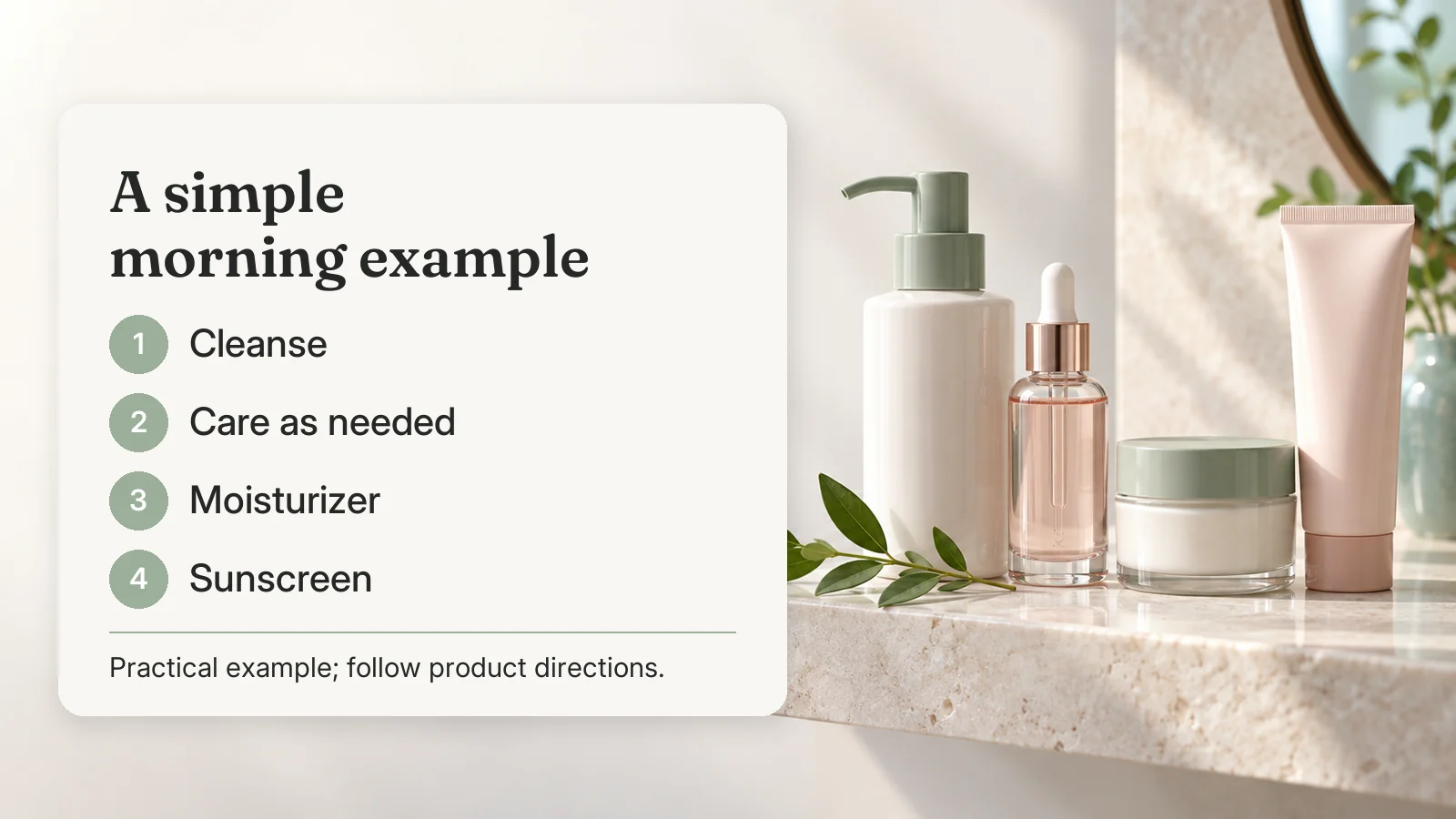
Do not let a generic compatibility list make the whole decision. The reviewed studies did not test every retinol, vitamin C or acid pairing. Introducing new actives at different times and simplifying when uncomfortable are practical approaches. They are not claims that a particular pair is chemically forbidden or universally safe.
| Other step | Practical consideration |
|---|---|
| Retinol | Avoid starting both on the same day; see salicylic acid with retinol |
| Another exfoliating acid, such as glycolic acid | Review the whole routine rather than automatically adding more; see the AHA vs BHA guide |
| Vitamin C | Separate times can be an option if application is uncomfortable |
| Niacinamide | Do not treat it as a shield against irritation |
| Moisturizer | Keep comfortable care as part of the routine |
Read the separate limits in the retinol guide and niacinamide guide. Tolerating one product does not establish that every addition can be used at the same frequency. Avoid independently building multiple new active steps on top of prescribed acne care.
Is another salicylic acid product necessary?
Using a salicylic acid cleanser and adding a matching toner and serum does not reproduce a single-product trial. First write down why each product is present and what its label says. If your cleanser meets your needs, another serum is optional.
If the concern persists, distinguish a meaningful goal from a desire to make the skin peel. Painful inflammation or scarring calls for assessment rather than more cosmetic layers. Keeping a brief record of changes can help, but personal observation is not a controlled trial and cannot separate every natural fluctuation.
A clinical study selects participants, a method and measurements. Your daily routine does not reproduce all those conditions, so a response rate is not an individual prediction. Recognizing that limit helps you use the evidence appropriately without dismissing it.
Who should be cautious?
Persistent irritation, a skin disease or significant acne should not be treated solely as a cosmetic experiment. The guideline recommendation is conditional and acne care is individualized. If lesions are painful, increasingly numerous or leaving scars, seek dermatological assessment rather than extending a succession of new-product trials. [2]
This guide does not make product-specific safety decisions for pregnancy or breastfeeding. Discuss application area, use and the complete formula with your clinician. Children, known salicylate allergy and damaged skin also require more than copying general adult serum advice.
The clinical-peel review discusses systemic salicylate effects, another reason not to equate professional procedures with everyday skincare. Preparing concentrated mixtures or reproducing professional treatment at home is not supported by this guide. [1]
What should you check before buying and storing?
Read the application area, rinse-off instructions and other active ingredients. Studies included special hydrogels and multi-ingredient cleansers, so the words salicylic acid do not make them interchangeable. Follow the label for storage, use after opening and eye-area warnings. The finished product matters as much as the highlighted ingredient. [3, 6]
Keep it in its own packaging, avoid mixing bottles and do not add another acid to alter the concentration. Choosing an unclear product solely for a high-strength claim is not a selection method established by the studies described here.
Frequently asked questions
Can it help acne-prone skin?
It appears in acne research and has a conditional guideline recommendation, but this does not make a cosmetic serum an individualized disease treatment. Special formulas in trials do not prove all products equivalent. Painful, persistent or scarring acne needs dermatological assessment; choosing skincare is not a replacement for that plan. [2]
Does no peeling mean no effect?
No. The research does not establish visible peeling as a necessary measure of success. Studies assessed outcomes such as lesion counts and clinical scores, while flaking and redness appeared among adverse effects. Do not increase use simply to make skin peel more; assess the actual goal and tolerance. [4]
What about dark spots?
Peel literature also addresses pigment concerns, but professional-procedure findings cannot be directly applied to a daily serum. Not every mark is the same, and irritation can be associated with further pigment changes. Read the dark spots guide and seek assessment before treating an unexplained mark with acid. [1, 8]
Should I leave cleanser on longer?
These studies do not show that exceeding a cleanser’s directions is better. The cleanser study involved a multi-ingredient product and truncal acne, not a new contact-time instruction for your bottle. Follow its application and rinsing directions rather than using it as if it were a leave-on serum. [6]
References
- Arif T. Salicylic acid as a peeling agent: a comprehensive review. Clin Cosmet Investig Dermatol. 2015;8:455-461. PubMed · DOI
- Reynolds RV, Yeung H, Cheng CE, et al. Guidelines of care for the management of acne vulgaris. J Am Acad Dermatol. 2024;90(5):1006.e1-1006.e30. PubMed · DOI
- Ye CX, Yi J, Su Z, et al. 2% supramolecular salicylic acid hydrogel vs. adapaline gel in mild to moderate acne vulgaris treatment: A multicenter, randomized, evaluator-blind, parallel-controlled trial. J Cosmet Dermatol. 2024;23(6):2125-2134. PubMed · DOI
- Liu H, Yu H, Xia J, et al. Topical azelaic acid, salicylic acid, nicotinamide, sulphur, zinc and fruit acid (alpha-hydroxy acid) for acne. Cochrane Database Syst Rev. 2020;5(5):CD011368. PubMed · DOI
- Zheng Y, Yin S, Xia Y, et al. Efficacy and safety of 2% supramolecular salicylic acid compared with 5% benzoyl peroxide/0.1% adapalene in the acne treatment: a randomized, split-face, open-label, single-center study. Cutan Ocul Toxicol. 2019;38(1):48-54. PubMed · DOI
- Towersey L, Correia P, Fajgenbaum Feiges M, et al. Assessment of the Benefit of a Deep Cleansing Gel Containing Salicylic Acid 2%, Zinc Gluconate 0.2% and Lipohydroxy Acids 0.05% in Patients with Mild to Moderate Truncal Acne: Results from an Exploratory Study. Clin Cosmet Investig Dermatol. 2023;16:119-123. PubMed · DOI
- Kulthanan K, Trakanwittayarak S, Tuchinda P, Chularojanamontri L, Limphoka P, Varothai S. A Double-Blinded, Randomized, Vehicle-Controlled Study of the Efficacy of Moisturizer Containing Licochalcone A, Decanediol, L-Carnitine, and Salicylic Acid for Prevention of Acne Relapse in Asian Population. Biomed Res Int. 2020;2020:2857812. PubMed · DOI
- Shenoy A, Madan R. Post-Inflammatory Hyperpigmentation: A Review of Treatment Strategies. J Drugs Dermatol. 2020;19(8):763-768. PubMed · DOI