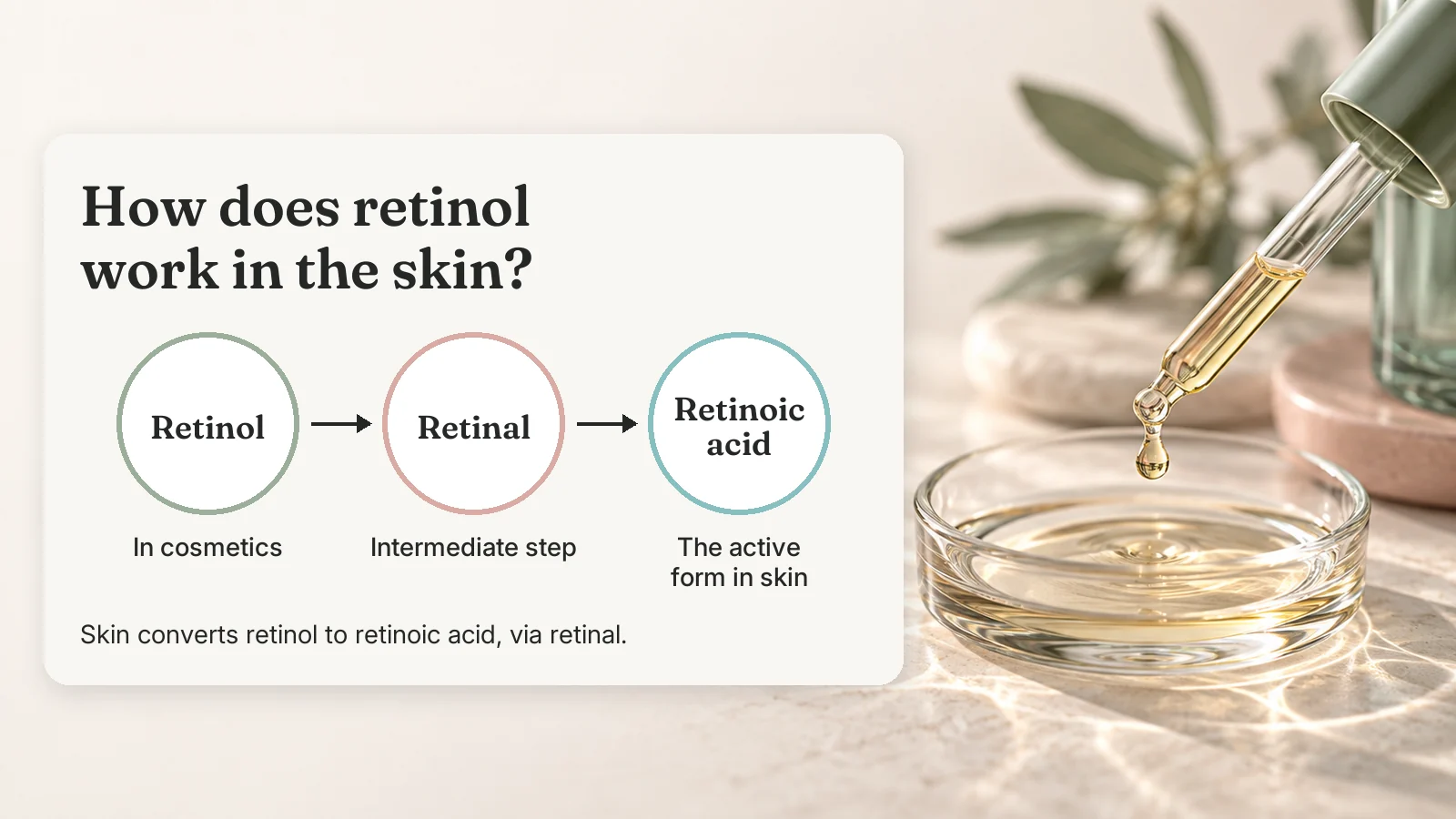
What is retinol? Retinol is a cosmetic ingredient from the vitamin A family (the retinoids); it is thought to work by converting into retinoic acid in the skin [1]. In controlled studies it improved the look of fine lines, wrinkles and dark spots [2, 3]. You start in the evening at a low percentage a few nights a week and build up as your skin adjusts. Sunscreen every morning is essential.
In this article
What is retinol?
Retinol is the vitamin A derivative cosmetic products use most often. It is a precursor of retinoic acid and is thought to act by converting into it in the skin [1]. Retinoic acid itself is tretinoin, a prescription drug. Retinyl esters, retinol and retinal are natural precursors the skin converts in a controlled way [8, 9].
| Retinoid | What is known |
|---|---|
| Retinyl esters (retinyl palmitate, retinyl propionate) | Cosmetic precursors of retinoic acid [5, 8, 10] |
| Retinol | Clearly less irritating than retinoic acid [6]. Under four days of occlusive application on 10 volunteers, retinol up to 1.6% caused only trace redness, while 0.025% retinoic acid increased redness 3.7-fold [11] |
| Retinal (retinaldehyde) | Like retinol, clearly less irritating [6] |
| Tretinoin (retinoic acid) | Prescription only; the most potent and most studied retinoid, with marked irritation [6] |
Retinol is generally taken to be about 10 times weaker than tretinoin. Even so, in a manufacturer-linked 12-week study using a special formula with anti-irritants, one half of the face received retinol and the other tretinoin at one tenth the percentage; among the 65 people who finished, both sides improved significantly on every measure, with no significant difference [12].
What does retinol do for your skin?
Controlled studies support retinol in two areas above all: reducing the appearance of fine lines and wrinkles, and improving dark spots and uneven tone [2]. Most were small and some manufacturer-linked. Biopsies showed increases related to collagen [1]. On acne, the evidence for retinol specifically is limited.
Fine lines and wrinkles
In a network meta-analysis of 23 randomized controlled trials and 3,905 participants, retinol improved fine wrinkles significantly, as did prescription tretinoin and isotretinoin. The authors flag limited ethnic diversity, possible commercial bias and differing assessment methods [2].
| Study | Result |
|---|---|
| 0.4% retinol; arm skin, 36 people, mean age 87, 24 weeks [13] | Significant improvement in fine wrinkles versus placebo |
| 0.1% stabilized retinol; full face, 62 people, 52 weeks [3] | Better than vehicle at every time point; 44% improvement in crow’s feet fine lines |
| 0.1% retinol; 48 people, 9 months, placebo-controlled [14] | Improvement in under-eye wrinkles, fine lines and tone; no notable side effects |
The first was done on arm skin in very elderly people; the other two were manufacturer-linked and tested a single formula.
Dark spots and uneven tone
In the one-year study with 0.1% retinol, mottled pigmentation improved by 84% [3], and in the network meta-analysis tretinoin and retinol stood out for hyperpigmentation [2]. In a 37-person study comparing 0.3% with 0.5% retinol, spots and uneven tone decreased as well [15].
A systematic review of 47 studies on post-inflammatory hyperpigmentation, including post-acne marks, found the best-supported agents were retinoids, hydroxy acids and broad-spectrum sunscreens; niacinamide was also among those with high-quality studies. The review treats retinoids as a group, and measurement methods varied [16].
Skin texture and collagen
In a small biopsy study, retinol and retinoic acid increased epidermal thickness and collagen types I and III over four weeks, retinol to a generally smaller degree; facial wrinkles decreased significantly after 12 weeks, although the abstract does not say whether the facial part had a placebo group [1]. In the arm-skin study, glycosaminoglycan and procollagen I increases were measured in only 6 and 4 people [13].
Does retinol help acne?
The evidence for retinol specifically is limited. A short 2009 review notes that guidelines support topical retinoids as a core part of acne care [17] — but those are mostly prescription drugs. Acne is a skin disease; see a dermatologist about your breakouts.
How do you use retinol?
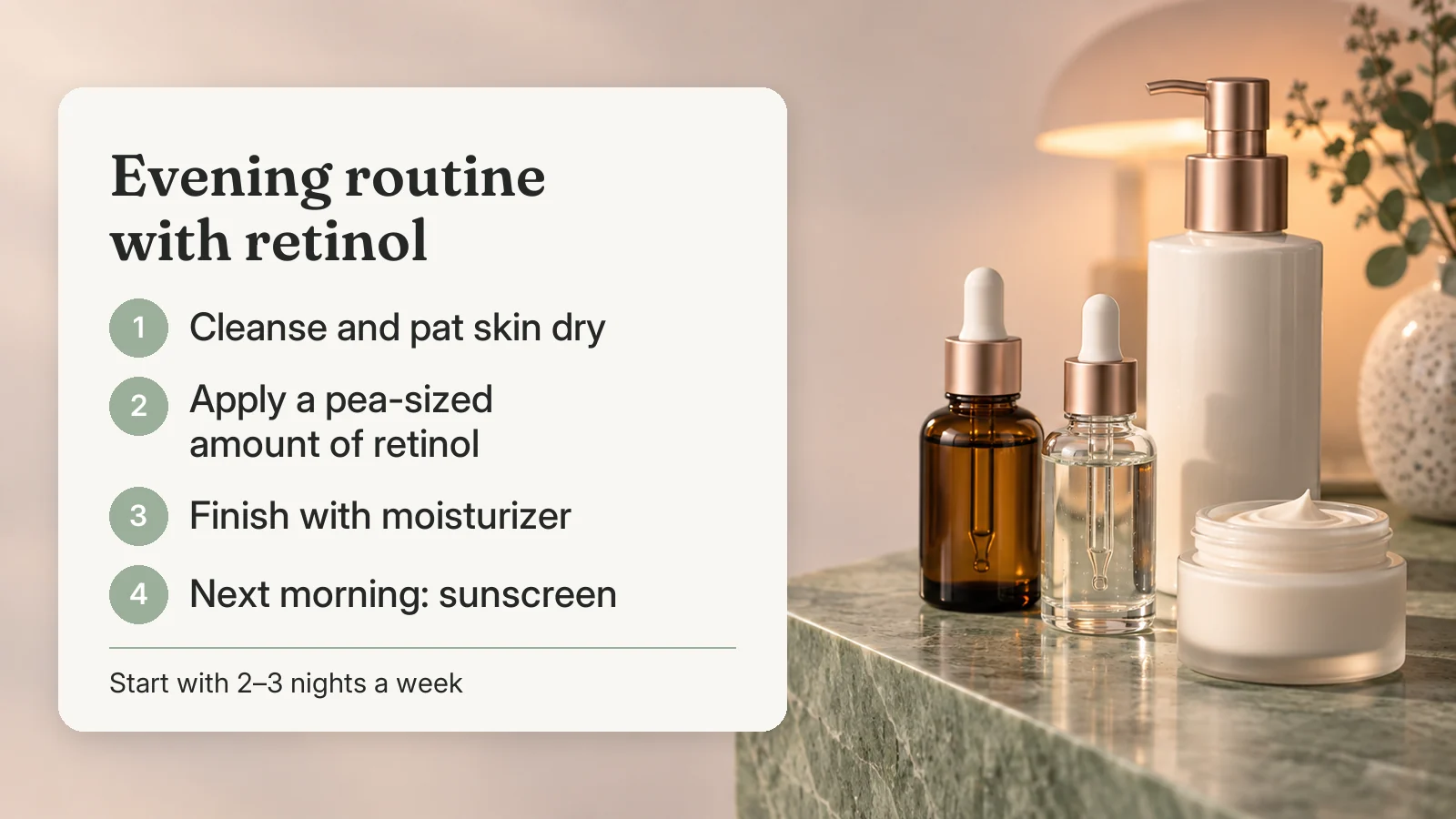
Apply retinol in the evening to clean, dry skin, about a pea-sized amount. Start low on both percentage and frequency, raising them as your skin adjusts [4, 15]. Follow with a moisturizer and do not skip broad-spectrum sunscreen in the morning [18]. The steps are the same for a serum, a cream or a lotion:
- Wash your face in the evening and pat it dry.
- Spread a pea-sized amount of retinol in a thin layer.
- Apply your moisturizer.
- Use sunscreen the next morning.
Should retinol be used at night?
Yes. Retinoids are chemically unstable and very sensitive to light, oxygen and heat [19]; in a laboratory study of commercial products, light-driven degradation was more pronounced than heat-driven [20]. No study in our sources measured retinol’s effect on sun sensitivity, but daytime sunscreen is essential either way — almost every study in the hyperpigmentation review recommended SPF 30 or higher [16].
How often should you use retinol?
Start with 2–3 nights a week; if you see no irritation, move to every other night and then nightly, stepping back if your skin reacts. Across the studies, frequency ranged from at most three times a week [13] to once daily [15, 21]. No study compares starting schedules.
Before or after moisturizer?
No study compares applying retinol before or after a moisturizer. Most people apply retinol first; if your skin gets dry, try the “sandwich method” (moisturizer, retinol, moisturizer). In one study the retinol group used the product alongside a moisturizer and saw a clear improvement in dryness [4]; with tretinoin, a barrier-supporting moisturizer containing niacinamide, panthenol and tocopheryl acetate eased the adjustment phase [22].
What percentage of retinol should you use?
There is no single percentage that suits everyone; start low and increase slowly.
| Percentage | What studies showed |
|---|---|
| 0.1% | Better than vehicle at 52 weeks [3]; wrinkles and tone improved over 9 months with no notable side effects [14] |
| 0.3% and 0.5% | Spots and wrinkles decreased on both sides; irritation more frequent and intense with 0.5% [15] |
| 0.25%, 0.5%, 1% | Efficacy similar to tretinoin with special formulas [4, 12]; in the first, raised in steps over 12 weeks |
EU Regulation 2024/996 caps retinol, retinyl acetate and retinyl palmitate at 0.05% in body lotions and 0.3% retinol equivalent elsewhere, face products included [5]. The 0.4% to 1% formulas used in studies sit above that cap.
Can you use retinol around the eyes?
You can, carefully. Under-eye wrinkles improved over 9 months with 0.1% retinol [14], and the one-year study reported a 44% improvement in crow’s feet fine lines [3]; both manufacturer-linked. Use a grain of rice, keep it off the lash line, and stop if it stings.
What happens when you use retinol?
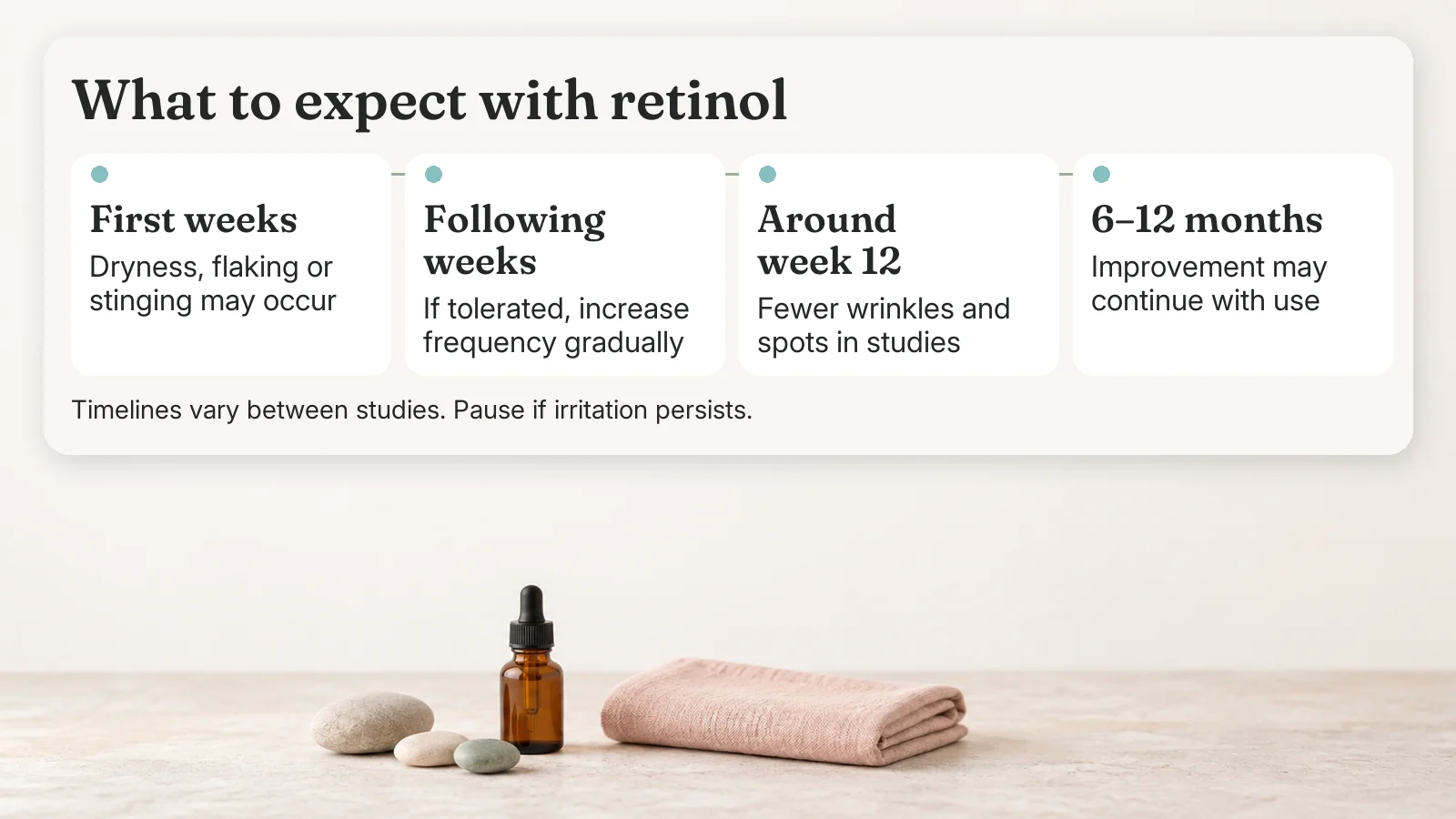
Dryness, flaking, redness or stinging can show up in the first weeks. Burning, peeling and dermatitis are what limit retinoid use, though retinol is clearly less irritating than tretinoin [6]. How long does it take to work? Most studies assessed the result at 12 weeks [1, 4, 15].
| Phase | What may happen | What to do (practical) |
|---|---|---|
| First weeks | Dryness, flaking, stinging; mostly mild to moderate irritation [15] | 2–3 nights a week, moisturizer after |
| Following weeks | With tretinoin, a barrier-supporting moisturizer eased the adjustment [22]; unclear for retinol | If no irritation, raise the frequency step by step |
| Around week 12 | Fewer wrinkles and spots, more even tone [1, 15]; new collagen in biopsies [4] | Keep going consistently |
| 6–12 months | Improvement at 24 weeks [13] and 9 months [14]; continued in the one-year study [3] | Do not let sun protection slip |
How common are side effects? Our sources give no rate specific to retinol. In a 355-person study, 44% of people using retinoic acid had redness in the first four weeks, 35% flaking and 29% burning or itching. Those figures are not for retinol. In the six-person patch test in the same publication, retinol had a low irritation potential [23].
What is retinol purging, and does it really happen?
Purging is the phase in which breakouts are believed to increase at the start of retinoid use. A short 2009 review found no primary clinical data supporting that belief; the authors suggest worsening in the first week or two may be part of the natural course of acne [17]. The review is not specific to cosmetic retinol. If the increase lasts, see a dermatologist.
What can you use retinol with?
Retinol and niacinamide can usually share a routine, although the evidence comes from studies with retinol’s relatives among the retinoids [10, 22]. For vitamin C (L-ascorbic acid), the usual arrangement is vitamin C in the morning and retinol at night. Keep AHAs and BHAs to separate nights, and never add retinol on top of a prescription retinoid.
| Ingredient | Use together | Note |
|---|---|---|
| Niacinamide | Yes | A cosmetic regimen with niacinamide and retinyl propionate (not retinol) was better tolerated than 0.02% tretinoin over 8 weeks [10]. See retinol and niacinamide together |
| Vitamin C | Vitamin C serum in the morning, retinol at night | Two biopsy studies with 8 and 11 people tested a preparation containing both; visible effects were measured only to a limited extent [24]. See retinol and vitamin C together |
| AHA/BHA (glycolic, salicylic acid) | On separate nights | Both the same night may strain the skin (practical); glycolic acid carried a higher side-effect risk [2] |
| Moisturizer, hyaluronic acid | Yes | Supportive (practical) |
| Prescription retinoids | Not advised | Talk to your doctor (practical) |
| Sunscreen | Every morning | Slowed skin aging [18] |
Who should avoid retinol?
Retinol is not recommended if you are pregnant or breastfeeding [7]. If your skin is sensitive or you have rosacea or eczema, ask a dermatologist first because of the irritation risk [6]. Never add retinol on top of a prescription retinoid, and do not skip sunscreen [18].
Can you use retinol during pregnancy? It is not recommended. Two meta-analyses covering mostly prescription retinoids found that first-trimester exposure was not linked to a significant increase in major congenital malformations or miscarriage [7, 25]. However:
- The authors who looked at 654 exposed and 1,375 unexposed pregnancies say the finding can reassure women who used one unknowingly, but the statistical power is not enough to justify use in pregnancy [7].
- The analysis covering 3,632,118 pregnancies across 8 studies is heavily influenced by a single large registry study [25].
If you used it without realizing, stop the product and talk to your doctor. Our sources include no study of retinol during breastfeeding or in rosacea and eczema.
Is there an alternative to retinol?
One studied option is bakuchiol. In a randomized 12-week study with 44 people, 0.5% bakuchiol twice daily and 0.5% retinol once daily both significantly reduced wrinkle surface area and hyperpigmentation, with no statistical difference; the retinol group reported more flaking and stinging [21]. A single small study, and our sources contain no evidence on bakuchiol in pregnancy.
How do you choose and store a retinol product?
Because retinoids are sensitive to light, oxygen and heat [19], choose opaque packaging, ideally an airless pump, and keep the product cool and dark. A clearly stated percentage also makes it easier to start low.
In a laboratory study, the retinoid content of 12 products fell by 0% to 80% at 25 °C and by 40% to 100% at 40 °C over six months, and some contained less than their labels stated [20]. Few products, and results depended on the formula. In the EU, products containing retinol, retinyl acetate or retinyl palmitate must carry the wording: “Contains Vitamin A. Consider your daily intake before use.” [5]
Frequently asked questions
At what age can you start using retinol?
There is no set starting age. The studies were done in adults, mostly on sun-damaged skin [6]; participants were 35 to 65 in one [4], mean age 87 in another [13]. If you are young and considering retinol for breakouts, see a dermatologist first — the evidence specific to retinol here is limited.
What is the difference between retinol and tretinoin?
Tretinoin (retinoic acid) is the prescription retinoid described as the most potent and most studied, with marked irritation [6]. Retinol produced similar changes with far less redness [11] and is generally taken to be 10 times weaker — although a manufacturer-linked study with a special formula found no significant difference [12].
Can you use retinol in summer?
Yes. Use it in the evening and do not skip broad-spectrum sunscreen in the morning. In an Australian study of 903 adults under 55, the daily-use group showed no detectable increase in skin aging over 4.5 years — 24% less than the group who used it when they felt like it. Some data were missing [18].
References
- Kong R, Cui Y, Fisher GJ, et al. A comparative study of the effects of retinol and retinoic acid on histological, molecular, and clinical properties of human skin. J Cosmet Dermatol. 2016;15(1):49-57. PubMed · DOI
- Lin L, Chen X, Liu C, et al. Comparative efficacy of topical interventions for facial photoaging: a network meta-analysis. Sci Rep. 2025;15(1):26889. PubMed · DOI
- Randhawa M, Rossetti D, Leyden JJ, et al. One-year topical stabilized retinol treatment improves photodamaged skin in a double-blind, vehicle-controlled trial. J Drugs Dermatol. 2015;14(3):271-280. PubMed
- Draelos ZD, Peterson RS. A Double-Blind, Comparative Clinical Study of Newly Formulated Retinol Serums vs Tretinoin Cream in Escalating Doses: A Method for Rapid Retinization With Minimized Irritation. J Drugs Dermatol. 2020;19(6):625-631. PubMed · DOI
- Commission Regulation (EU) 2024/996 of 3 April 2024 amending Regulation (EC) No 1223/2009 as regards the use of Vitamin A, Alpha-Arbutin and Arbutin and certain substances with potential endocrine disrupting properties in cosmetic products. Official Journal of the European Union.
- Mukherjee S, Date A, Patravale V, Korting HC, Roeder A, Weindl G. Retinoids in the treatment of skin aging: an overview of clinical efficacy and safety. Clin Interv Aging. 2006;1(4):327-348. PubMed · DOI
- Kaplan YC, Ozsarfati J, Etwel F, Nickel C, Nulman I, Koren G. Pregnancy outcomes following first-trimester exposure to topical retinoids: a systematic review and meta-analysis. Br J Dermatol. 2015;173(5):1132-1141. PubMed · DOI
- Sorg O, Antille C, Kaya G, Saurat JH. Retinoids in cosmeceuticals. Dermatol Ther. 2006;19(5):289-296. PubMed · DOI
- Vahlquist A. What are natural retinoids? Dermatology. 1999;199 Suppl 1:3-11. PubMed · DOI
- Fu JJ, Hillebrand GG, Raleigh P, et al. A randomized, controlled comparative study of the wrinkle reduction benefits of a cosmetic niacinamide/peptide/retinyl propionate product regimen vs. a prescription 0.02% tretinoin product regimen. Br J Dermatol. 2010;162(3):647-654. PubMed · DOI
- Kang S, Duell EA, Fisher GJ, et al. Application of retinol to human skin in vivo induces epidermal hyperplasia and cellular retinoid binding proteins characteristic of retinoic acid but without measurable retinoic acid levels or irritation. J Invest Dermatol. 1995;105(4):549-556. PubMed · DOI
- Babcock M, Mehta RC, Makino ET. A Randomized, Double-blind, Split-face Study Comparing the Efficacy and Tolerability of Three Retinol-based Products vs. Three Tretinoin-based Products in Subjects With Moderate to Severe Facial Photodamage. J Drugs Dermatol. 2015;14(1):24-30. PubMed
- Kafi R, Kwak HS, Schumacher WE, et al. Improvement of naturally aged skin with vitamin A (retinol). Arch Dermatol. 2007;143(5):606-612. PubMed · DOI
- Bellemère G, Stamatas GN, Bruère V, Bertin C, Issachar N, Oddos T. Antiaging action of retinol: from molecular to clinical. Skin Pharmacol Physiol. 2009;22(4):200-209. PubMed · DOI
- Zasada M, Budzisz E, Erkiert-Polguj A. A Clinical Anti-Ageing Comparative Study of 0.3 and 0.5% Retinol Serums: A Clinically Controlled Trial. Skin Pharmacol Physiol. 2020;33(2):102-116. PubMed · DOI
- Tan MG, Kim WB, Jo CE, Nabieva K, Kirshen C, Ortiz AE. Topical treatment for postinflammatory hyperpigmentation: a systematic review. J Dermatolog Treat. 2022;33(5):2518-2526. PubMed · DOI
- Yentzer BA, McClain RW, Feldman SR. Do topical retinoids cause acne to “flare”? J Drugs Dermatol. 2009;8(9):799-801. PubMed
- Hughes MC, Williams GM, Baker P, Green AC. Sunscreen and prevention of skin aging: a randomized trial. Ann Intern Med. 2013;158(11):781-790. PubMed · DOI
- Zhong J, Zhao N, Song Q, Du Z, Shu P. Topical retinoids: Novel derivatives, nano lipid-based carriers, and combinations to improve chemical instability and skin irritation. J Cosmet Dermatol. 2024;23(10):3102-3115. PubMed · DOI
- Temova Rakuša Ž, Škufca P, Kristl A, Roškar R. Retinoid stability and degradation kinetics in commercial cosmetic products. J Cosmet Dermatol. 2021;20(7):2350-2358. PubMed · DOI
- Dhaliwal S, Rybak I, Ellis SR, et al. Prospective, randomized, double-blind assessment of topical bakuchiol and retinol for facial photoageing. Br J Dermatol. 2019;180(2):289-296. PubMed · DOI
- Draelos ZD, Ertel KD, Berge CA. Facilitating facial retinization through barrier improvement. Cutis. 2006;78(4):275-281. PubMed
- Fluhr JW, Vienne MP, Lauze C, Dupuy P, Gehring W, Gloor M. Tolerance profile of retinol, retinaldehyde and retinoic acid under maximized and long-term clinical conditions. Dermatology. 1999;199 Suppl 1:57-60. PubMed · DOI
- Seité S, Bredoux C, Compan D, et al. Histological evaluation of a topically applied retinol-vitamin C combination. Skin Pharmacol Physiol. 2005;18(2):81-87. PubMed · DOI
- Alali AB, Alhammad FA, Almohammed Saleh JA, et al. Topical retinoids and risk of major congenital malformations and spontaneous abortion: a systematic review and meta-analysis. Front Drug Saf Regul. 2026;6:1864872. PubMed · DOI