How do you use a vitamin C serum? In the morning, on clean skin, a few drops before your moisturizer and sunscreen. Topical vitamin C (L-ascorbic acid) is one of the most powerful antioxidants in skin, a cofactor in collagen synthesis and a suppressor of melanin formation [1, 2]. The catch is the molecule: it is unstable, so the formula and the way you store it are part of whether it works [3].
In this article
- What is a vitamin C serum?
- What does a vitamin C serum do?
- Which form of vitamin C should you choose?
- How do you use a vitamin C serum?
- What happens when you use a vitamin C serum?
- How should you store a vitamin C serum?
- What can you use vitamin C with?
- Who should be careful with a vitamin C serum?
- Frequently asked questions
- References
What is a vitamin C serum?
A vitamin C serum is a leave-on product built around L-ascorbic acid, the form your skin can actually use. Reviews describe it as one of the most powerful antioxidants in skin, with protective effects against sun-driven aging, a role in collagen synthesis and a reduction in melanin formation; it also regenerates vitamin E and works synergistically with it [1]. L-ascorbic acid additionally suppresses tyrosinase, the enzyme that starts pigment production [2].
Two things to be clear about. This guide is about topical vitamin C; oral vitamin C is a separate subject. And the honest caveat comes from the reviews themselves: clinical studies on topical formulas are still limited, and the real difficulty is finding a formula that is both stable and able to get into the skin [1, 3].
What does a vitamin C serum do?
The evidence here is a mix, and the mix matters: the strongest results come from laboratory and animal-skin models, while the human studies are small and few. Each claim below says which kind of study sits behind it.
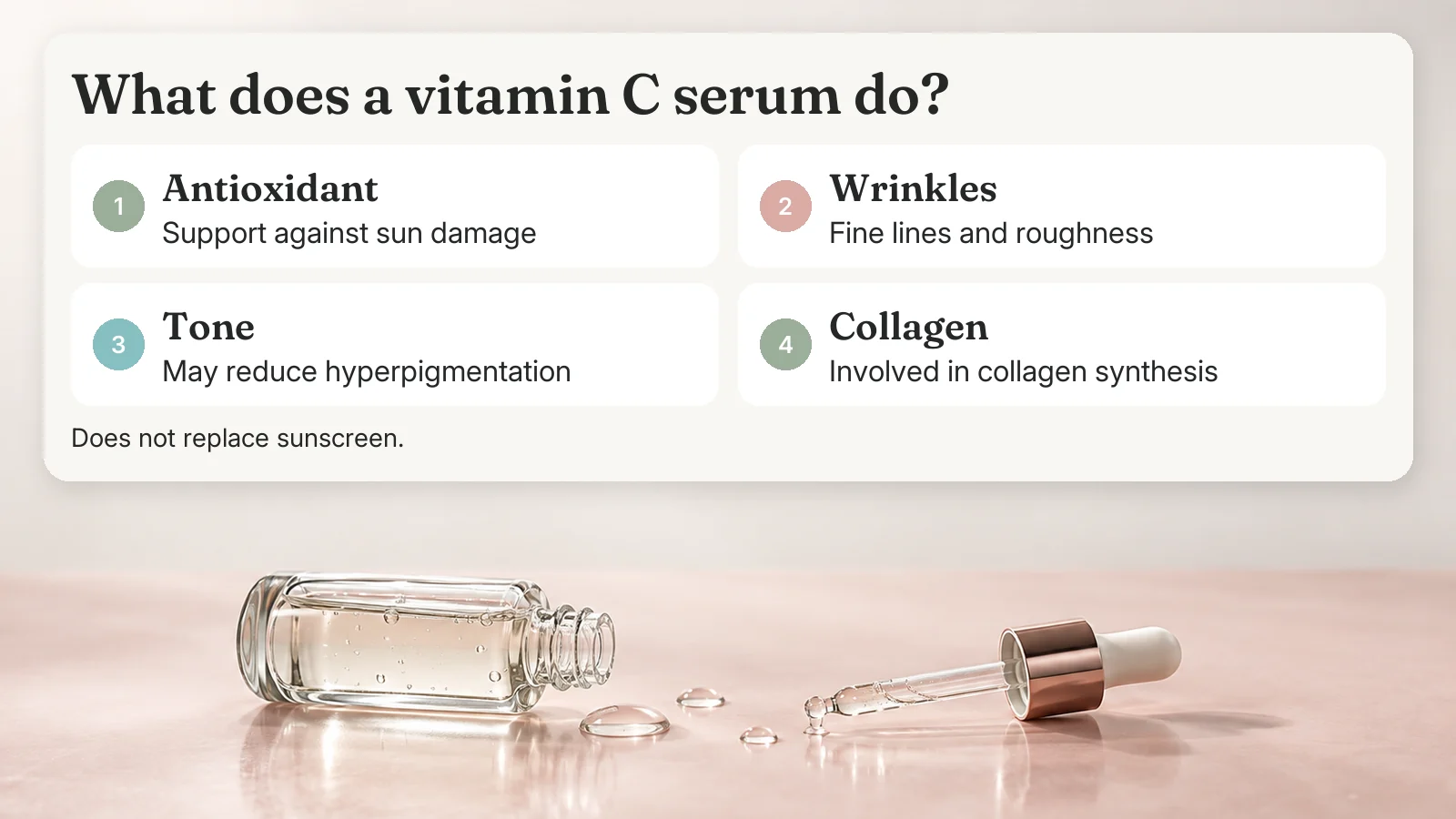
Antioxidant support against sun damage
This is vitamin C’s clearest role. In pig skin, 15% L-ascorbic acid with 1% alpha-tocopherol protected against UV-driven redness and sunburn cell formation better than either alone, reaching an antioxidant protection factor of 4 after four days [4]. Adding ferulic acid improved the vitamins’ chemical stability and roughly doubled that factor, from about 4 to 8 [5]. Both are experimental models.
The human evidence: the same solution with 0.5% ferulic acid, applied to human skin for four days, gave significant protection against UV irradiation, measured by redness, sunburn cells, thymine dimers and p53. The authors note the mechanism differs from sunscreens and is expected to complement the protection they give [6]. Few participants, short experiment.
Fine lines and roughness
Three sources, all small. In a double-blind study, 19 people applied an ascorbic acid serum to one side of the face and vehicle to the other for 3 months; the vitamin C side improved significantly more in fine wrinkling, roughness, coarse lines, laxity and sallowness [7]. Very small sample, single commercial product.
In a second double-blind study, women with sun-damaged skin used a 5% vitamin C cream versus vehicle on the décolletage and arms for 6 months. The vitamin C side improved significantly on the overall score, micro-relief density increased and deep lines decreased, with signs of repair in elastic tissue [8]. Note the site: not facial skin.
A systematic review of 7 publications and 139 volunteers found that skin treated with topical vitamin C looked smoother and less wrinkled, supported by biopsy data [9]. The studies were few and small.
Dark spots and uneven tone
The same systematic review found significant lightening on objective pigment measurements. Hydration increased equally on the vitamin C and placebo sides, so this is not a hydrating ingredient [9].
For melasma, be careful with expectations. In a double-blind study, 16 women applied 5% ascorbic acid to one side of the face and 4% hydroquinone to the other, at night for 16 weeks, with daily sunscreen. By patient assessment the hydroquinone side did better (93% versus 62.5%), but colour measurements showed no significant difference, and side effects were far more common with hydroquinone: 68.7% versus 6.2% [10]. A very small sample. A systematic review of 35 randomized controlled trials on melasma, which included ascorbic acid, gave a strong clinical recommendation only for cysteamine, triple combination therapy and tranexamic acid [11]. If you think you have melasma, see a dermatologist.
Collagen
Vitamin C is a cofactor in collagen synthesis — the enzymes that build collagen need it to work — and reviews credit it with increasing collagen synthesis and organizing collagen fibres [1, 2]. Treat this as mechanism, not as a promise about the mirror; what was measured in people is in the two sections above.
Which form of vitamin C should you choose?
This is the decision that matters most, and every option trades off two things you cannot have at once: staying intact in the bottle, and getting through the surface of your skin.
In a pig-skin absorption study, L-ascorbic acid had to be in a formula with a pH below 3.5 to penetrate at all. The best absorption came at 20% and higher concentrations did not increase it; skin levels saturated after three days, with a half-life of about four days. Crucially, magnesium ascorbyl phosphate, ascorbyl palmitate and dehydroascorbic acid did not raise skin L-ascorbic acid levels [12]. This is a pig-skin model; no clinical effect was measured in human skin.
| Form | Upside | Watch out |
|---|---|---|
| L-ascorbic acid | The form measured in most studies | Needs pH below 3.5; unstable; can sting |
| Derivatives (magnesium ascorbyl phosphate, ascorbyl palmitate) | More stable in the bottle | Did not raise skin levels in the pig-skin study |
| With vitamin E and ferulic acid | Better stability, higher protection factor | Shown in experimental models |
Reviews put it the same way: derivatives are more stable but penetrate less [2, 3], while combining L-ascorbic acid with vitamin E and ferulic acid raises both stability and photoprotection [5, 4].
What percentage of vitamin C should a serum have?
Our studies used 5% and 15%: 5% on the décolletage over 6 months [8] and in the melasma study [10], 15% in the photoprotection work [6]. Above 20% absorption did not increase in the pig-skin study [12], so a bigger number on the box is not automatically better, and the systematic review says outright that more work is needed on the ideal concentration [9]. On sensitive skin, start lower and use it every other day.
How do you use a vitamin C serum?
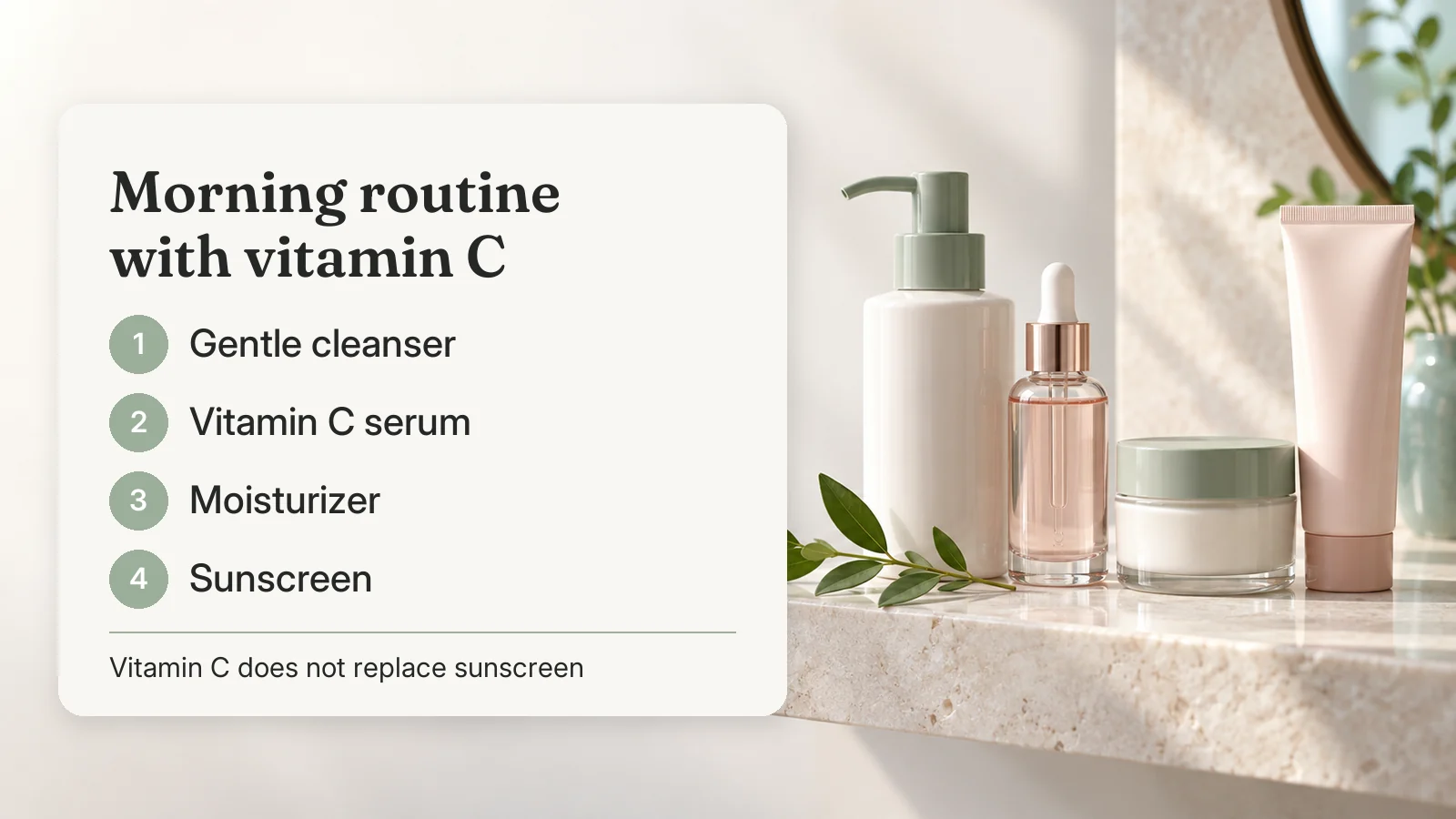
Vitamin C goes on early, while the skin is clean and nothing stands between the serum and the surface. It is thin, so it belongs under the moisturizer:
- Cleanse with a gentle cleanser.
- Apply the vitamin C serum — a few drops, spread over the face.
- Moisturizer on top.
- Sunscreen as the last morning step.
Vitamin C serum in the morning or at night?
Morning, for a sound reason: the point of an antioxidant is to be there while your skin is meeting daylight, and the photoprotection studies applied it before UV exposure [6, 4]. But this is not a rule from a comparison study — the melasma study applied it overnight [10]. If you use retinol at night, morning is the easier slot anyway.
Does vitamin C replace sunscreen?
No, and this matters more than anything else on this page. The authors of the human study say plainly that the mechanism differs from sunscreens and is expected to complement the protection they give [6].
Daily sunscreen is also the best-evidenced habit for skin aging there is. In an Australian trial with 903 adults under 55, the daily-use group showed no detectable increase in skin aging over 4.5 years — 24% less than the group who used it when they felt like it. Some data were missing [13].
What happens when you use a vitamin C serum?
Tolerance is generally good: the 6-month cream was well tolerated [8], and in the melasma study side effects occurred in 6.2% of the ascorbic acid side against 68.7% for hydroquinone [10]. Stinging does happen, an unavoidable consequence of the low pH L-ascorbic acid needs. If it stings, drop to a lower percentage or use it every other day.
Timelines, as the studies measured them:
| What | When it was measured |
|---|---|
| Fine lines, roughness, sallowness (face) | 3 months [7] |
| Pigmentation (melasma) | 16 weeks [10] |
| Overall score, deep lines (décolletage and arms) | 6 months [8] |
The systematic review adds the honest framing: long-term use may be needed before a clear change shows [9]. None of these are promises.
How should you store a vitamin C serum?
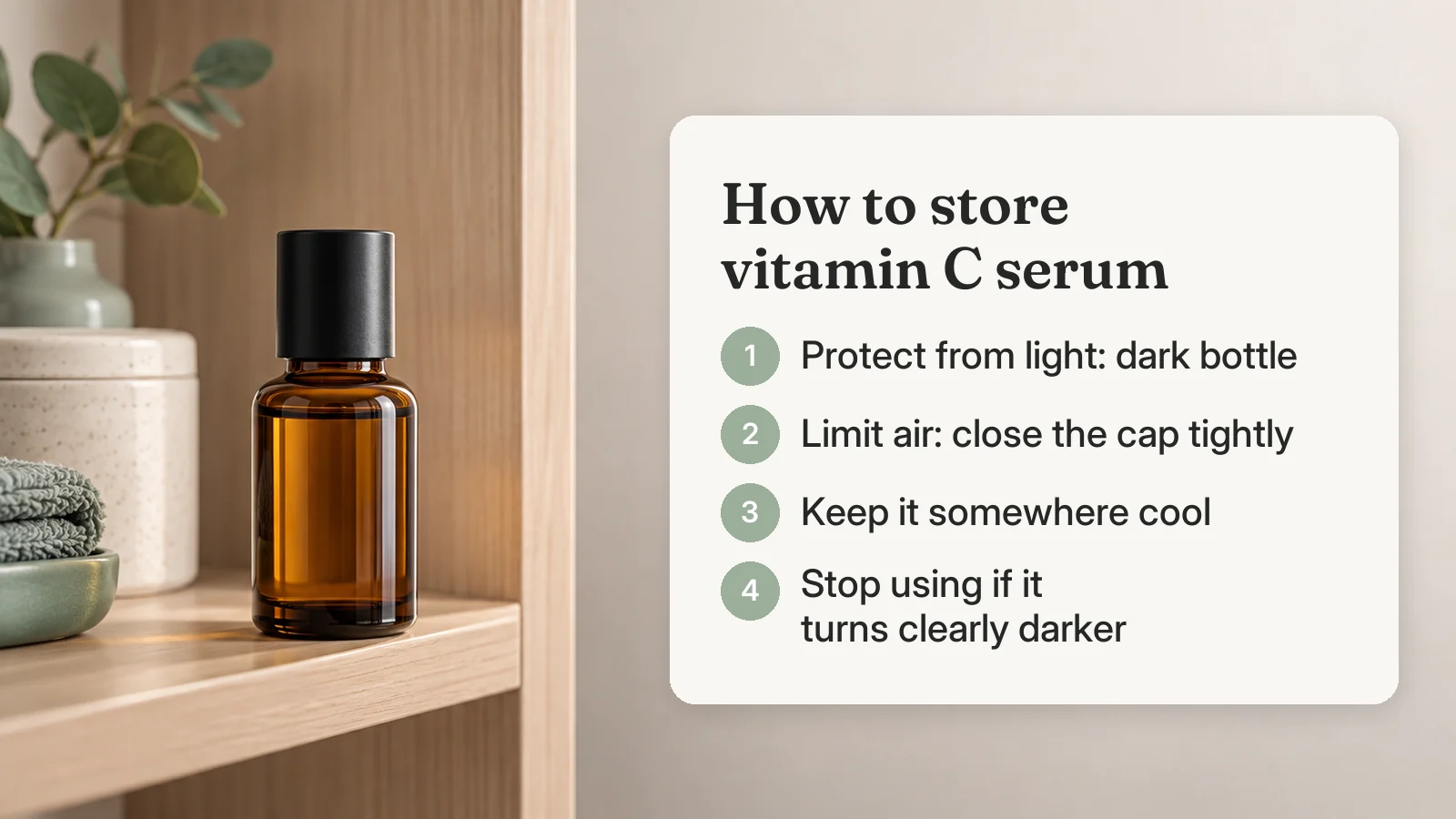
Storage is not an afterthought here. Vitamin C is water-soluble and unstable, and that instability is what makes these products hard to formulate [3]; manufacturers fight it with pH adjustment and encapsulation [2]. Once the bottle is in your bathroom the rest is on you: keep it dark, close the cap tightly, and store it somewhere cool.
Can you use a vitamin C serum that changed color?
A serum that has clearly darkened — from pale yellow to orange or brown — has most likely oxidized, and there is no reason to expect the same effect from it. Our sources do not put a number on how much activity is lost at a given shade, so we will not either. A slight deepening is common; a clear shift to brown means stop using it.
What can you use vitamin C with?
Vitamin C has a reputation for being fussy about company, and most of it does not survive a look at the studies. Where it sits next to the other actives you are likely to own:
| With | Verdict | Why |
|---|---|---|
| Vitamin E and ferulic acid | Use together | Raises stability and protection factor [4, 5] |
| Sunscreen | Every morning | Complementary mechanisms [6, 13] |
| Retinol | Vitamin C in the morning, retinol at night | Practical separation; the pair has been studied together [14] |
| Niacinamide | Can be combined | The interaction shown was inside one cream, in the lab [15, 16] |
| AHA/BHA | Separate the times if irritated | Two low-pH products at once can irritate (practical) |
On retinol: two small double-blind studies in post-menopausal women tested a preparation containing both retinol and vitamin C — on aged skin (8 people, elbow, 3 months) and on sun-damaged facial skin (11 people, 6 months). It produced changes in the epidermis (a more compact stratum corneum, increased cell proliferation) and in the dermis (a fall in the type III to type I procollagen ratio); the authors suggest the combination may partly reverse age-related changes [14]. Very small samples, and tissue findings rather than measurements of what you would see. The practical routine: using retinol and vitamin C together.
On niacinamide: the concern comes from a laboratory study where, inside oil-in-water creams under UV light, nicotinamide sped up the light-driven breakdown of ascorbic acid [15]. That is a chemical interaction within one cream, not a result for two products applied separately, and niacinamide has been used alongside other actives in clinical studies [16]. More on using niacinamide and vitamin C together.
Who should be careful with a vitamin C serum?
Vitamin C is not a high-risk ingredient, and it was tolerated well in these studies. Three situations are worth naming anyway, and two are less about the serum than about knowing when a concern needs a doctor rather than a shelf of products.
- Sensitive skin: the low pH L-ascorbic acid needs is also what makes it sting. Start lower, use it every other day at first, and patch test.
- Melasma: no strong recommendation for ascorbic acid [11], and the one head-to-head study was tiny [10]. See a dermatologist.
- Pregnancy and breastfeeding: our sources include no pregnancy study specific to topical vitamin C. Most skincare products act locally and reach very low levels in the body, with hydroquinone and tretinoin as the noted exceptions [17]. Ask your doctor first.
Frequently asked questions
Can you use a vitamin C serum every day?
Yes. It was applied daily in the studies: 3 months on the face [7], 6 months on the décolletage [8]. If it stings, start every other day.
Does a vitamin C serum shrink pores?
No study in our sources measured pore size. The measured effects are on tone, fine lines and surface roughness.
Does a vitamin C serum help post-acne marks?
Possibly, for the pigmented kind: topical vitamin C produced significant lightening on objective pigment measurements [9]. For post-inflammatory hyperpigmentation specifically, the best-supported options in a review of 47 studies were retinoids, hydroxy acids and broad-spectrum sunscreen [18]. Pitted scars are a different problem.
Can you use vitamin C and niacinamide together?
Yes. The often-repeated warning traces back to a laboratory study of one cream under UV light [15]. See using niacinamide and vitamin C together.
Does a vitamin C serum harm your skin in the sun?
Our sources give no reason to think so: it was applied before UV exposure in the photoprotection study and reduced the damage measured [6]. Use it with sunscreen, not instead of it.
References
- Al-Niaimi F, Chiang NYZ. Topical Vitamin C and the Skin: Mechanisms of Action and Clinical Applications. J Clin Aesthet Dermatol. 2017;10(7):14-17. PubMed
- Badash A, Garibay A, Petronic-Rosic V. Vitamins and the skin: Vitamin C in dermatology. Clin Dermatol. 2026;44(2):241-247. PubMed · DOI
- Stamford NP. Stability, transdermal penetration, and cutaneous effects of ascorbic acid and its derivatives. J Cosmet Dermatol. 2012;11(4):310-317. PubMed · DOI
- Lin JY, Selim MA, Shea CR, et al. UV photoprotection by combination topical antioxidants vitamin C and vitamin E. J Am Acad Dermatol. 2003;48(6):866-874. PubMed · DOI
- Lin FH, Lin JY, Gupta RD, et al. Ferulic acid stabilizes a solution of vitamins C and E and doubles its photoprotection of skin. J Invest Dermatol. 2005;125(4):826-832. PubMed · DOI
- Murray JC, Burch JA, Streilein RD, Iannacchione MA, Hall RP, Pinnell SR. A topical antioxidant solution containing vitamins C and E stabilized by ferulic acid provides protection for human skin against damage caused by ultraviolet irradiation. J Am Acad Dermatol. 2008;59(3):418-425. PubMed · DOI
- Traikovich SS. Use of topical ascorbic acid and its effects on photodamaged skin topography. Arch Otolaryngol Head Neck Surg. 1999;125(10):1091-1098. PubMed · DOI
- Humbert PG, Haftek M, Creidi P, et al. Topical ascorbic acid on photoaged skin. Clinical, topographical and ultrastructural evaluation: double-blind study vs. placebo. Exp Dermatol. 2003;12(3):237-244. PubMed · DOI
- Correia G, Magina S. Efficacy of topical vitamin C in melasma and photoaging: A systematic review. J Cosmet Dermatol. 2023;22(7):1938-1945. PubMed · DOI
- Espinal-Perez LE, Moncada B, Castanedo-Cazares JP. A double-blind randomized trial of 5% ascorbic acid vs. 4% hydroquinone in melasma. Int J Dermatol. 2004;43(8):604-607. PubMed · DOI
- Austin E, Nguyen JK, Jagdeo J. Topical Treatments for Melasma: A Systematic Review of Randomized Controlled Trials. J Drugs Dermatol. 2019;18(11):1156-1171. PubMed
- Pinnell SR, Yang H, Omar M, et al. Topical L-ascorbic acid: percutaneous absorption studies. Dermatol Surg. 2001;27(2):137-142. PubMed · DOI
- Hughes MC, Williams GM, Baker P, Green AC. Sunscreen and prevention of skin aging: a randomized trial. Ann Intern Med. 2013;158(11):781-790. PubMed · DOI
- Seité S, Bredoux C, Compan D, et al. Histological evaluation of a topically applied retinol-vitamin C combination. Skin Pharmacol Physiol. 2005;18(2):81-87. PubMed · DOI
- Ahmad I, Sheraz MA, Ahmed S, Bano R, Vaid FH. Photochemical interaction of ascorbic acid with riboflavin, nicotinamide and alpha-tocopherol in cream formulations. Int J Cosmet Sci. 2012;34(2):123-131. PubMed · DOI
- Boo YC. Mechanistic Basis and Clinical Evidence for the Applications of Nicotinamide (Niacinamide) to Control Skin Aging and Pigmentation. Antioxidants (Basel). 2021;10(8):1315. PubMed · DOI
- Bozzo P, Chua-Gocheco A, Einarson A. Safety of skin care products during pregnancy. Can Fam Physician. 2011;57(6):665-667. PubMed
- Tan MG, Kim WB, Jo CE, Nabieva K, Kirshen C, Ortiz AE. Topical treatment for postinflammatory hyperpigmentation: a systematic review. J Dermatolog Treat. 2022;33(5):2518-2526. PubMed · DOI