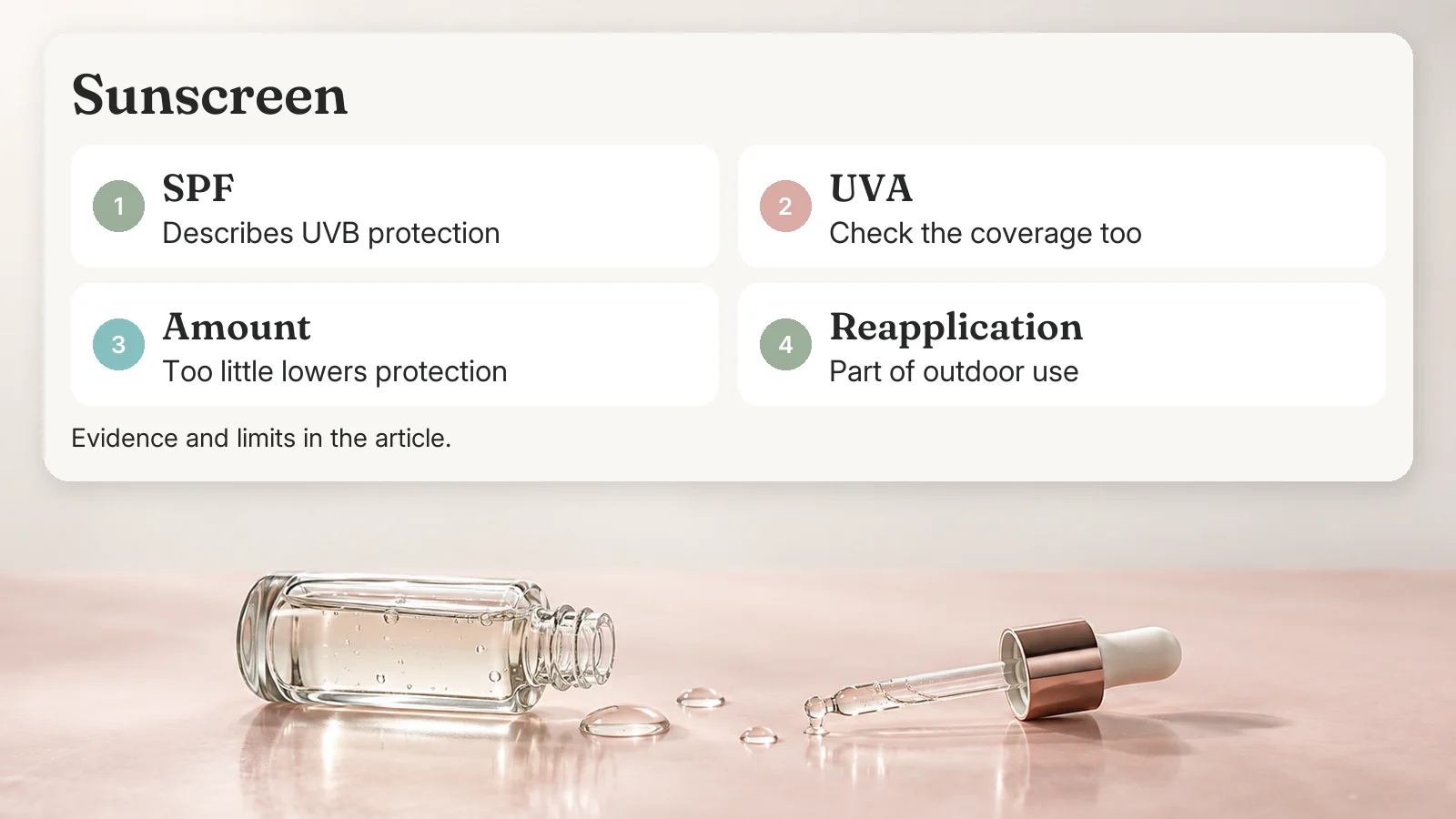
Sunscreen is one part of protection against ultraviolet radiation. The SPF number does not describe every aspect of protection: amount, missed areas, reapplication and UVA coverage matter. A controlled trial supports regular use to reduce photoaging. Consider sunscreen alongside shade, clothing and planning your time outdoors, rather than treating the bottle as complete protection. [1, 2, 3, 4]
In this article
- What does sunscreen protect against?
- How should you read SPF, UVA and broad spectrum?
- How much sunscreen should you apply?
- When should you reapply?
- How do mineral, organic and tinted products differ?
- What should you expect after starting regular use?
- Where does it fit with serum and moisturizer?
- Who needs individual advice?
- Frequently asked questions
- References
What does sunscreen protect against?
Sunscreen aims to reduce the skin’s exposure to UV radiation. Research examines different outcomes, including sunburn, photoaging and pigmentation. They are not interchangeable. A high SPF does not mean complete protection under every condition, nor does it give a personal allowance for unlimited time in the sun regardless of application. [1, 2]
Clothing, shade and managing exposure time are additional parts of protection. When arranging serums and moisturizer, think about these measures as a separate need rather than another optional cosmetic effect. [4]
A randomized study involving 903 adults younger than 55 found no detectable increase in skin aging in the daily broad-spectrum sunscreen group over 4.5 years. Aging was 24% less than in the discretionary-use group. The Australian trial had missing data; it is not a formula for predicting your individual aging rate. [3]
For dark spots, there is another reason to consider protection: UV and visible light can worsen melasma and post-inflammatory pigmentation. Exposure therefore matters when judging what a serum seems to achieve, not only when thinking about wrinkles or sunburn. [6]
How should you read SPF, UVA and broad spectrum?
SPF means sun protection factor and primarily describes UVB protection. UVA is another dimension, so the largest number on the packaging is not the whole label. Broad spectrum concerns UV coverage; it does not by itself describe protection from visible light, which can be relevant to particular pigmentation concerns. [4, 7]
| Label information | What it addresses | What it does not establish |
|---|---|---|
| SPF | UVB protection under test conditions | Your personal safe time in sunlight |
| UVA or broad spectrum | Scope of UV protection | Equal protection at every wavelength |
| Tint | Pigments may be present | Equal visible-light protection from every tinted product |
| Water resistance | The stated use conditions | No need to reapply |
Do not use SPF as a simple time multiplier. The amount in laboratory testing can differ from what you actually apply, and some areas may be missed. Calculating a fixed number of hours from the label hides those practical differences. [2]
Most studies in a review of post-inflammatory hyperpigmentation recommended SPF 30 or higher. Read that alongside broad-spectrum coverage and adequate, sustainable application. If a skin disease or particular risk affects your choice, discuss the level of protection with your dermatologist. [8]
How much sunscreen should you apply?
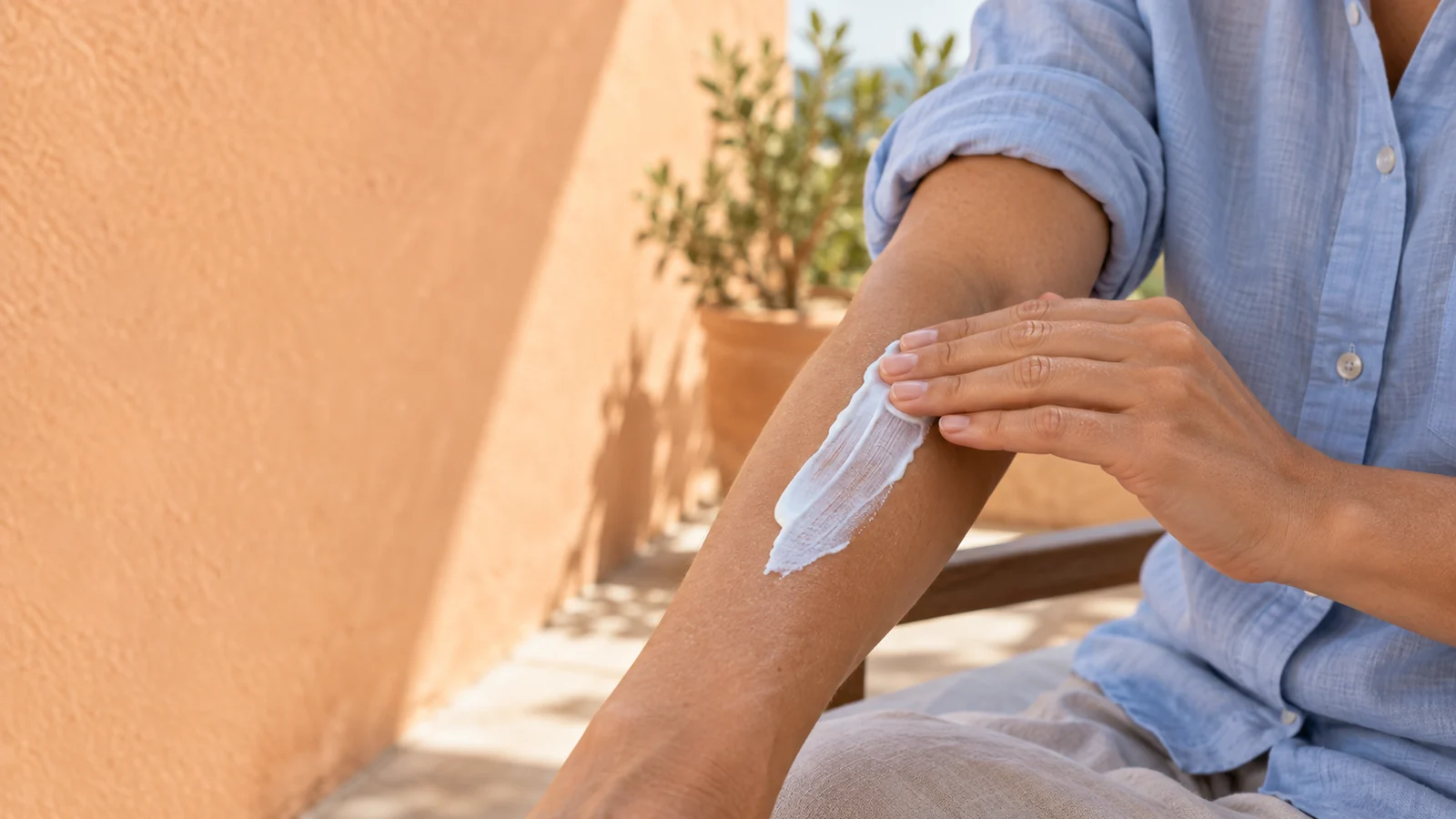
SPF tests use 2 mg of product per square centimeter of skin, while real-world studies find lower amounts. Following the product’s directions and covering exposed areas evenly is therefore important. A very thin layer should not be assumed to match the protection on the label simply because the printed SPF is high. [2]
You do not necessarily need to measure your face or weigh product every morning. It is useful, however, to reconsider an automatic habit of applying only a few tiny dots. Finger size and product consistency vary, so a finger-length rule is not presented here as an exact laboratory dose for everyone.
A practical application check:
- Plan before exposure. Avoid making application after sun exposure your usual method.
- Think beyond the face center. Include exposed neck, ears and other relevant areas.
- Check the edges. Look for missed areas as you spread the product.
- Respect warnings. Follow instructions around eyes and sensitive areas.
- Make reapplication possible. Take the product with you when the day’s plans require it.
These are handling suggestions rather than an individual clinical dosing protocol. Research identifies exposure before application and missed areas as practical weaknesses. Addressing those issues is more comprehensive than concentrating only on the largest available SPF number. [2]
How covering the eye area fits into managing under-eye darkness is explained in the dark circles guide.
Does a second layer solve uneven coverage?
In a forearm study, applying again after 30 minutes increased the total amount but did not significantly improve the evenness of distribution. Even after the second application, the amount remained below the test standard. Reapplication may help, but it does not remove the need to inspect gaps in the initial coverage. [9]
When should you reapply?
About every two hours outdoors is a common recommendation; swimming and sweating also require attention to the product’s instructions. A small study of outdoor workers found that facial sunscreen coverage decreased through the day. A morning application should therefore not be assumed to provide unchanged coverage until evening. [5]
The study followed 20 people and used fluorescent imaging to assess remaining coverage. It illustrates that application changes over time, not that protection ends at an identical minute for everyone. Spending much of the day outside was part of the study context. [5]
Think through walking, outdoor work, sport or swimming before leaving. Water resistance should be interpreted according to the stated conditions, not as unlimited durability. After towel drying, return to the directions rather than assuming the original layer is intact.
If you wear makeup, it may help to try a workable reapplication method beforehand. This guide does not establish that a powder, spray or makeup product provides an amount equivalent to a sunscreen cream. Check whether the product is actually intended for sun protection and how adequate application is described.
How do mineral, organic and tinted products differ?
A filter category alone does not finish the selection process. Coverage, the complete formula and comfort of use all matter. Mineral filters do not automatically establish visible-light protection. For pigmentation concerns in particular, distinguish the role of pigments in tinted formulas from the role of UV filters. [1, 7]
A review of tinted sunscreens discusses iron oxides and pigment-sized titanium dioxide as contributors to visible-light protection. Nano-sized mineral filters used to reduce white cast should not be assumed to perform the same job. Mineral and tinted are not interchangeable descriptions. [7]
A melasma review emphasizes tailored protection including visible light and UVA1. Skin-tone match and willingness to use the product are relevant too. It does not follow that every tinted sunscreen performs equally; discuss specific pigmentation concerns with your dermatologist. [10]
In practical terms, ask whether you can apply the recommended amount, reapply when needed and avoid skipping areas because of texture. A product you continually postpone using is a reason to reconsider your routine, even if its label looks appealing.
What should you expect after starting regular use?
Do not measure sunscreen’s value by expecting spots or lines to disappear in the first week. The photoaging trial ran for years, while pigmentation literature treats protection as a supporting measure. The first practical question is whether you can apply enough evenly and comfortably and maintain the routine when your day changes. [3, 6]
| Period | Realistic assessment |
|---|---|
| First days | Texture, white cast, eye-area comfort and coverage |
| First weeks | Sustainable application and reapplication |
| Pigmentation follow-up | Assessment alongside other care |
| Long term | Protective goals not visible in daily photographs |
If a formula causes burning, itching or pronounced redness, you do not need to force yourself to continue it. Stop and assess another suitable formula; seek advice if symptoms persist. Manage exposure with clothing and shade as well while considering a more comfortable product.
Where does it fit with serum and moisturizer?
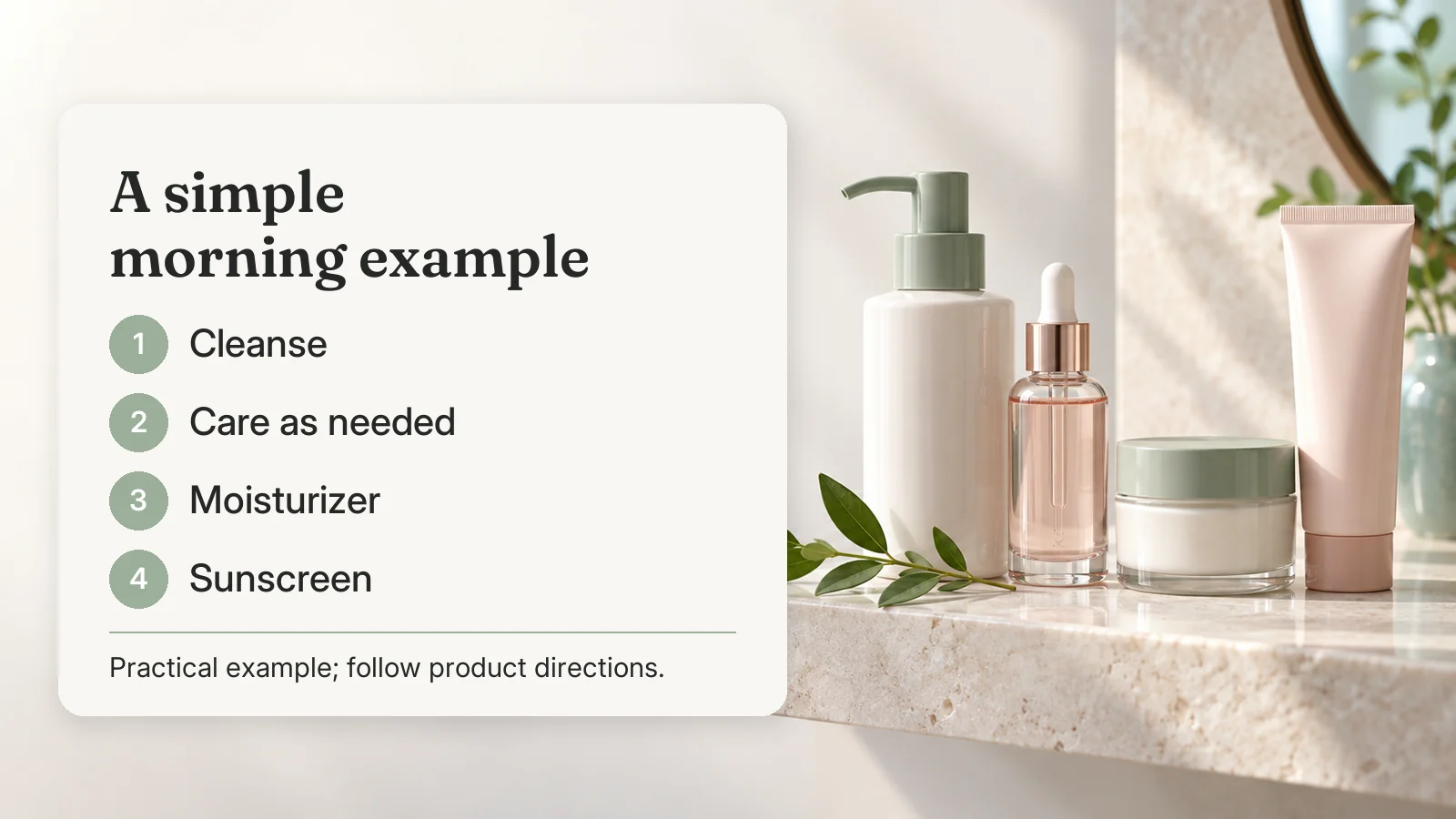
A practical morning routine can place sunscreen after cleansing and your selected skincare, while giving priority to product-specific directions. Using serums does not remove a separate protection need. This distinction matters especially when caring for pigmentation: cosmetic goals and protection from light are related, but they are not the same job. [6]
Vitamin C and niacinamide are not substitutes for an SPF claim that has actually been established for a finished product. Their studies measure different outcomes. Apply products according to their directions rather than mixing formulas together in your palm.
If too many layers pill, consider reducing serum steps or choosing a different texture. Applying much less sunscreen to solve a texture problem conflicts with the finding that amount affects protection. Simplifying the surrounding routine can be a more useful practical adjustment. [2]
Make the plan workable
Where you keep the product can matter to daily organization. Having it with your morning toiletries may help you remember; carrying it when expecting a long outdoor day makes reapplication feasible. These are planning examples rather than claims tested by the clinical trials.
A brief walk and hours of outdoor work are not identical situations. Consider your exposure, sweating or swimming, and the instructions together. Clothing and shade belong in the same plan; no single step should be treated as complete protection by itself. [4]
Who needs individual advice?
People with melasma, light-sensitive skin disease or a history of skin cancer should discuss protection with their clinician. Sunscreen does not replace personal risk assessment. For children, pregnancy and breastfeeding, consider the formula and use conditions rather than treating this general guide as approval of every product for every person.
Follow-up of an Australian trial found fewer melanomas in the daily-use group. However, the confidence interval for total melanoma included uncertainty, and case numbers were small. The result cannot support a promise that a sunscreen user will not develop skin cancer. [11]
For its research limits, see the bakuchiol guide.
Frequently asked questions
Can a high SPF compensate for applying less?
Do not treat a high number as permission to reduce the amount. Test conditions and real application differ, and uncovered areas remain a problem. Follow your own product’s amount and reapplication directions together. The label does not make gaps or an excessively thin layer irrelevant. [2]
Does everyone need a tinted product?
Tinted formulas can be relevant to pigment problems influenced by visible light. That does not mean everyone needs the same tinted product. Discuss suitable pigments and protection with a dermatologist for melasma or post-inflammatory pigmentation. Tint alone does not make all finished formulas equivalent. [7, 10]
Can I add two SPF numbers?
These studies do not support adding label numbers to calculate a new SPF. SPF describes a finished product under test conditions. Apply sunscreen according to its own instructions rather than adding its number to that of makeup, or counting another cosmetic as a replacement for the required amount. [2]
Should I see a difference every day?
No. Protection goals are not limited to changes visible in a mirror. The controlled photoaging trial assessed 4.5 years, and protection is only one part of pigmentation care. Focus on a workable application and reapplication plan instead of making daily appearance the sole test of whether protection matters. [3, 6]
References
- Abdel Azim S, Bainvoll L, Vecerek N, DeLeo VA, Adler BL. Sunscreens part 1: Mechanisms and efficacy. J Am Acad Dermatol. 2025;92(4):677-686. PubMed · DOI
- Petersen B, Wulf HC. Application of sunscreen—theory and reality. Photodermatol Photoimmunol Photomed. 2014;30(2-3):96-101. PubMed · DOI
- Hughes MC, Williams GM, Baker P, Green AC. Sunscreen and prevention of skin aging: a randomized trial. Ann Intern Med. 2013;158(11):781-790. PubMed · DOI
- Calzavara-Pinton P, Sala R, Arisi MC, Bussoletti C, Celleno L. Photobiology, photodermatology and sunscreens: a comprehensive overview. Part 1: damage from acute and chronic solar exposure. G Ital Dermatol Venereol. 2013;148(1):89-106. PubMed
- Kobwanthanakun W, Silpa-Archa N, Wongpraparut C, Pruksaekanan C, Manuskiatti W. An evaluation of the course of facial sunscreen coverage and sustainability over an 8-hour workday among outdoor workers. Health Sci Rep. 2021;4(3):e350. PubMed · DOI
- Fatima S, Braunberger T, Mohammad TF, Kohli I, Hamzavi IH. The Role of Sunscreen in Melasma and Postinflammatory Hyperpigmentation. Indian J Dermatol. 2020;65(1):5-10. PubMed · DOI
- Lyons AB, Trullas C, Kohli I, Hamzavi IH, Lim HW. Photoprotection beyond ultraviolet radiation: A review of tinted sunscreens. J Am Acad Dermatol. 2021;84(5):1393-1397. PubMed · DOI
- Tan MG, Kim WB, Jo CE, Nabieva K, Kirshen C, Ortiz AE. Topical treatment for postinflammatory hyperpigmentation: a systematic review. J Dermatolog Treat. 2022;33(5):2518-2526. PubMed · DOI
- De Villa D, Nagatomi AR, Paese K, Guterres S, Cestari TF. Reapplication improves the amount of sunscreen, not its regularity, under real life conditions. Photochem Photobiol. 2011;87(2):457-460. PubMed · DOI
- Morgado-Carrasco D, Piquero-Casals J, Granger C, Trullàs C, Passeron T. Melasma: The need for tailored photoprotection to improve clinical outcomes. Photodermatol Photoimmunol Photomed. 2022;38(6):515-521. PubMed · DOI
- Green AC, Williams GM, Logan V, Strutton GM. Reduced melanoma after regular sunscreen use: randomized trial follow-up. J Clin Oncol. 2011;29(3):257-263. PubMed · DOI
- Plensdorf S, Livieratos M, Dada N. Pigmentation Disorders: Diagnosis and Management. Am Fam Physician. 2017;96(12):797-804. PubMed