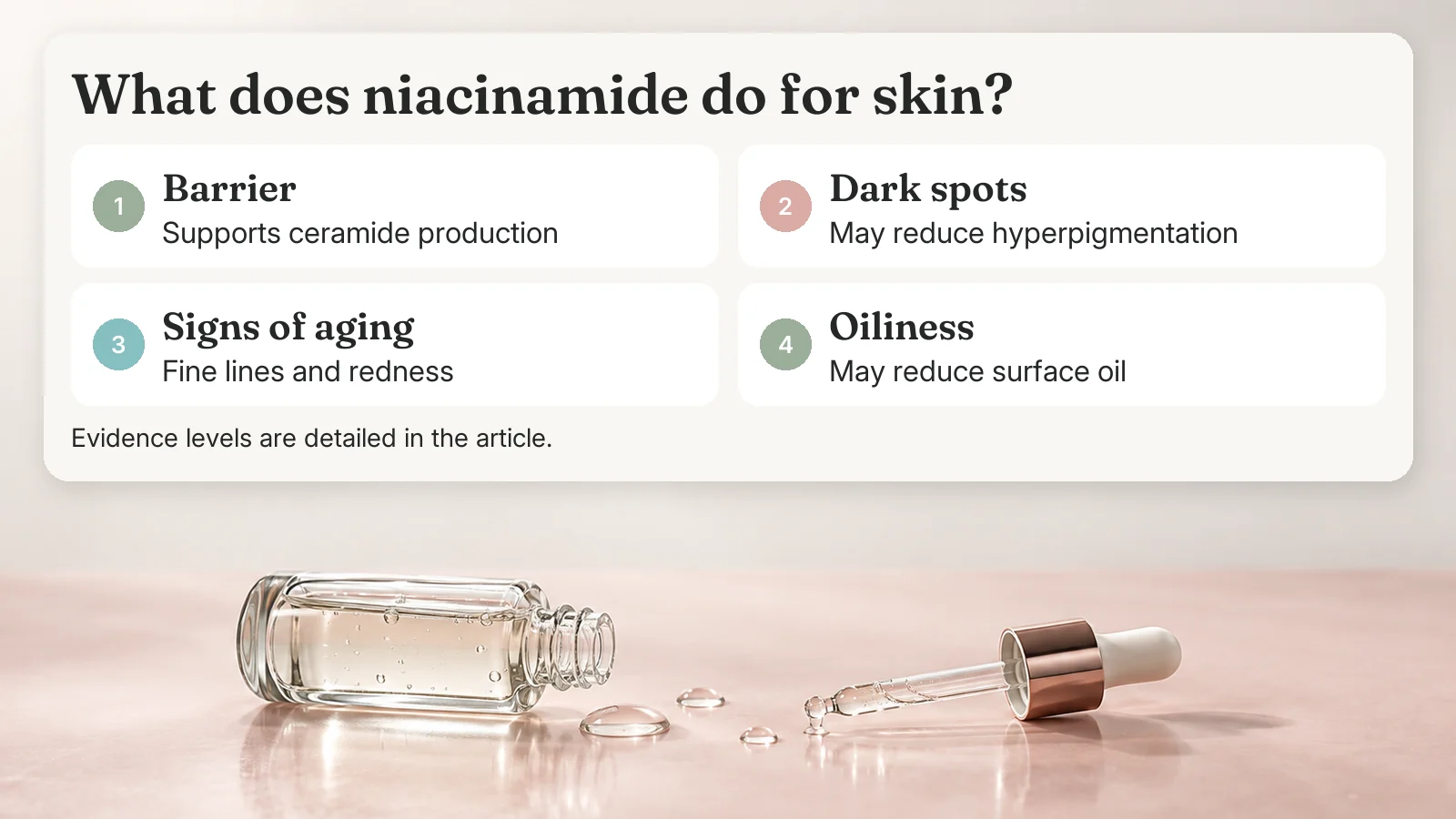
So what does niacinamide do? Niacinamide (nicotinamide, a form of vitamin B3) is a cosmetic ingredient your skin generally tolerates well [1]. Reviews credit it with supporting the skin barrier, and in controlled studies it reduced hyperpigmentation and slowed the progression of aging signs [1, 2]. The claims you hear most often — shrinking pores, controlling oil — rest on much thinner evidence. It suits morning or evening, and it layers easily with almost everything else in a routine.
In this article
What is niacinamide?
Niacinamide is a form of vitamin B3; on labels you will also see its other name, nicotinamide. In the body it is used to build NAD+ coenzymes, the helper molecules cells run their energy and repair reactions on [1, 2].
Two things are worth setting straight. This guide is about topical niacinamide; oral vitamin B3 supplements are a separate subject and nothing here transfers to them. And although niacinamide is one of the most studied ingredients in skincare, a 2021 review notes there is no convincing evidence that it acts on one specific molecular target [1]. It appears to nudge several processes at once, which is why its effects read as broad rather than dramatic.
What does niacinamide do for your skin?
Each effect below comes with the kind of study behind it, because the evidence is far from even: some rests on controlled trials in people, some is still cell-culture work. That difference is the whole story with this ingredient.
It supports the skin barrier
Your skin barrier is the outermost layer that limits water loss, and ceramides are among the fats holding it together.
In cultured human keratinocytes (the main cell type of the outer skin layer), nicotinamide increased ceramide synthesis 4.1- to 5.5-fold in a dose-dependent way, and also raised free fatty acid and cholesterol production. In the clinical part of the same work, applying it to dry skin raised ceramide and free fatty acid levels in the stratum corneum and reduced water loss through the skin [3]. Most of that study is cell culture, and the clinical portion is small.
A review reaches the same conclusion clinically: topical niacinamide steadies barrier function, lowering water loss and raising stratum corneum hydration [2]. This is the most consistently supported thing niacinamide does.
It may reduce dark spots and uneven tone
Pigment is made inside melanocytes, packaged into melanosomes, and handed to the surrounding skin cells. Niacinamide does not appear to interfere with the making of it: in one study it affected neither the tyrosinase enzyme nor melanin production inside the melanocyte. What it did, in a cell model, was cut the transfer of those pigment packages to keratinocytes by 35% to 68%. In the clinical arms — 18 people using 5% niacinamide, and 120 people using 2% niacinamide with sunscreen — hyperpigmentation was significantly lower than vehicle after 4 weeks [5]. The participants were Japanese women and the authors were linked to a manufacturer.
The half-face study of 50 women with signs of sun damage also reported fewer spots on the niacinamide side [6].
For post-inflammatory hyperpigmentation — the marks left behind after inflammation, including after acne — a systematic review of 47 studies listed niacinamide among the topical agents that have high-quality studies, alongside retinoids and hydroxy acids. Retinoids, hydroxy acids and broad-spectrum sunscreens were the best supported, and nearly every study recommended SPF 30 or above [7]. Measurement methods varied between studies.
Melasma is different. A systematic review of 35 randomized controlled trials on melasma included niacinamide, but issued a strong clinical recommendation only for cysteamine, triple combination therapy and tranexamic acid [8]. If you think you have melasma, see a dermatologist rather than working through serums.
Fine lines, redness and sallowness
The main clinical evidence is a single randomized half-face study. Fifty women with signs of sun damage applied 5% niacinamide to one side of the face and vehicle to the other, twice daily for 12 weeks, double-blind. On the niacinamide side, fine lines and wrinkles, spots, red blotchiness and yellowing all decreased, and elasticity improved; the abstract notes the skin tolerated it well [6]. Two limitations matter: only fair-skinned women took part, and the authors were linked to a manufacturer. A review reaches a similar conclusion for topical use alone or with other actives [1].
Can it reduce oiliness?
This is where the marketing runs ahead of the data. One study tested a moisturizer with 2% niacinamide in two places, and got two different answers. In a placebo-controlled study of 100 people in Japan, the sebum excretion rate fell significantly after 2 and 4 weeks. In a 30-person half-face study in the United States, the amount of sebum on the surface fell after 6 weeks, but the excretion rate did not change significantly [9].
Short studies, small groups, and results that did not agree across two populations. Calling this “oil control” overstates it.
Does it help acne-prone skin?
Two randomized studies compared 4% nicotinamide gel with 1% clindamycin gel over 8 weeks. In the first, with 76 patients, physician-rated improvement was 82% versus 68%, a difference that was not significant [10]. In the second, with 80 patients with moderate inflammatory acne, acne severity fell to a similar degree in both groups, nicotinamide did better on oily skin, and no serious side effects were seen [11]. That study was single-centre and short.
Set against that, a Cochrane review found four studies comparing nicotinamide with clindamycin or erythromycin. None measured participants’ own assessment of improvement, no difference was shown in dropout rates or mild side effects, and the evidence was rated low quality [12].
Acne is a skin disease, not a cosmetic concern, and this guide makes no treatment claim. If your breakouts are persistent or leaving marks, a dermatologist is the right address.
Redness-prone and sensitive skin
One randomized study assessed a niacinamide-containing facial moisturizer over 4 weeks in 50 people with rosacea (a condition with facial redness). The study’s own title states that the moisturizer improved the skin barrier and benefited the participants [13]. We are deliberately cautious here: the abstract gives no numbers, the study was short, and the authors were linked to a manufacturer. Rosacea belongs with a dermatologist.
How do you use niacinamide?
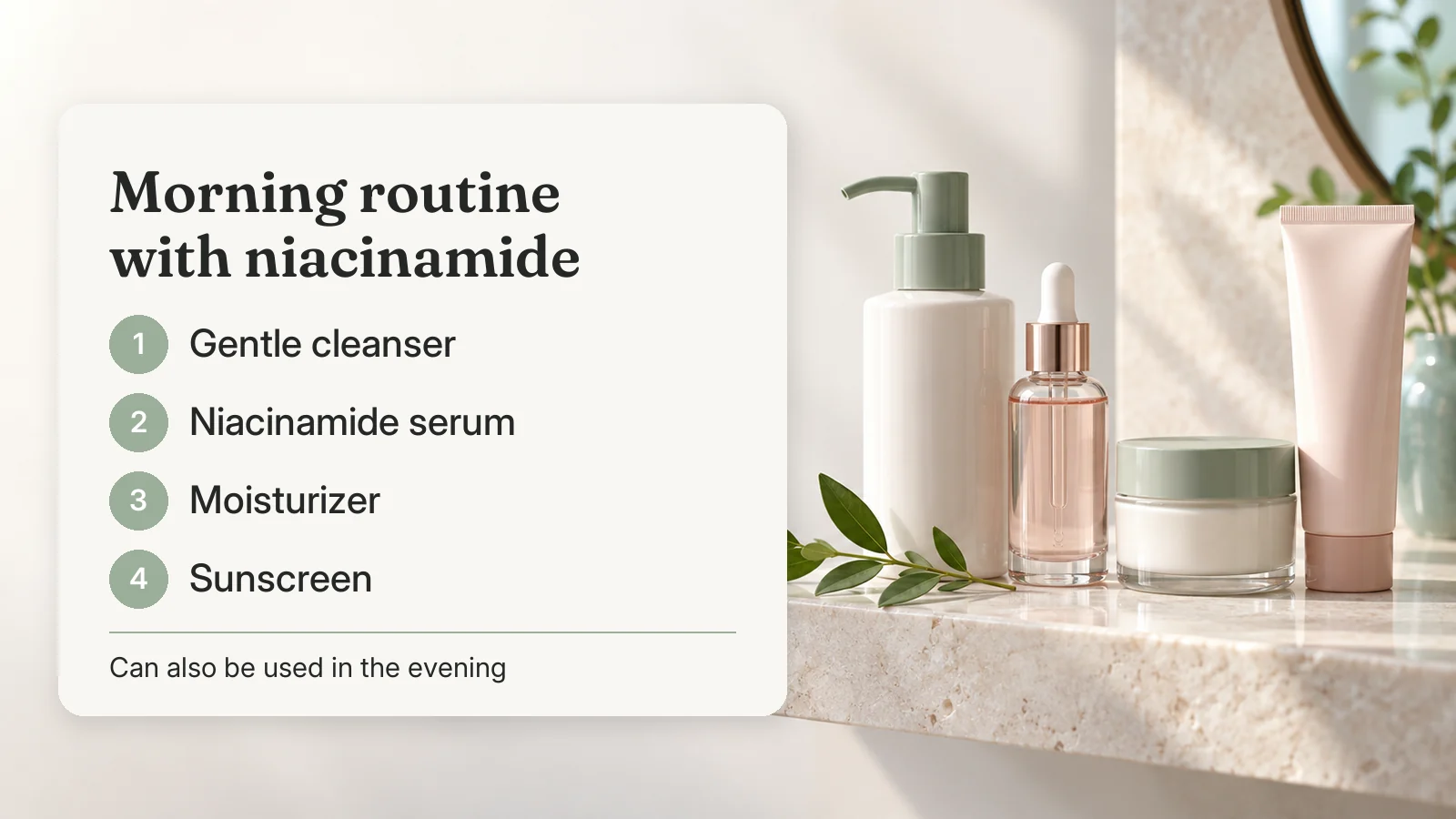
Niacinamide is one of the least demanding actives to place in a routine: it does not need a particular time of day, it does not ask for a build-up period, and it sits happily under a moisturizer. The order:
- Cleanse with a gentle cleanser.
- Apply niacinamide to clean skin — a serum is the usual format.
- Moisturizer on top.
- Sunscreen in the morning, as the last step.
In the studies it was used once or twice daily [6, 11]. In the pigmentation study, the 120-person arm used it together with sunscreen [5] — worth copying, since pigment responds to light. Daily broad-spectrum sunscreen is also the best-supported habit for skin aging: in an Australian trial with 903 adults under 55, the daily-use group showed no detectable increase in skin aging over 4.5 years, 24% less than the group who used it when they felt like it. Some data were missing [14].
Niacinamide in the morning or at night?
Either. Unlike retinol, niacinamide is not light-sensitive in a way that pushes it to the evening, and studies applied it twice daily [6]. Pick the slot you will actually keep. If you already use a vitamin C serum in the morning and retinol at night, niacinamide fits comfortably in either.
What percentage of niacinamide should you use?
Studies in our sources used 2%, 4% and 5%: 2% for sebum [9] and in the larger pigmentation arm [5], 4% in the acne studies [10, 11], 5% for pigmentation and aging signs [5, 6].
No study in our source pool compares percentages head to head, so there is no evidence here that a higher number works better. Products at 10% and above exist, but nothing in these sources supports them over 5% — and on sensitive skin, higher percentages are the more likely to sting.
What happens when you use niacinamide?
Niacinamide is generally well tolerated. The half-face study reports that skin tolerated it well [6], a review says the same [1], and the 80-person acne study saw no serious side effects [11]. There is no “purge” phase and no adjustment period of the kind retinol asks for.
Well tolerated is not the same as tolerated by everyone. On sensitive skin, patch test a new product for a few days first. If it stings every time, the concentration or the rest of the formula may not suit you.
Timelines, taken from the studies themselves:
| What | When it was measured |
|---|---|
| Sebum excretion rate | 2–4 weeks (Japan); surface sebum at 6 weeks (United States) [9] |
| Hyperpigmentation | 4 weeks [5] |
| Acne-prone skin | 8 weeks [10, 11] |
| Fine lines and elasticity | 12 weeks [6] |
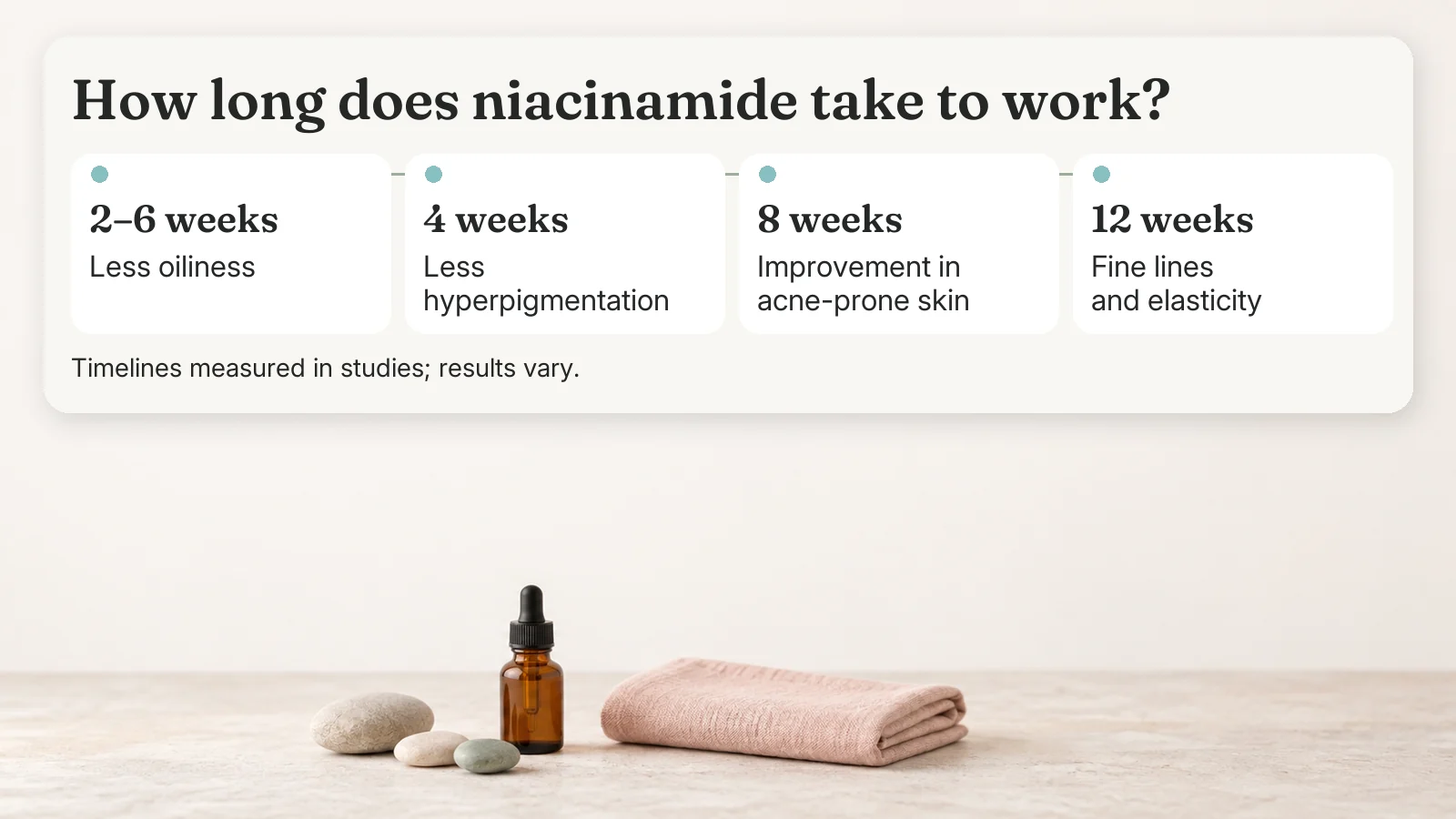
These are the points at which studies took their measurements, not promises. Your own result depends on your skin, your routine and how consistently you use the product.
What can you use niacinamide with?
Niacinamide is one of the easiest actives to combine. A quick map of where it sits alongside the other actives you are likely to own:
| With | Verdict | Why |
|---|---|---|
| Retinol | Can be combined | Niacinamide-containing regimens were well tolerated alongside retinoids [15, 4] |
| Vitamin C | Can be combined | See below |
| Sunscreen | Can be combined | Used together in the pigmentation study [5] |
| AHA/BHA | Separate the times if irritated | Practical advice |
| Moisturizer | Supportive | Practical advice |
On retinol specifically: in a 196-woman study, an 8-week cosmetic regimen built around niacinamide (with peptides and 0.3% retinyl propionate) improved wrinkle appearance significantly more than 0.02% tretinoin at week 8, and was significantly better tolerated on every measure over those 8 weeks [15]. Note the caveats: retinyl propionate rather than retinol, multi-ingredient products, manufacturer-linked authors. A separate study found a barrier-supporting moisturizer containing niacinamide, panthenol and tocopheryl acetate made the first weeks of adjusting to tretinoin easier [4] — again a vitamin blend, not niacinamide alone. Details in our guide to using retinol and niacinamide together.
Can you use niacinamide and vitamin C together?
Yes, and the worry you may have read about comes from a laboratory study, not from skin. In oil-in-water cream formulations under UV light, nicotinamide (and riboflavin) sped up the light-driven breakdown of ascorbic acid, while alpha-tocopherol stabilized it [16]. That is a chemical interaction inside the same cream — it is not a direct result for two products applied separately. In clinical studies niacinamide has been used alongside other actives without trouble [1]. If your skin gets irritated, simply put them at different times of day.
Who should be careful with niacinamide?
Most people can use niacinamide without special precautions, and it is one of the gentler actives on the shelf. There are still three situations worth naming, and two of them are less about the ingredient than about what your skin is actually dealing with:
- Sensitive skin: patch test first, and stop if a product stings consistently.
- Pregnancy and breastfeeding: our sources contain no niacinamide-specific pregnancy study. Most skincare products act locally and reach very low levels in the body, with hydroquinone and tretinoin as the noted exceptions [17]. Ask your doctor before adding anything new.
- Acne, rosacea, melasma: these are medical conditions. The evidence for niacinamide in acne is low quality [12], and it has no strong recommendation in melasma [8]. See a dermatologist.
Frequently asked questions
Does niacinamide shrink pores?
We cannot say that it does. No study in our sources measured pore size, and the evidence on oiliness — the thing usually linked to pore appearance — is limited and inconsistent [9].
Can you use niacinamide every day?
Yes. In the studies it was applied twice daily for 12 weeks [6]; it is not an ingredient you build up to.
Does niacinamide help post-acne marks?
For post-inflammatory hyperpigmentation, niacinamide is among the topical agents with high-quality studies, although retinoids, hydroxy acids and broad-spectrum sunscreen were best supported [7]. Pitted scars are a different problem and do not respond to serums.
Is 10% niacinamide more effective than 5%?
There is no comparative study in our sources to answer that. The studies here used 2% to 5%, and all the reported benefits come from that range.
Can you use niacinamide during pregnancy?
There is no niacinamide-specific pregnancy study in our sources. Most skincare products act locally and reach very low levels in the body [17]; make the decision with your doctor.
Can you apply niacinamide and retinol at the same time?
Yes. Niacinamide-containing regimens were well tolerated alongside retinoids [15, 4]. Order and routine examples: using retinol and niacinamide together.
References
- Boo YC. Mechanistic Basis and Clinical Evidence for the Applications of Nicotinamide (Niacinamide) to Control Skin Aging and Pigmentation. Antioxidants (Basel). 2021;10(8):1315. PubMed · DOI
- Gehring W. Nicotinic acid/niacinamide and the skin. J Cosmet Dermatol. 2004;3(2):88-93. PubMed · DOI
- Tanno O, Ota Y, Kitamura N, Katsube T, Inoue S. Nicotinamide increases biosynthesis of ceramides as well as other stratum corneum lipids to improve the epidermal permeability barrier. Br J Dermatol. 2000;143(3):524-531. PubMed · DOI
- Draelos ZD, Ertel KD, Berge CA. Facilitating facial retinization through barrier improvement. Cutis. 2006;78(4):275-281. PubMed
- Hakozaki T, Minwalla L, Zhuang J, et al. The effect of niacinamide on reducing cutaneous pigmentation and suppression of melanosome transfer. Br J Dermatol. 2002;147(1):20-31. PubMed · DOI
- Bissett DL, Oblong JE, Berge CA. Niacinamide: A B vitamin that improves aging facial skin appearance. Dermatol Surg. 2005;31(7 Pt 2):860-865. PubMed · DOI
- Tan MG, Kim WB, Jo CE, Nabieva K, Kirshen C, Ortiz AE. Topical treatment for postinflammatory hyperpigmentation: a systematic review. J Dermatolog Treat. 2022;33(5):2518-2526. PubMed · DOI
- Austin E, Nguyen JK, Jagdeo J. Topical Treatments for Melasma: A Systematic Review of Randomized Controlled Trials. J Drugs Dermatol. 2019;18(11):1156-1171. PubMed
- Draelos ZD, Matsubara A, Smiles K. The effect of 2% niacinamide on facial sebum production. J Cosmet Laser Ther. 2006;8(2):96-101. PubMed · DOI
- Shalita AR, Smith JG, Parish LC, Sofman MS, Chalker DK. Topical nicotinamide compared with clindamycin gel in the treatment of inflammatory acne vulgaris. Int J Dermatol. 1995;34(6):434-437. PubMed · DOI
- Khodaeiani E, Fouladi RF, Amirnia M, Saeidi M, Karimi ER. Topical 4% nicotinamide vs. 1% clindamycin in moderate inflammatory acne vulgaris. Int J Dermatol. 2013;52(8):999-1004. PubMed · DOI
- Liu H, Yu H, Xia J, et al. Topical azelaic acid, salicylic acid, nicotinamide, sulphur, zinc and fruit acid (alpha-hydroxy acid) for acne. Cochrane Database Syst Rev. 2020;5(5):CD011368. PubMed · DOI
- Draelos ZD, Ertel K, Berge C. Niacinamide-containing facial moisturizer improves skin barrier and benefits subjects with rosacea. Cutis. 2005;76(2):135-141. PubMed
- Hughes MC, Williams GM, Baker P, Green AC. Sunscreen and prevention of skin aging: a randomized trial. Ann Intern Med. 2013;158(11):781-790. PubMed · DOI
- Fu JJ, Hillebrand GG, Raleigh P, et al. A randomized, controlled comparative study of the wrinkle reduction benefits of a cosmetic niacinamide/peptide/retinyl propionate product regimen vs. a prescription 0.02% tretinoin product regimen. Br J Dermatol. 2010;162(3):647-654. PubMed · DOI
- Ahmad I, Sheraz MA, Ahmed S, Bano R, Vaid FH. Photochemical interaction of ascorbic acid with riboflavin, nicotinamide and alpha-tocopherol in cream formulations. Int J Cosmet Sci. 2012;34(2):123-131. PubMed · DOI
- Bozzo P, Chua-Gocheco A, Einarson A. Safety of skin care products during pregnancy. Can Fam Physician. 2011;57(6):665-667. PubMed