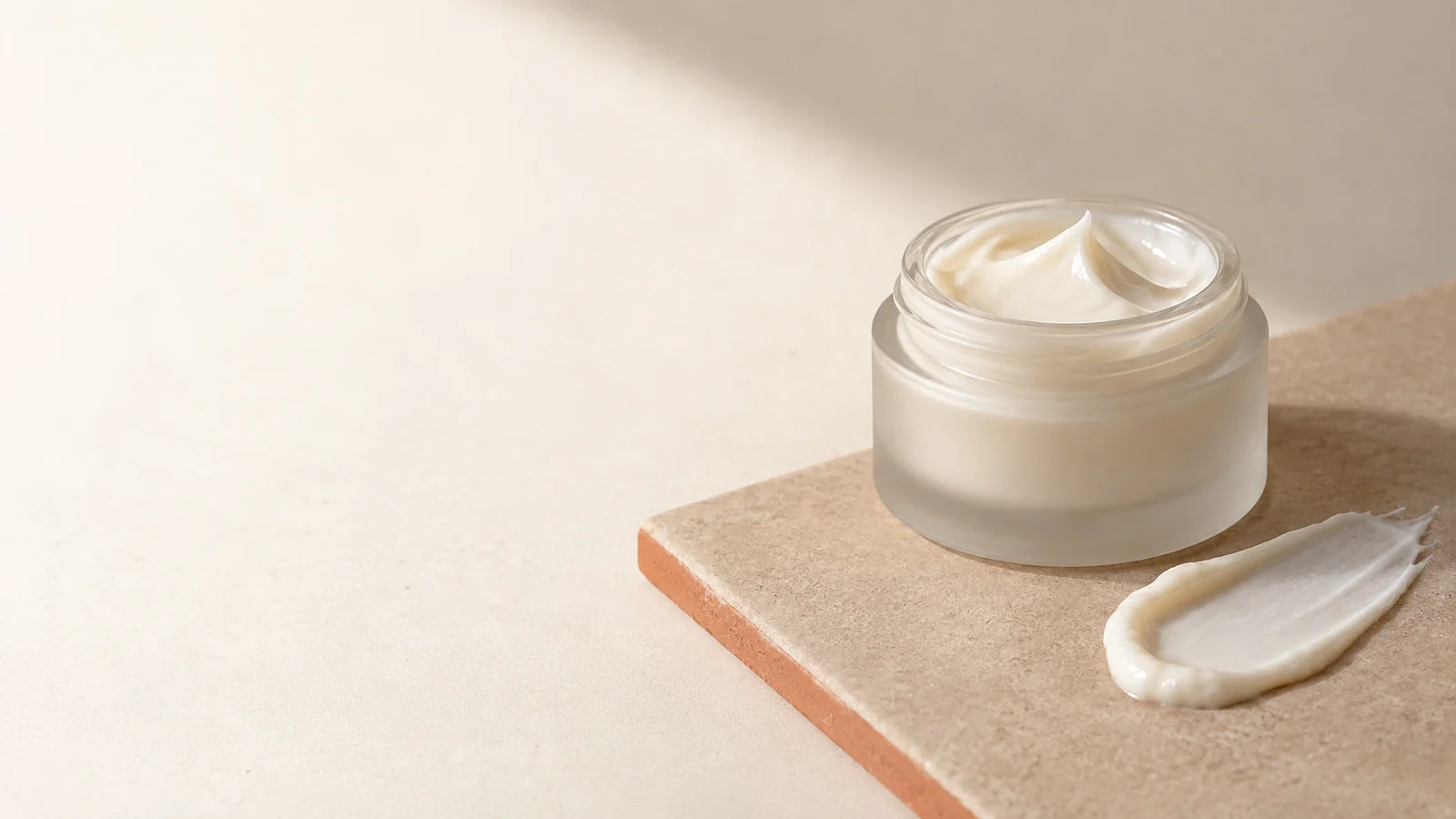
What are ceramides? They are fats (lipids) that form the main part of the lipid layers between cells in your skin’s outermost layer. With cholesterol and free fatty acids, they help limit water loss. [1] Ceramide creams improved hydration in small trials, but studies comparing them with other moisturizers found small or no differences. [2, 3]
In this article
What are ceramides?
Ceramides are a structurally varied group of sphingolipids, a type of fat, found in the stratum corneum, the outermost layer of your skin. They are the main lipid in the layered sheets that fill the spaces between skin cells. Together with cholesterol and free fatty acids, in roughly equal molar amounts, they form the skin’s water barrier. [1]
Flattened cells called corneocytes sit in this lipid matrix alongside natural moisturizing factor, enzymes and antimicrobial peptides. Together they limit water loss and keep out harmful substances, and how well they do so varies with body site, age and skin type. [4] The skin barrier guide explains the rest of that system and what tends to strain it.
What types of ceramides are there?
Ceramides are sorted into classes by chemical structure. A 1991 study measured six ceramide fractions in the skin. [5] Newer studies and many labels use letter codes such as ceramide NP and ceramide NS, [6] while older papers number them, as in ceramides 1, 3 and 6-II. [2]
Pseudo-ceramides, covered below, are lab-made look-alikes. The guide to reading an ingredient list explains what a name’s position on a label can and cannot tell you.
Do ceramide levels drop with age?
In a 1991 study of 65 healthy people, total ceramides in forearm skin fell significantly with age. People with atopic dermatitis had clearly lower levels than healthy people of the same age, in affected skin and also in unaffected skin; ceramide 1 showed the largest drop. [5]
That is an association from forearm skin and an older measuring method, not proof of cause. Linking skin disorders to lipid changes is hard because so many factors are involved, [1] and the mechanisms behind dry, flaky and sensitive skin are not fully understood. [4] Low ceramides are likely one piece of dryness, not the whole story.
What do ceramides do for skin?
In your skin, ceramides help build the barrier that holds water in. In products, the evidence is narrower: small controlled trials link specific ceramide-containing formulas with higher hydration and lower transepidermal water loss (the water that evaporates through the skin’s surface). Each tested formula contained other ingredients, so the ceramide’s own share cannot be separated. [2, 7]
Ceramides for skin that feels dry
The clearest trial involved 24 people with mild to moderate xerosis (dry skin), 91.7% of them women, with an average age of 54.83. In a double-blind design, one calf received a cream with ceramides 1, 3 and 6-II and the other a hydrophilic cream. After a single application, the ceramide side showed better hydration, water loss and skin pH for up to 24 hours. [2]
After 28 days of twice-daily use, hydration, barrier function and pH improved more on the ceramide side at every measurement, and hemoglobin index, wrinkle and texture measures fell. Seven days after stopping, that side was still ahead. The limits are real: 24 people, calf skin, one formula whose other ingredients may have contributed, and no funding details in the abstract. [2]
What are pseudo-ceramides?
Pseudo-ceramides are synthetic molecules built to resemble ceramides. In a randomized trial, people who described their skin as dry and sensitive, and whose measurements showed raised water loss, used a pseudo-ceramide spray (33 people) or a spray without it (19 people) twice a day for four weeks. [6]
Water content, water loss, corneocyte area and scaling improved in the pseudo-ceramide group, while the control group did not change. The skin’s ratio of two ceramide types (NP to NS) rose in step with the amount applied. However, the authors work for the company that developed the molecule, the study was single-blind, the groups were small and uneven, and the abstract gives no direct comparison between groups. [6]
Can ceramides help during acne treatment?
In a double-blind study, a prescription acne treatment raised water loss, a sign of barrier disruption. People who added a ceramide-containing foaming cleanser and lotion kept water loss significantly lower than a group using a basic foaming cleanser at every time point, and improved from baseline by week 12; dryness scores were lower too. [7]
The abstract does not report how many people took part, and a whole routine was tested. The acne guide covers the broader picture; your dermatologist can say which products fit your treatment.
Does the 3:1:1 ratio matter?
Some products promise a “3:1:1” ratio of ceramides, cholesterol and fatty acids. The idea comes from mouse experiments on damaged skin. Applying only one or two of these lipids delayed barrier repair, an equimolar mix allowed normal repair, and raising any one of them up to three times sped repair further; early results in damaged human skin were similar. [8]
Which lipid dominates matters too. In older mice, a cholesterol-dominant 3:1:1:1 mix sped repair, while a fatty-acid-dominant mix slowed it. The cholesterol-dominant mix also sped repair at 6 hours in the tape-stripped skin of six people aged 80 ± 5. [9] None of our sources shows that a ratio printed on a label gives the same effect in a finished product.
Are ceramide creams better than other moisturizers?
Not clearly. The head-to-head trials were done in people with atopic dermatitis (eczema), and they found small or no differences between ceramide creams and other moisturizers. A large review found no reliable evidence that any one moisturizer beats another. That makes the whole formula, and how well you tolerate it, more important than a single ingredient. [3, 10, 11]
A 2023 meta-analysis pooled five small studies of 15 to 38 people each. Water loss did not differ significantly between ceramide moisturizers and the others (mean difference −3.56; 95% CI −8.63 to 1.52). Eczema severity scores (SCORAD) improved slightly more with ceramides, by about one point (mean difference −0.98), a gap whose clinical importance is unclear. Comparison products ranged from aloe vera to petrolatum. [3]
A double-blind trial in 53 children with mild to moderate atopic dermatitis compared a ceramide-based and a paraffin-based moisturizer, each applied twice daily. After three months, severity scores had fallen by 22.1 and 21.4 points (p = 0.37), and water loss, quality of life and corticosteroid needs were similar. The study could not statistically prove the two were equivalent. [10]
A Cochrane review of 77 trials with 6,603 participants found that moisturizers in general reduced eczema severity compared with control treatments, but not that one type outperforms another. [11] Eczema needs a dermatologist’s care; a moisturizer supports that care rather than replacing it. The moisturizer guide explains how to compare formulas.
Can you help your skin make its own ceramides?
Possibly, but the evidence is early. Instead of applying finished ceramides, one strategy is to supply precursors, building blocks the skin can turn into its own lipids. A review describes this as an alternative approach, and in mouse experiments glucosylceramides and sphingomyelin could stand in for ceramides. [1, 8]
Niacinamide is the best-studied example. In cultured human skin cells, it raised ceramide synthesis 4.1 to 5.5 times depending on the dose, along with free fatty acids and cholesterol. Applied to dry skin, it increased ceramides and free fatty acids in the stratum corneum and reduced water loss, though most of the work was in cell culture. [12] The niacinamide guide covers its other uses.
A review also notes that acidic moisturizers may support enzyme activity and ceramide production. [13] We found no independent clinical study showing that products marketed with “ceramide precursors” work better than other moisturizers.
How do you use ceramides in your routine?
In practice, ceramides usually come in a moisturizer, so they go on after cleansing and any serum, and before sunscreen in the morning. The trials in this guide applied their products twice a day, which is study information rather than a rule. [2, 6, 10]
A practical way to start:
- Pick one product. A daily cream or lotion is enough; a separate ceramide serum is optional.
- Apply to clean skin, morning, evening or both, following the label.
- Change one thing at a time, so reactions are easier to trace.
- Judge it over weeks, not after one day.
- Keep sun protection separate. A ceramide cream is not a sunscreen.
What pairs well with ceramides?
This is practical guidance; no study here tested specific pairings. Many formulas already combine ceramides with cholesterol and fatty acids, with humectants such as glycerin or hyaluronic acid, or with emollients such as squalane. The hyaluronic acid guide, squalane guide and panthenol guide explain what each adds.
If you use a retinoid or an exfoliating acid, a plain ceramide moisturizer can be a sensible companion, but it does not make an irritating routine safe to push harder. The retinol guide explains how to introduce a retinoid gradually.
If niacinamide is also part of your routine, the retinol and niacinamide guide explains application order and the limits of the evidence.
What should you expect?
Expect gradual comfort rather than a transformation. In the trials, one application changed measurements for up to 24 hours, and changes built over four weeks, 28 days and 12 weeks. Those were study schedules for calves, a spray and an acne routine, not a timeline for your face. [2, 6, 7]
| Period | What studies measured | What you can watch |
|---|---|---|
| First day | Hydration and water loss up to 24 hours after one application | Texture, stinging, comfort |
| Four weeks | Water content and scaling with a pseudo-ceramide spray | Tightness after washing |
| 28 days | Hydration, barrier and pH on dry calf skin | Rough or flaky patches |
| 12 weeks | Water loss during a drying acne treatment | Dryness from other products |
If irritation builds or dryness has not eased after several weeks, reconsider both the product and your cleansing habits.
Are ceramides safe?
An expert panel that reviews cosmetic ingredients concluded that ceramides are safe in cosmetics at the concentrations and uses it described. Its summary gives few details on irritation and allergy testing, and a safety verdict does not rule out a personal reaction. [14]
If a ceramide cream stings, the ceramide may not be the cause. Moisturizers differ widely, emulsifiers can weaken the barrier, and ingredients considered inactive can have larger effects than expected. [15] In practice, try a new product on a small area first, and stop if redness, itching or swelling appears.
Our sources include no studies of ceramide products in pregnancy or breastfeeding. Check the full ingredient list with your clinician rather than relying on the word “ceramide” alone.
Frequently asked questions
What are ceramides made of?
Ceramides consist of a sphingoid base attached to a fatty acid by an amide bond. [3] Those two building blocks form the ceramide molecule. A ceramide cream contains a complete mixture of ingredients, so findings about a tested moisturizer apply to that formula and cannot be attributed to its ceramides alone. [1, 3]
What are the main ceramide benefits?
In small trials, ceramide-containing creams increased hydration and reduced water loss on dry skin, and a ceramide routine kept water loss lower during a drying acne treatment. [2, 7] Wrinkle and texture measures did fall in one trial on dry calf skin, but that is a single, small study of one formula.
Are ceramides good for every skin type?
No study in our sources compared ceramides across skin types. The trials involved dry skin, self-described dry and sensitive skin, eczema and acne treatment. In practice, oily or acne-prone skin may prefer a light lotion or gel, while very dry skin may like a richer cream. Ceramides are part of every skin’s barrier; the texture around them is what varies.
Do oral ceramides work for skin?
Supplements are outside the scope of this guide. For context, a meta-analysis in healthy adults found that oral ceramides gave a statistically significant rise in skin hydration compared with placebo. [16] The effect was small, results varied widely between studies and some carried a risk of bias, so it is neither proof nor disproof. Ask your doctor before starting any supplement.
What should you look for in skin care products with ceramides?
Look at the whole formula rather than the word on the front. A texture you will use daily, few likely irritants, such as fragrance if your skin reacts easily, and clear directions matter more than a ratio claim. Labels rarely say how much ceramide a product contains, and no study in our sources sets an ideal amount.
References
- Coderch L, López O, de la Maza A, Parra JL. Ceramides and skin function. Am J Clin Dermatol. 2003;4(2):107-129. PubMed · DOI
- Lueangarun S, Tragulplaingam P, Sugkraroek S, Tempark T. The 24-hr, 28-day, and 7-day post-moisturizing efficacy of ceramides 1, 3, 6-II containing moisturizing cream compared with hydrophilic cream on skin dryness and barrier disruption in senile xerosis treatment. Dermatol Ther. 2019;32(6):e13090. PubMed · DOI
- Nugroho WT, Sawitri S, Astindari A, et al. The Efficacy of Moisturisers Containing Ceramide Compared with Other Moisturisers in the Management of Atopic Dermatitis: A Systematic Literature Review and Meta-Analysis. Indian J Dermatol. 2023;68(1):53-58. PubMed · DOI
- Fluhr JW, Moore DJ, Lane ME, Lachmann N, Rawlings AV. Epidermal barrier function in dry, flaky and sensitive skin: A narrative review. J Eur Acad Dermatol Venereol. 2024;38(5):812-820. PubMed · DOI
- Imokawa G, Abe A, Jin K, Higaki Y, Kawashima M, Hidano A. Decreased level of ceramides in stratum corneum of atopic dermatitis: an etiologic factor in atopic dry skin? J Invest Dermatol. 1991;96(4):523-526. PubMed · DOI
- Akahane T, Watanabe D, Shimizu E, Tanaka K, Kaizu K. Efficacy of Pseudo-Ceramide Absorption Into the Stratum Corneum and Effects on Transepidermal Water Loss and the Ceramide Profile: A Randomized Controlled Trial. J Cosmet Dermatol. 2025;24(1):e16655. PubMed · DOI
- Draelos ZD, Baalbaki N, Colon G, Dreno B. Ceramide-Containing Adjunctive Skin Care for Skin Barrier Restoration During Acne Vulgaris Treatment. J Drugs Dermatol. 2023;22(6):554-558. PubMed · DOI
- Man MQ M, Feingold KR, Thornfeldt CR, Elias PM. Optimization of physiological lipid mixtures for barrier repair. J Invest Dermatol. 1996;106(5):1096-1101. PubMed · DOI
- Zettersten EM, Ghadially R, Feingold KR, Crumrine D, Elias PM. Optimal ratios of topical stratum corneum lipids improve barrier recovery in chronologically aged skin. J Am Acad Dermatol. 1997;37(3 Pt 1):403-408. PubMed · DOI
- Gupta S, Ramam M, Sharma VK, Sethuraman G, Pandey RM, Bhari N. Evaluation of a paraffin-based moisturizer compared to a ceramide-based moisturizer in children with atopic dermatitis: A double-blind, randomized controlled trial. Pediatr Dermatol. 2023;40(4):627-632. PubMed · DOI
- van Zuuren EJ, Fedorowicz Z, Christensen R, Lavrijsen A, Arents BWM. Emollients and moisturisers for eczema. Cochrane Database Syst Rev. 2017;2(2):CD012119. PubMed · DOI
- Tanno O, Ota Y, Kitamura N, Katsube T, Inoue S. Nicotinamide increases biosynthesis of ceramides as well as other stratum corneum lipids to improve the epidermal permeability barrier. Br J Dermatol. 2000;143(3):524-531. PubMed · DOI
- Rajkumar J, Chandan N, Lio P, Shi V. The Skin Barrier and Moisturization: Function, Disruption, and Mechanisms of Repair. Skin Pharmacol Physiol. 2023;36(4):174-185. PubMed · DOI
- Burnett CL, Boyer IJ, Bergfeld WF, et al. Safety Assessment of Ceramides as Used in Cosmetics. Int J Toxicol. 2020;39(3_suppl):5S-25S. PubMed · DOI
- Lodén M. Role of topical emollients and moisturizers in the treatment of dry skin barrier disorders. Am J Clin Dermatol. 2003;4(11):771-788. PubMed · DOI
- Sun Q, Wu J, Qian G, Cheng H. Effectiveness of Dietary Supplement for Skin Moisturizing in Healthy Adults: A Systematic Review and Meta-Analysis of Randomized Controlled Trials. Front Nutr. 2022;9:895192. PubMed · DOI