Yes, you can use them together. In studies that combined niacinamide with a retinoid, the combinations improved the look of wrinkles and were better tolerated than prescription tretinoin. Practical order: niacinamide first, then retinol; or niacinamide in the morning and retinol at night.
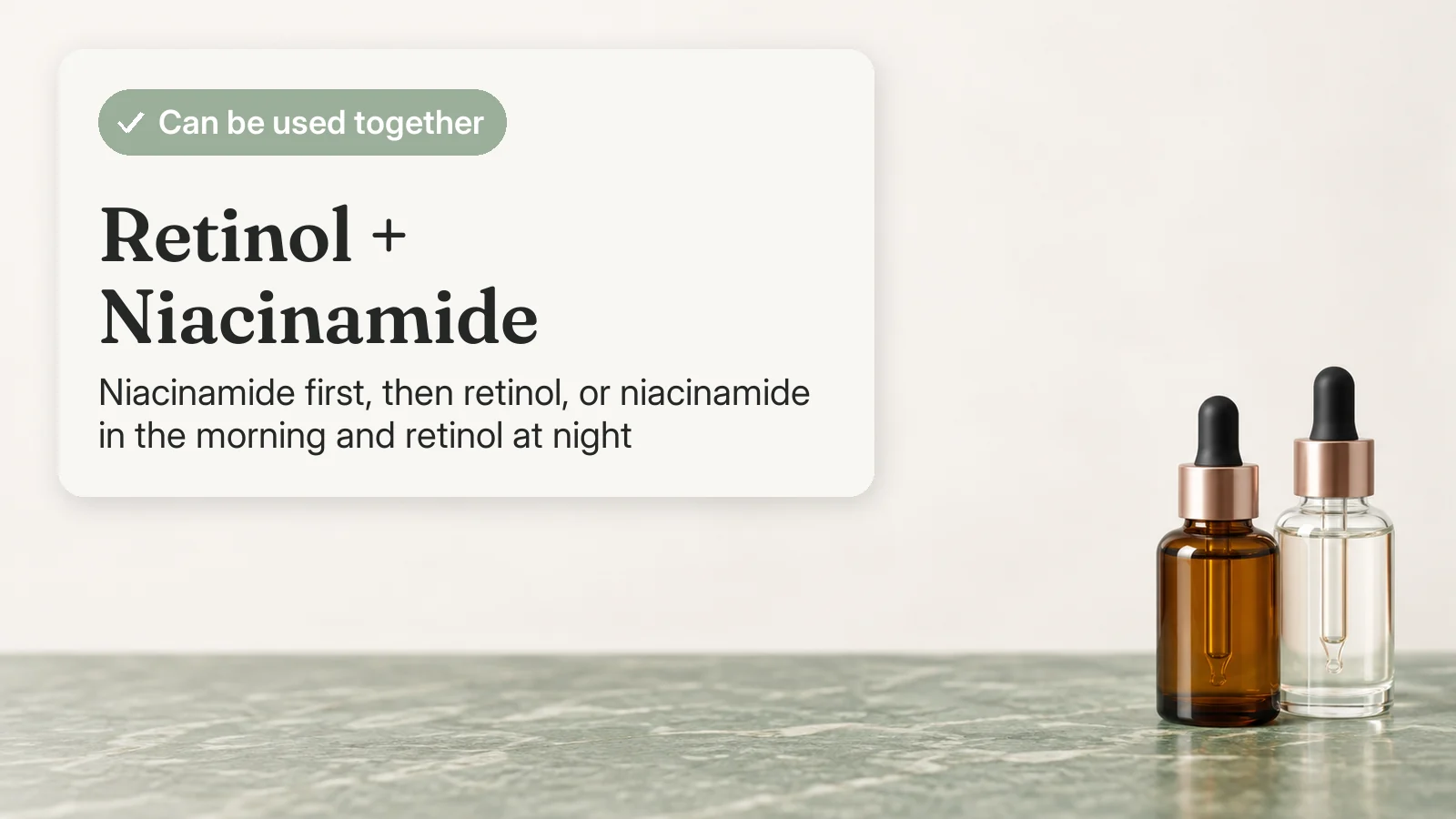
Can you use retinol and niacinamide together? Yes. Cosmetic products containing niacinamide alongside a retinoid (a vitamin A derivative) improved the look of wrinkles in controlled studies and were better tolerated than prescription tretinoin (retinoic acid) [1, 2]. No study in our sources tests retinol and niacinamide on their own as a pair. In practice, retinol goes on in the evening, after niacinamide.
In this article
Can you use retinol and niacinamide together?
Yes. In controlled studies that put niacinamide and a retinoid in the same routine, the combinations improved the look of wrinkles and were better tolerated than prescription tretinoin [1, 2]. The important caveat comes first: those studies used retinyl propionate or tretinoin rather than retinol, and the products contained other active ingredients alongside niacinamide.
- 196 women, 8 weeks: In a randomized study, three cosmetic products containing niacinamide (one of them with 0.3% retinyl propionate) were compared with 0.02% tretinoin plus sunscreen. The cosmetic regimen improved wrinkle appearance significantly more at week 8 and was significantly better tolerated on every measure over those 8 weeks; at week 24 the results were similar, in subgroups of 25 [1].
- Three-ingredient formula, 16 weeks: In a double-blind study (neither participant nor researcher knew which product was which) in women aged 47 to 66, a formula with retinyl propionate, 4-hexylresorcinol and niacinamide improved the appearance of sun-driven aging, crow’s feet, wrinkles and pores as much as 0.02% tretinoin, with less irritation [2].
- Barrier moisturizer: Women applied a moisturizer containing niacinamide, panthenol and tocopheryl acetate to one half of the face and a similar vitamin-free moisturizer to the other; from week two, prescription tretinoin was added to the whole face. The vitamin-containing moisturizer was reported to ease the first phase of adjusting to tretinoin and to improve the response [3].
- Eye area, 4 weeks: In two half-face studies (42 and 35 women), niacinamide products — one of which also contained retinyl propionate — significantly improved periorbital roughness compared with the untreated side [4].
The limits: none of these studies used retinol; in multi-ingredient products you cannot separate which ingredient did what; and most were manufacturer-linked. Because no study in our sources tests retinol and niacinamide alone as a pair, we rate the evidence Moderate rather than Strong. How retinol itself is used is covered in our retinol guide.
What is the benefit of using them together?
The two ingredients work on different things, which is why pairing them is popular in the first place.
| Retinol | Niacinamide | |
|---|---|---|
| Main effect | Fine lines and hyperpigmentation [5] | Barrier lipids [6], pigmentation [7] |
| Tolerance | Can irritate, especially early on [8] | Generally well tolerated |
| Timing | Evening | Morning or evening |
On retinol: a network meta-analysis of 23 randomized controlled trials and 3,905 participants found that isotretinoin, retinol and tretinoin significantly improved fine wrinkles, with tretinoin and retinol standing out for hyperpigmentation. The authors note limited ethnic diversity, possible commercial bias and differences in assessment methods [5]. Retinoids also irritate: burning, flaking and dermatitis limit their use, although retinaldehyde and retinol are markedly less irritating than tretinoin and tazarotene [8].
On niacinamide: in cultured human keratinocytes it raised ceramide synthesis 4.1- to 5.5-fold and, applied to dry skin, reduced water loss [6]. It also cut melanosome transfer by 35% to 68% in a cell model, with hyperpigmentation significantly reduced at 4 weeks in the clinical arms [7].
The rationale for combining them is not just additive. A systematic review of topical retinoids notes that retinoids are chemically unstable and often irritating, and that new derivatives, nano carriers and combinations with vitamins, soothing agents and antioxidants are being developed specifically to reduce those problems [9]. Niacinamide is one of the vitamins in that picture. What our sources do not contain is a study isolating how much of the tolerability benefit comes from niacinamide itself.
In which order do you apply retinol and niacinamide?
No study in our sources compares the order. Anyone telling you there is one correct sequence is going beyond the evidence. What we can offer is a practical rule used across skincare: apply the lighter, water-based product first, and let the richer one go on top.
Three workable options:
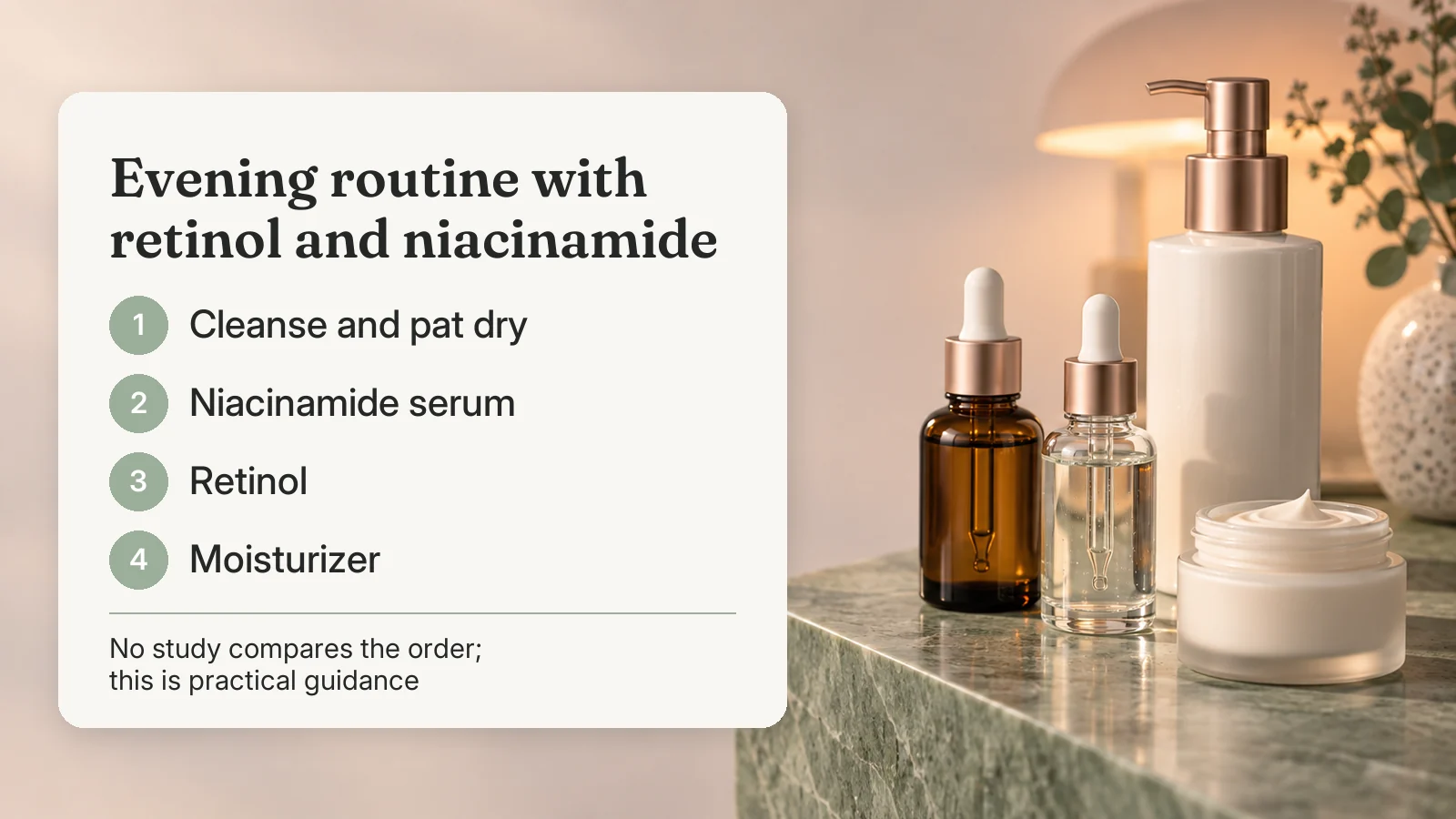
- Same evening: cleanser → niacinamide → retinol → moisturizer.
- Split the day: niacinamide in the morning, retinol at night. The simplest option if your skin is easily irritated.
- One product containing both, which removes the question entirely.
There is also no evidence in our sources for the popular advice to wait ten or twenty minutes between layers. Once a product has settled into the skin, move on.
Example routines
| Beginner | Experienced | |
|---|---|---|
| Morning | Cleanser → niacinamide → moisturizer → sunscreen | Cleanser → niacinamide → moisturizer → sunscreen |
| Evening | Retinol 2–3 nights a week, moisturizer after; niacinamide and moisturizer on the other nights | Cleanser → niacinamide → retinol → moisturizer |
If you are starting out, increasing the retinol dose gradually is the approach that was actually tested: in a 12-week study, 45 women used escalating strengths (retinol 0.25% → 0.5% → 1%, or tretinoin 0.025% → 0.05% → 0.1%) together with a moisturizer. Effectiveness was similar in both groups, and the retinol group showed a marked improvement in dryness [10]. Small sample, specially made formulas.
Do not drop the morning sunscreen. In an Australian trial with 903 adults under 55, the group using broad-spectrum sunscreen every day showed no detectable increase in skin aging over 4.5 years — 24% less than the group who used it when they felt like it. Some data were missing [11].
What happens when you use them?
Almost everything you will feel in the first weeks comes from the retinol side. Dryness, flaking and redness are the typical early reactions [8]; in a 12-week study comparing 0.3% and 0.5% retinol serums in 37 volunteers, side effects were mostly mild to moderate irritation and were more frequent and more intense on the 0.5% side [12]. Niacinamide is generally well tolerated [13, 14], which is a large part of why it is a comfortable partner here.
What about “purging” — the idea that retinoids make breakouts worse before they get better? A review looking for evidence found no primary clinical study data supporting that common belief, and suggests that worsening in the first week or two may be part of the natural course of the condition in some people [15].
Timelines from the studies:
| What | When it was measured |
|---|---|
| Periorbital roughness, hyperpigmentation | 4 weeks [4, 7] |
| Wrinkle appearance (cosmetic regimen) | 8 weeks [1] |
| Fine lines, elasticity, wrinkles | 12 weeks [13, 16] |
Who should be careful?
The caution here is about retinol, not the pairing.
- Sensitive skin, rosacea or eczema: irritation reactions are what limit retinoid use [8]. Start with retinol once or twice a week, or use option 2 above, and ask a dermatologist first.
- Pregnancy and breastfeeding: retinol is not recommended. A meta-analysis covering 654 exposed and 1,375 unexposed pregnancies found no significant increase in major congenital malformations or miscarriage after first-trimester exposure to a topical retinoid, but the authors say the statistical power is not enough to justify use in pregnancy [17]. The studies mostly concern prescription retinoids. Talk to your doctor.
- Anyone on a prescription retinoid: do not add a cosmetic retinol on top. Ask the doctor who prescribed it.
Common myth: does niacinamide cancel out retinol?
No study in our sources supports this. What the sources show is the opposite direction: combinations containing niacinamide alongside a retinoid were effective and, in two studies, better tolerated than prescription tretinoin [1, 2].
A similar warning circulates about niacinamide and vitamin C, and it has the same shape — a claim about ingredients neutralizing each other that the clinical evidence does not carry. We make no claim about where either idea started.
Frequently asked questions
Should I apply retinol and niacinamide at the same time?
You can, and you do not have to. Either put niacinamide on first and retinol on top in the same evening, or split them between morning and night. No study in our sources compares the two approaches.
Do I need to wait in between?
There is no evidence in our sources for a waiting period. Once a product has settled, apply the next one.
Can I use retinol in the morning and niacinamide at night?
You can, but retinol is better suited to the evening: retinoids are chemically unstable and very sensitive to light, oxygen and heat [9]. Niacinamide works either way.
Do retinol and niacinamide help acne-prone skin?
The evidence specific to this pair is limited, and acne is a skin disease rather than a cosmetic concern. Guidelines support topical retinoids as a core part of acne treatment, but those are largely prescription retinoids [15]. See a dermatologist.
Can you use them together around the eyes?
The eye-area study used niacinamide products — one containing retinyl propionate — twice daily for 4 weeks and saw improvement in periorbital roughness [4]. Use a small amount, keep away from the lash line, and stop if the area gets irritated.
Can you use them during pregnancy?
Retinol is not recommended in pregnancy; the evidence is not strong enough to justify it [17]. Niacinamide has no pregnancy-specific study in our sources. Talk to your doctor.
References
- Fu JJ, Hillebrand GG, Raleigh P, et al. A randomized, controlled comparative study of the wrinkle reduction benefits of a cosmetic niacinamide/peptide/retinyl propionate product regimen vs. a prescription 0.02% tretinoin product regimen. Br J Dermatol. 2010;162(3):647-654. PubMed · DOI
- Davis A, Furtak A, Paterson S, et al. Topical application of retinyl propionate, 4 hexyl resorcinol, and niacinamide reverses molecular and clinical features of ageing. Int J Cosmet Sci. 2024;46(5):761-774. PubMed · DOI
- Draelos ZD, Ertel KD, Berge CA. Facilitating facial retinization through barrier improvement. Cutis. 2006;78(4):275-281. PubMed
- Kaczvinsky JR, Griffiths CE, Schnicker MS, Li J. Efficacy of anti-aging products for periorbital wrinkles as measured by 3-D imaging. J Cosmet Dermatol. 2009;8(3):228-233. PubMed · DOI
- Lin L, Chen X, Liu C, et al. Comparative efficacy of topical interventions for facial photoaging: a network meta-analysis. Sci Rep. 2025;15(1):26889. PubMed · DOI
- Tanno O, Ota Y, Kitamura N, Katsube T, Inoue S. Nicotinamide increases biosynthesis of ceramides as well as other stratum corneum lipids to improve the epidermal permeability barrier. Br J Dermatol. 2000;143(3):524-531. PubMed · DOI
- Hakozaki T, Minwalla L, Zhuang J, et al. The effect of niacinamide on reducing cutaneous pigmentation and suppression of melanosome transfer. Br J Dermatol. 2002;147(1):20-31. PubMed · DOI
- Mukherjee S, Date A, Patravale V, Korting HC, Roeder A, Weindl G. Retinoids in the treatment of skin aging: an overview of clinical efficacy and safety. Clin Interv Aging. 2006;1(4):327-348. PubMed · DOI
- Zhong J, Zhao N, Song Q, Du Z, Shu P. Topical retinoids: Novel derivatives, nano lipid-based carriers, and combinations to improve chemical instability and skin irritation. J Cosmet Dermatol. 2024;23(10):3102-3115. PubMed · DOI
- Draelos ZD, Peterson RS. A Double-Blind, Comparative Clinical Study of Newly Formulated Retinol Serums vs Tretinoin Cream in Escalating Doses: A Method for Rapid Retinization With Minimized Irritation. J Drugs Dermatol. 2020;19(6):625-631. PubMed · DOI
- Hughes MC, Williams GM, Baker P, Green AC. Sunscreen and prevention of skin aging: a randomized trial. Ann Intern Med. 2013;158(11):781-790. PubMed · DOI
- Zasada M, Budzisz E, Erkiert-Polguj A. A Clinical Anti-Ageing Comparative Study of 0.3 and 0.5% Retinol Serums: A Clinically Controlled Trial. Skin Pharmacol Physiol. 2020;33(2):102-116. PubMed · DOI
- Bissett DL, Oblong JE, Berge CA. Niacinamide: A B vitamin that improves aging facial skin appearance. Dermatol Surg. 2005;31(7 Pt 2):860-865. PubMed · DOI
- Boo YC. Mechanistic Basis and Clinical Evidence for the Applications of Nicotinamide (Niacinamide) to Control Skin Aging and Pigmentation. Antioxidants (Basel). 2021;10(8):1315. PubMed · DOI
- Yentzer BA, McClain RW, Feldman SR. Do topical retinoids cause acne to “flare”? J Drugs Dermatol. 2009;8(9):799-801. PubMed
- Kong R, Cui Y, Fisher GJ, et al. A comparative study of the effects of retinol and retinoic acid on histological, molecular, and clinical properties of human skin. J Cosmet Dermatol. 2016;15(1):49-57. PubMed · DOI
- Kaplan YC, Ozsarfati J, Etwel F, Nickel C, Nulman I, Koren G. Pregnancy outcomes following first-trimester exposure to topical retinoids: a systematic review and meta-analysis. Br J Dermatol. 2015;173(5):1132-1141. PubMed · DOI