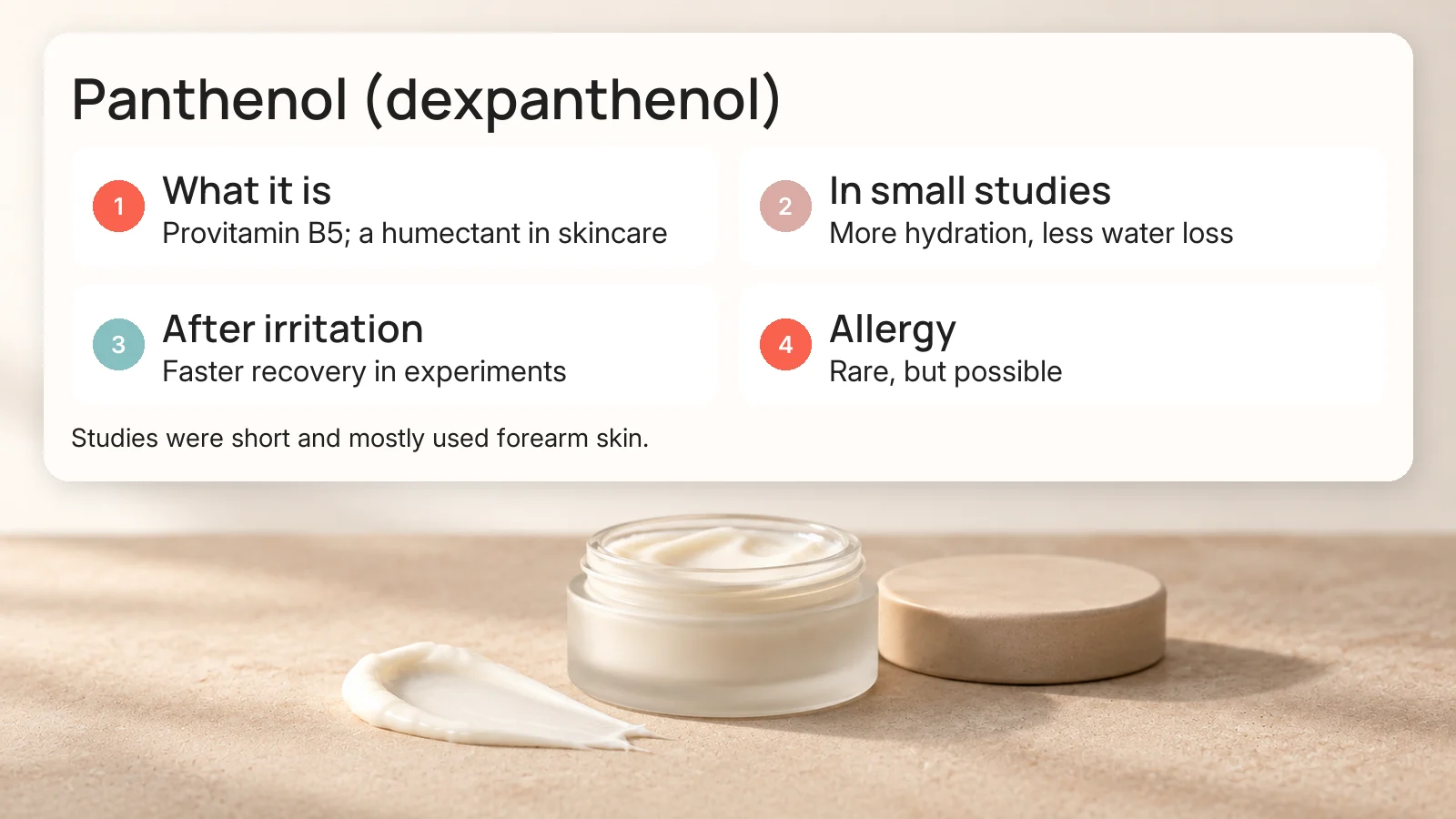
Panthenol is a stable alcohol form of pantothenic acid (vitamin B5) that works as a humectant, a water-binding ingredient, in skincare. [1, 2] In small controlled studies, mostly on forearms, it increased skin hydration and reduced water loss. [3, 4] It is usually well tolerated, but allergy, while rare, is possible. [5]
In this article
What is panthenol?
Panthenol, called dexpanthenol in most medical studies, is the stable alcohol form of pantothenic acid (vitamin B5). In the body’s tissues, including skin, it is converted to pantothenic acid, which is part of coenzyme A, a helper molecule involved in making fats and many other substances. That is why it is often called provitamin B5. [2, 6]
In cosmetics, panthenol works as a skin-conditioning humectant and a solvent, and it conditions hair too. [1] In a suitable base, such as a water-in-oil emulsion, it penetrates the skin well and reaches high local concentrations. [2] The first topical formula containing it was developed about 70 years ago. [7]
Panthenol vs dexpanthenol: is there a difference?
For skincare purposes, they belong to one family. Dexpanthenol is the name used in most clinical research and medicines, while cosmetic labels usually say panthenol; you may also see D-panthenol, another name for dexpanthenol, or DL-panthenol. An expert panel assessed panthenol, pantothenic acid and five related ingredients together. [1] The guide to reading an ingredient list explains how to find it on a label.
How does panthenol work?
Nobody knows exactly. A 2017 review says its mechanism has not been fully clarified. [7] Proposed explanations include helping the skin make barrier lipids through coenzyme A, [6] and increasing the mobility of stratum corneum components that matter for barrier function. [7] Treat these as plausible ideas, not settled facts.
The skin barrier guide explains what that barrier is made of, and the ceramides guide covers its main lipids.
What are the benefits of panthenol for skin?
The best-supported benefits of panthenol for skin are more hydration and less water loss, seen in several small controlled studies. In irritation experiments, it also helped skin recover faster. The studies were short and mostly used forearm skin, so they describe a useful moisturizing ingredient rather than a repair treatment. [3, 4, 6]
Is panthenol a humectant?
Yes. A humectant draws in and holds water, and an expert panel lists panthenol as a skin-conditioning humectant. [1] In a randomized, double-blind, placebo-controlled study, dexpanthenol in two different oily bases, used for 7 days, raised stratum corneum hydration and lowered transepidermal water loss (the water that evaporates through the skin) more than the bases alone. The abstract does not give the number of participants, the body site or the concentration. [3]
Another study applied formulas with 0.5%, 1.0% or 5.0% panthenol, or none, to healthy forearms every day. After 30 days, the 1.0% and 5.0% formulas significantly reduced water loss. On skin washed with a harsh surfactant (SLES), panthenol formulas lowered water loss within 2 hours compared with the base and untreated skin. The number of participants was not reported. [4]
The base matters too: moisturizers differ widely, and so-called inactive ingredients can have marked effects. [8] Hyaluronic acid is another humectant; the hyaluronic acid guide reviews its evidence separately.
Does it help skin recover from irritation?
In experiments where skin was irritated on purpose with sodium lauryl sulfate (SLS), a common surfactant, a dexpanthenol cream applied twice daily sped barrier repair compared with its base and with untreated skin. It also raised hydration and reduced roughness more than the base. The abstract gives no sample size, duration or concentration. [6]
In a double-blind study, 25 healthy volunteers aged 18 to 45 applied a hand balm with 5% dexpanthenol to one inner forearm and a placebo to the other, twice daily for 26 days, with SLS added on days 15 to 22. Of the 21 who finished, only the hydration measurement differed significantly: it fell on the placebo side. Within individuals, 11 did better on the dexpanthenol side and 1 on the placebo side. Six developed irritant dermatitis; in five, it was worse on the placebo side. [9]
Does panthenol calm redness?
There are hints, no more. In the SLS experiment, the dexpanthenol cream significantly reduced redness, a sign of inflammation, while the base did not. [6] An older review describes an anti-inflammatory effect in experimental UV-induced redness. [2] Both are skin models, so they do not show that panthenol calms everyday redness or conditions such as rosacea, which need a dermatologist’s assessment.
Dry, rough or cracked skin
A German dermatology panel on dry skin (xerosis) lists urea or dexpanthenol as example ingredients for cracks and fissures, while noting that the best evidence by far is for urea. It also advises richer, more lipid-based products the drier skin looks. [10] An older review reports that care products with dexpanthenol clearly improved signs of irritated skin, such as dryness, roughness, scaling, itching and cracks, within 3 to 4 weeks. [2] Deep or painful cracks deserve a doctor’s look.
What is the purpose of panthenol in skincare products?
Panthenol’s purpose in most products is to hold water and condition skin or hair. An expert panel describes it as a skin-conditioning humectant and a solvent in cosmetics, and as a hair conditioner. That is why it appears in so many everyday formulas, from creams to cleansers, rather than only in specialist products. [1]
It is also added to many personal care products marketed as hypoallergenic, and to medicines. [5] Dexpanthenol ointments have a long history in two roles: moisturizing and barrier support, and helping wounds heal. [7] A review of its use after medical and cosmetic procedures, such as laser treatments, concluded that it supports healing of superficial wounds, but its summary gives no study quality ratings or figures. [11]
That wound history is context, not advice. This guide does not cover burns, wounds, tattoos or care after procedures; for those, follow the instructions of your doctor or the clinic that treated you.
How do you use panthenol?
In practice, panthenol usually comes inside a moisturizer, serum or cleanser, so you use it as that product directs. Studies applied it once or twice a day. [4, 9, 6] It suits morning or evening routines and needs no special order beyond the usual thinnest-to-thickest layering.
How much panthenol is enough?
Studies used 0.5% to 5%. In one, 1.0% and 5.0% significantly reduced water loss after 30 days, while no significant result was reported for 0.5%. [4] The hand balm trial used 5%. [9] No study in our sources compared higher strengths, such as 10%, with lower ones, so a bigger number on the label is not proof of a better product.
Where does it go in your routine?
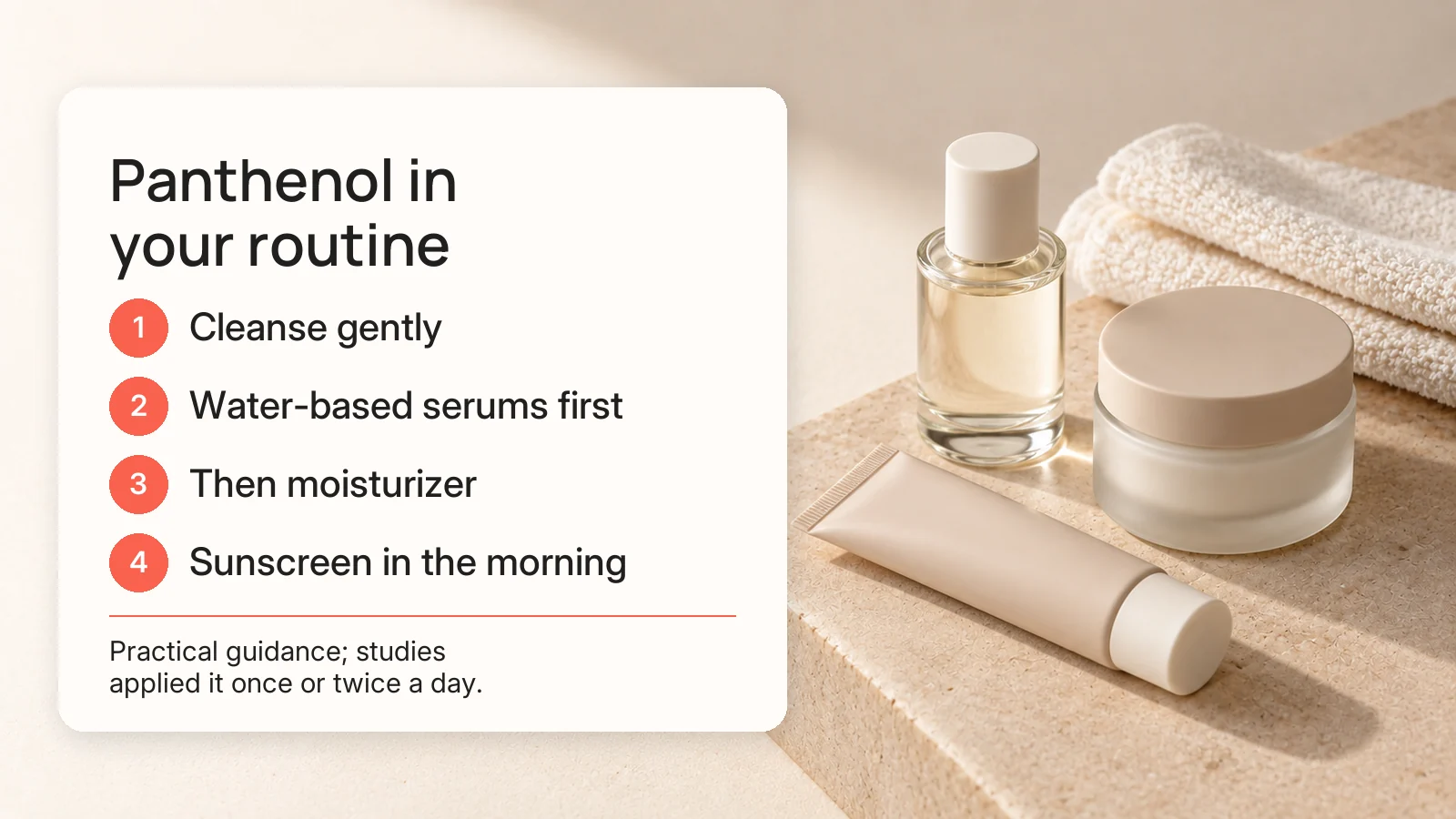
This is practical guidance rather than tested advice:
- Cleanse gently. Harsh cleansing can undo what a moisturizer adds.
- Apply water-based serums first, including a panthenol serum if you use one.
- Follow with moisturizer, which may already contain panthenol.
- Finish with sunscreen in the morning.
If your moisturizer already lists panthenol, a separate panthenol serum is optional. The moisturizer guide explains how to judge the rest of the formula.
Can you use panthenol with retinol?
Probably, and it may ease the start, though the evidence is indirect. In a 10-week study, women applied a moisturizer containing niacinamide, panthenol and tocopheryl acetate (a form of vitamin E) to one half of the face and a similar moisturizer without these vitamins to the other, twice daily. From week 2, they also used a prescription retinoid on the whole face. [12]
The vitamin moisturizer eased the first weeks of adjustment and was linked to a better treatment response. But the study tested a vitamin mix, used a prescription retinoid rather than retinol and was linked to a manufacturer, so panthenol’s own role cannot be separated. [12] The retinol guide explains how to introduce a retinoid gradually.
What should you expect?
Expect subtle comfort changes rather than a visible transformation. In the studies, lower water loss appeared within 2 hours on washed skin, while hydration and water loss were also measured after 7, 26 and 30 days. A review describes improvements in signs of irritated skin within 3 to 4 weeks. [4, 3, 9, 2]
| Time point | What studies measured | Scope of the evidence |
|---|---|---|
| 2 hours | Lower water loss after washing with a harsh surfactant [4] | Experiment after surfactant washing |
| 7 days | Higher hydration, lower water loss [3] | Short study; body site not stated in the abstract |
| 26 to 30 days | Hydration held under irritation; lower water loss with 1% and 5% [9, 4] | Different formulas and study designs |
| 3 to 4 weeks | Fewer signs of irritated skin, in a review [2] | Review, not a personal timetable |
These are study time points on forearms and irritation models, not a personal timeline. If nothing changes after several weeks, the product may not address what is drying your skin.
Is panthenol safe for sensitive skin?
For most people it is well tolerated: a review describes a low risk of irritation and sensitization, and an expert panel found panthenol safe in cosmetics as currently used. But no controlled study in our sources tested it in people defined as having sensitive skin, and allergy, though rare, has been reported more often in recent years. [2, 1, 5]
The irritation trials involved healthy volunteers whose skin was irritated on purpose. [9] They show that panthenol did not worsen irritated forearm skin under those conditions, not how every sensitive face will react. In practice, try a new product on a small area for a few days before using it all over.
Can you be allergic to panthenol?
Yes, though it is uncommon. Contact allergy to panthenol is quite rare, but positive patch-test rates have risen from 0.2–0.7% to 1.2% in recent years. These figures come from people referred for patch testing, not the general public. In many reported cases, people reacted when their own product was tested as is, and testing its ingredients one by one pointed to panthenol; contact urticaria (hives on contact) has also been described. [5]
Because panthenol is common in products labeled hypoallergenic, switching to such products may not help. If a rash persists after that switch, a dermatologist can arrange patch testing that includes panthenol. [5]
Is panthenol safe during pregnancy or breastfeeding?
We found no study of panthenol specifically in pregnancy or breastfeeding. A clinical review notes that most skincare products act locally and reach very low levels in the body, with a few named exceptions. [13] That general point is not proof of safety for panthenol, so check the full ingredient list with your doctor or midwife.
Frequently asked questions
Does panthenol clog pores?
No study in our sources tested whether panthenol clogs pores or triggers breakouts. It is a water-binding humectant, not an oil, [1] but whether a product clogs pores depends on the whole formula. In practice, if you break out after starting a panthenol product, check the full ingredient list and reintroduce products one at a time to find the trigger.
Does panthenol help sunburn?
No study in our sources tested panthenol on sunburn. An older review describes an anti-inflammatory effect in experimentally induced UV redness, [2] but an experiment is not the same as treating a burn. For mild sunburn, cool the skin and stay out of the sun; for blistering, severe pain, fever or a large burned area, see a doctor.
Is panthenol a moisturizer?
It is a moisturizing ingredient rather than a complete moisturizer. As a humectant, it draws water into the skin, [1] while emollients blend into the outer layer and occlusives cover its surface. [14] Many moisturizers combine all three. A panthenol serum on its own may feel light, but it may not be enough for dry skin.
Can panthenol cause irritation?
It can, but rarely. A review rates the risk of irritation and sensitization as low, [2] and irritation from a panthenol product may come from other ingredients in the formula. [8] Stinging, itching or a rash that keeps coming back is worth a dermatologist visit, since patch testing can show whether panthenol itself is the trigger. [5]
References
- Scott LN, Fiume M, Bergfeld WF, et al. Safety Assessment of Panthenol, Pantothenic Acid, and Derivatives as Used in Cosmetics. Int J Toxicol. 2022;41(3_suppl):77-128. PubMed · DOI
- Ebner F, Heller A, Rippke F, Tausch I. Topical use of dexpanthenol in skin disorders. Am J Clin Dermatol. 2002;3(6):427-433. PubMed · DOI
- Gehring W, Gloor M. Effect of topically applied dexpanthenol on epidermal barrier function and stratum corneum hydration. Results of a human in vivo study. Arzneimittelforschung. 2000;50(7):659-663. PubMed · DOI
- Camargo FB, Gaspar LR, Maia Campos PM. Skin moisturizing effects of panthenol-based formulations. J Cosmet Sci. 2011;62(4):361-370. PubMed
- Weber B, Hylwa S. Panthenol Allergic Contact Dermatitis: Sources of Exposure, Reported Cases, and a Call for More Frequent Testing. Dermatitis. 2025;36(4):343-351. PubMed · DOI
- Proksch E, Nissen HP. Dexpanthenol enhances skin barrier repair and reduces inflammation after sodium lauryl sulphate-induced irritation. J Dermatolog Treat. 2002;13(4):173-178. PubMed · DOI
- Proksch E, de Bony R, Trapp S, Boudon S. Topical use of dexpanthenol: a 70th anniversary article. J Dermatolog Treat. 2017;28(8):766-773. PubMed · DOI
- Lodén M. Role of topical emollients and moisturizers in the treatment of dry skin barrier disorders. Am J Clin Dermatol. 2003;4(11):771-788. PubMed · DOI
- Biro K, Thaçi D, Ochsendorf FR, Kaufmann R, Boehncke WH. Efficacy of dexpanthenol in skin protection against irritation: a double-blind, placebo-controlled study. Contact Dermatitis. 2003;49(2):80-84. PubMed · DOI
- Augustin M, Wilsmann-Theis D, Körber A, et al. Diagnosis and treatment of xerosis cutis - a position paper. J Dtsch Dermatol Ges. 2019;17 Suppl 7:3-33. PubMed · DOI
- Gorski J, Proksch E, Baron JM, Schmid D, Zhang L. Dexpanthenol in Wound Healing after Medical and Cosmetic Interventions (Postprocedure Wound Healing). Pharmaceuticals (Basel). 2020;13(7). PubMed · DOI
- Draelos ZD, Ertel KD, Berge CA. Facilitating facial retinization through barrier improvement. Cutis. 2006;78(4):275-281. PubMed
- Bozzo P, Chua-Gocheco A, Einarson A. Safety of skin care products during pregnancy. Can Fam Physician. 2011;57(6):665-667. PubMed
- Rajkumar J, Chandan N, Lio P, Shi V. The Skin Barrier and Moisturization: Function, Disruption, and Mechanisms of Repair. Skin Pharmacol Physiol. 2023;36(4):174-185. PubMed · DOI