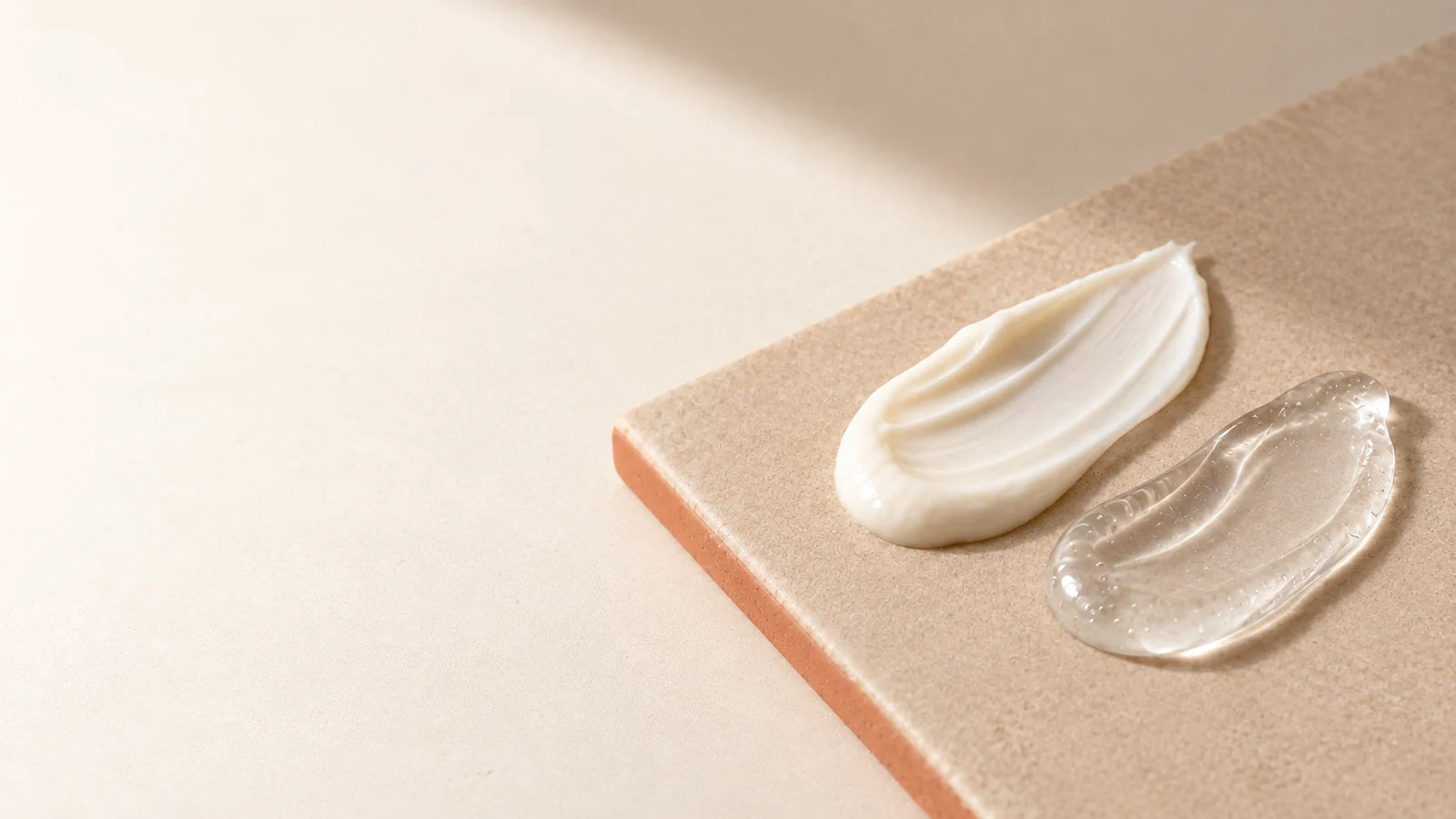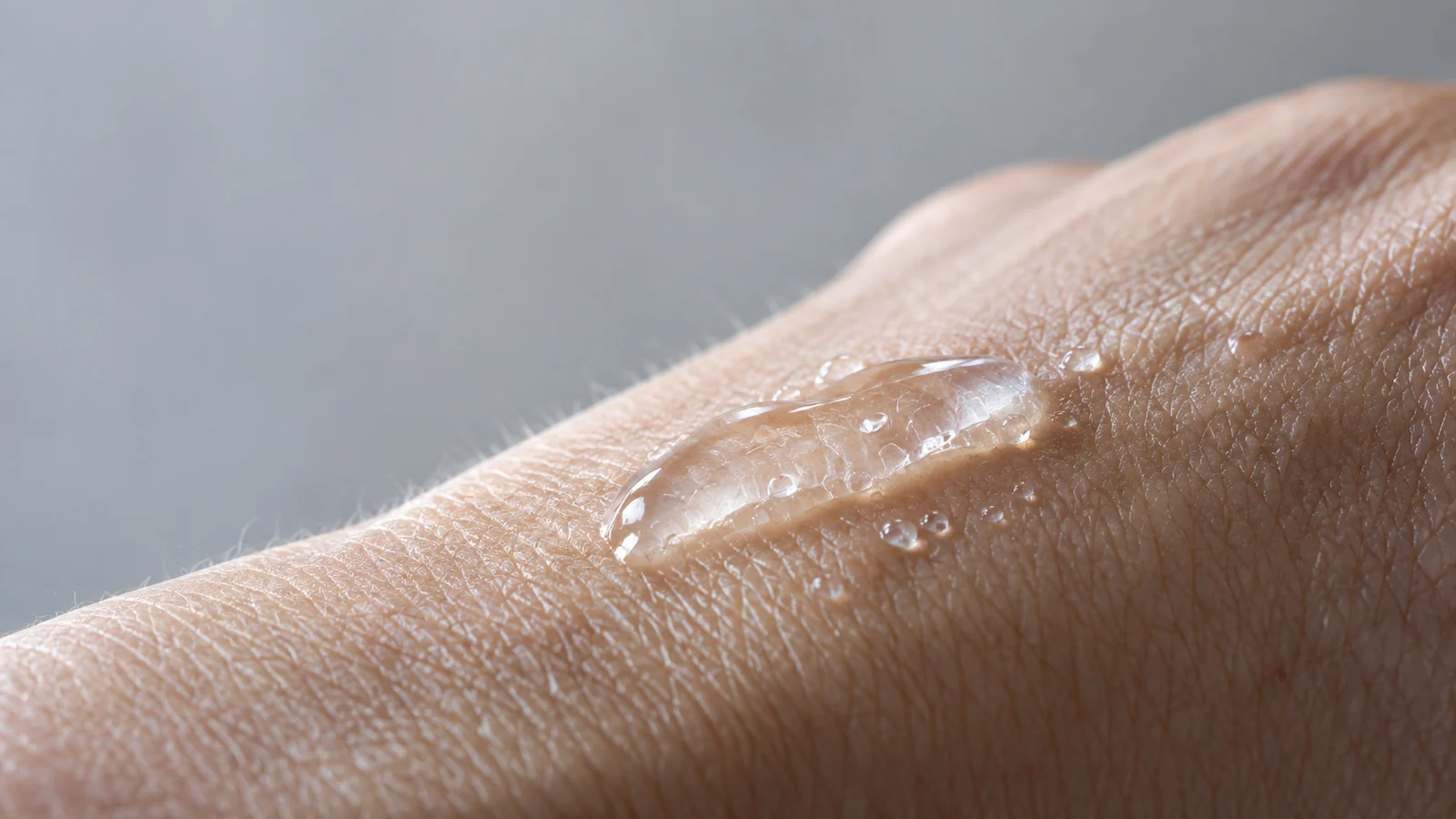
What is squalane oil? It is a colorless, odorless and very stable oil made by fully hydrogenating squalene, a lipid found in shark liver oil, some plant oils and human sebum. [1, 2] In skincare it works as an emollient that softens the skin’s surface. [3] No controlled human study in our sources has measured what squalane does on its own.
In this article
What is squalane oil?
Squalane (pronounced SKWAY-layn) is a saturated hydrocarbon with the formula C30H62. It is made by adding hydrogen to all six double bonds of squalene, which turns an unstable, polyunsaturated molecule into a colorless, odorless oil that resists oxidation. It is widely used in cosmetics as an emollient. [1]
It is a common ingredient. An expert panel counted squalane in 2,785 cosmetic formulas in 2019, at concentrations up to 96.8%, the top end being close to pure oil. [4] Because it sits in the oil phase of a product, it plays a different role from water-binding ingredients; the skin barrier guide explains how the outer layer of skin relies on both water and lipids.
What is the difference between squalane and squalene?
One letter, and a big chemical difference. Squalene (C30H50) is polyunsaturated, with six double bonds that make it prone to oxidation. It occurs in shark liver oil and, in smaller amounts, some plant oils, and it makes up 13% of human sebum. [2] Squalane is its fully saturated, stable relative. [1]
Your skin makes squalene, not squalane. Squalene and wax esters are unique to sebum; they are not found elsewhere in the body or in the surface lipids of the epidermis. [5] The share varies: in one small study it was 15% of sebum lipids in young men without acne and 20% in those with acne. [6] So when a label says squalane is “like your skin’s own oil”, the resemblance runs through squalene.
What is squalane oil made from?
Squalane is made from squalene, which comes from three main sources: the liver oil of deep-sea sharks, by-products of olive oil refining, and farnesene made by fermenting sugarcane sugar with genetically modified yeast. Whatever the source, the starting material is hydrogenated before it becomes squalane. [1]
For decades, shark liver oil was the main source. Producing one ton of squalene takes the livers of roughly 3,000 sharks. [1] In some deep-sea sharks, squalene makes up 40–70% of liver mass, and one review estimates that three to six million deep-sea sharks are caught each year to meet demand for squalene, a figure that covers all uses, not only cosmetics. [7]
Olive oil contains 0.4–0.6% squalene, and plant squalane comes from refining by-products rather than from the oil itself. The sugarcane route yields a product with 92–93% squalane. [1] A manufacturer’s estimate from 2012 split the market between olive, shark and sugarcane sources, but it is old and was made by an interested party, so it says little about what is on shelves today.
Is plant-derived squalane natural?
It depends on what you mean by natural. Plant-derived squalane starts from olives or sugarcane, but like shark squalane it is produced by hydrogenation, so it is always a processed ingredient. Labels do not always say where it came from; cosmetic companies can check the source with isotope analysis. [1] No study in our sources compares sources for their effects on skin.
What does squalane oil do for skin?
Squalane acts as an emollient: it blends into the stratum corneum, the outermost layer of skin, and softens it. It does not draw water in like a humectant or cover the surface like an occlusive. No controlled human study in our sources has measured squalane alone for hydration or water loss. [3]
You will often read that squalane feels light and non-greasy. A chemistry review describes it that way, [1] but that is a description of the oil, not a measurement on skin, and how a product feels also depends on everything else in it.
Does squalane work as a moisturizer?
As one part of a moisturizer, yes. The closest evidence is a short study in 177 healthy Korean volunteers aged 20 to 35, which tested 41 common ingredients in simple oil-in-water emulsions on the forearm. Fifteen single-oil emulsions, one with 20% squalane, raised skin hydration by an average of 11.8% after 3 hours and 7.9% after 6 hours, with no significant difference between the oils. [8]
The study was funded by a cosmetics company, involved a single application, used one type of hydration measurement and did not report squalane’s own result. [8] Moisturizing effects credited to squalane elsewhere come from animal and laboratory studies. [2] In a finished cream, the whole formula decides the result. [9] For very dry skin, an emollient alone may not be enough; in practice, it works best alongside a humectant and, where needed, an occlusive. The moisturizer guide explains how those parts work together.
Is squalane a humectant?
No. Humectants pull water from the deeper skin into the outer layer, emollients like squalane blend into that layer, and occlusives cover its surface. [3] In the Korean study, humectant combinations raised hydration more than oils in the short term, by 28% at 3 hours and 22.2% at 6 hours, with glycerin and urea standing out. [8] Ceramides are another class again, lipids that belong to the barrier itself; the ceramides guide covers them.
Squalane or hyaluronic acid?
You do not have to choose. Hyaluronic acid is a water-binding humectant and squalane an oil-phase emollient, so they do different jobs and can be used together. [3] No study in our sources compared the two directly, and the Korean study did not test hyaluronic acid. The hyaluronic acid guide covers its own evidence.
What about antioxidant and anti-aging claims?
They come from the lab. In human skin cells grown in a dish, squalane at 0.005–0.015% blocked UVA-induced oxidative stress and the drop in collagen production, and helped cells close a scratch wound. [10] Antioxidant effects have also been reported in animal and laboratory studies. [2] No human study in our sources shows that squalane reduces wrinkles or spots, and cell culture concentrations cannot be compared with product percentages.
Is squalane good for oily or acne-prone skin?
Nobody has properly tested it. We found no human study of squalane on oily or acne-prone skin, or of whether it clogs pores. The research people cite concerns squalene, the version in your own sebum, especially once it oxidizes. Those findings cannot simply be transferred to squalane. It resists oxidation as a raw material, but no study we found checked what happens to it on skin. [1]
In a 1983 rabbit-ear experiment, squalene itself caused almost no comedones (clogged pores), but squalene oxidized with UVA light was highly comedogenic. Squalane was among the tested substances, yet the abstract reports no separate result for it. [11] In human skin cells grown in a lab, oxidized squalene raised inflammatory signals. [12]
Human data are small and mixed. In 18 people with mild comedonal acne and 10 controls, the amount of squalene in sebum was similar, but the share of oxidized squalene was higher in those with acne. [13] In a pilot study of 9 young men, those with acne had 2.2 times more squalene. [6] Sebum is central to acne, and some sebum lipids can clog pores on their own. [14]
None of this shows that squalane causes or prevents breakouts. The acne guide and blackheads guide explain what the stronger evidence supports. In practice, if you are acne-prone, try squalane on a small area for a couple of weeks and watch for new clogged pores.
How do you use squalane oil?
In practice, a few drops of squalane oil go on after water-based products, either instead of a cream or mixed into it. Because it is an oil, a little goes a long way. These are practical suggestions only: no study in our sources tested amounts, order or timing for squalane, so let your skin’s comfort guide you.
Do you put squalane on before or after moisturizer?
Either can work. A common approach looks like this:
- Cleanse and apply any water-based serum, such as hyaluronic acid.
- Press in two or three drops of squalane while skin is slightly damp, or mix them into your moisturizer.
- Add moisturizer if your skin still feels dry; skip it if squalane feels like enough.
- Finish with sunscreen in the morning. Squalane is not a sun filter.
An oil layered under a rich cream can feel heavy, so adjust by feel rather than by rule. Squalane can be used morning and evening; if you use a retinoid or exfoliating acid at night, adding it afterward is a practical way to soften any dryness, though no study has tested that pairing.
How do you choose a squalane oil?
A chemistry review says cosmetic squalane should be more than 92% pure, with an iodine value (a measure of leftover double bonds) below 1.00 and ideally below 0.10. [1] Retail labels rarely show these numbers, so in practice look for a short ingredient list, a stated source if that matters to you, and packaging that closes well. The guide to reading an ingredient list helps you check what else is in a blend. Because squalane is saturated, it is very stable and resists oxidation, [1] but follow the expiry date and storage advice on the label.
Is squalane safe?
Squalane has a good safety record in cosmetics. An expert panel re-reviewed it in light of newer studies and confirmed that squalane and squalene are safe as used. Some newer studies pointed to a potential for allergy, but the panel found no meaningful clinical evidence of it and noted a lack of case reports despite growing use. [4]
That is a safety assessment, not proof that squalane works, and it does not rule out an individual reaction. In practice, try a new oil on a small area first.
We found no studies of squalane in pregnancy or breastfeeding. Wide use is not the same as proven safety, so check the full ingredient list with your doctor or midwife. Squalene supplements and shark liver oil capsules are a separate topic that this guide does not cover.
Frequently asked questions
Is squalane water soluble?
No. Squalane is a hydrocarbon oil, so it does not dissolve in water. [1] In creams it sits in the oil phase, and on its own it will not rinse off with water alone. In practice, your regular cleanser removes it; you do not need a special oil cleanser just because you use a squalane product.
Does squalane clog pores?
We could not find a human study that tested it. The pore-clogging findings in the research involve oxidized squalene in animal and lab studies, not squalane. [11, 12] So neither a “non-comedogenic” promise nor a warning rests on direct evidence. If you are prone to breakouts, introduce it on its own and watch your skin for a few weeks.
Is squalane oil good for rosacea or eczema?
No study in our sources tested squalane in rosacea, eczema or seborrheic dermatitis, although many people search for it. These are medical conditions, and a dermatologist should guide treatment. If your dermatologist agrees to a gentle oil as part of your care, squalane’s stability and good cosmetic safety record count in its favor. [1, 4]
Is squalane an active ingredient?
Not in the usual sense. Squalane is an emollient that softens the skin’s surface rather than an ingredient meant to change pigment, pores or wrinkles. [3] Its antioxidant effects have been seen only in lab studies. [10] That makes it a supporting ingredient for texture and comfort, not a replacement for the actives in your routine.
References
- Ciriminna R, Pandarus V, Béland F, Pagliaro M. Catalytic hydrogenation of squalene to squalane. Org Process Res Dev. 2014;18(9):1110-1115. DOI
- Kim SK, Karadeniz F. Biological importance and applications of squalene and squalane. Adv Food Nutr Res. 2012;65:223-233. PubMed · DOI
- Rajkumar J, Chandan N, Lio P, Shi V. The Skin Barrier and Moisturization: Function, Disruption, and Mechanisms of Repair. Skin Pharmacol Physiol. 2023;36(4):174-185. PubMed · DOI
- Fiume M, Bergfeld WF, Belsito DV, et al. Squalane and Squalene. Int J Toxicol. 2023;42(3_suppl):107S-109S. PubMed · DOI
- Picardo M, Ottaviani M, Camera E, Mastrofrancesco A. Sebaceous gland lipids. Dermatoendocrinol. 2009;1(2):68-71. PubMed · DOI
- Pappas A, Johnsen S, Liu JC, Eisinger M. Sebum analysis of individuals with and without acne. Dermatoendocrinol. 2009;1(3):157-161. PubMed · DOI
- Patel A, Bettiga M, Rova U, Christakopoulos P, Matsakas L. Microbial genetic engineering approach to replace shark livering for squalene. Trends Biotechnol. 2022;40(10):1261-1273. PubMed · DOI
- Jeong CB, Han JY, Cho JC, Suh KD, Nam GW. Analysis of electrical property changes of skin by oil-in-water emulsion components. Int J Cosmet Sci. 2013;35(4):402-410. PubMed · DOI
- Lodén M. Role of topical emollients and moisturizers in the treatment of dry skin barrier disorders. Am J Clin Dermatol. 2003;4(11):771-788. PubMed · DOI
- Wolosik K, Chalecka M, Gasiewska G, Palka J, Surazynski A. Squalane as a Promising Agent Protecting UV-Induced Inhibition of Collagen Biosynthesis and Wound Healing in Human Dermal Fibroblast. Molecules. 2025;30(9). PubMed · DOI
- Motoyoshi K. Enhanced comedo formation in rabbit ear skin by squalene and oleic acid peroxides. Br J Dermatol. 1983;109(2):191-198. PubMed · DOI
- Ottaviani M, Alestas T, Flori E, Mastrofrancesco A, Zouboulis CC, Picardo M. Peroxidated squalene induces the production of inflammatory mediators in HaCaT keratinocytes: a possible role in acne vulgaris. J Invest Dermatol. 2006;126(11):2430-2437. PubMed · DOI
- Capitanio B, Lora V, Ludovici M, et al. Modulation of sebum oxidation and interleukin-1α levels associates with clinical improvement of mild comedonal acne. J Eur Acad Dermatol Venereol. 2014;28(12):1792-1797. PubMed · DOI
- Del Rosso JQ, Kircik L. The primary role of sebum in the pathophysiology of acne vulgaris and its therapeutic relevance in acne management. J Dermatolog Treat. 2024;35(1):2296855. PubMed · DOI