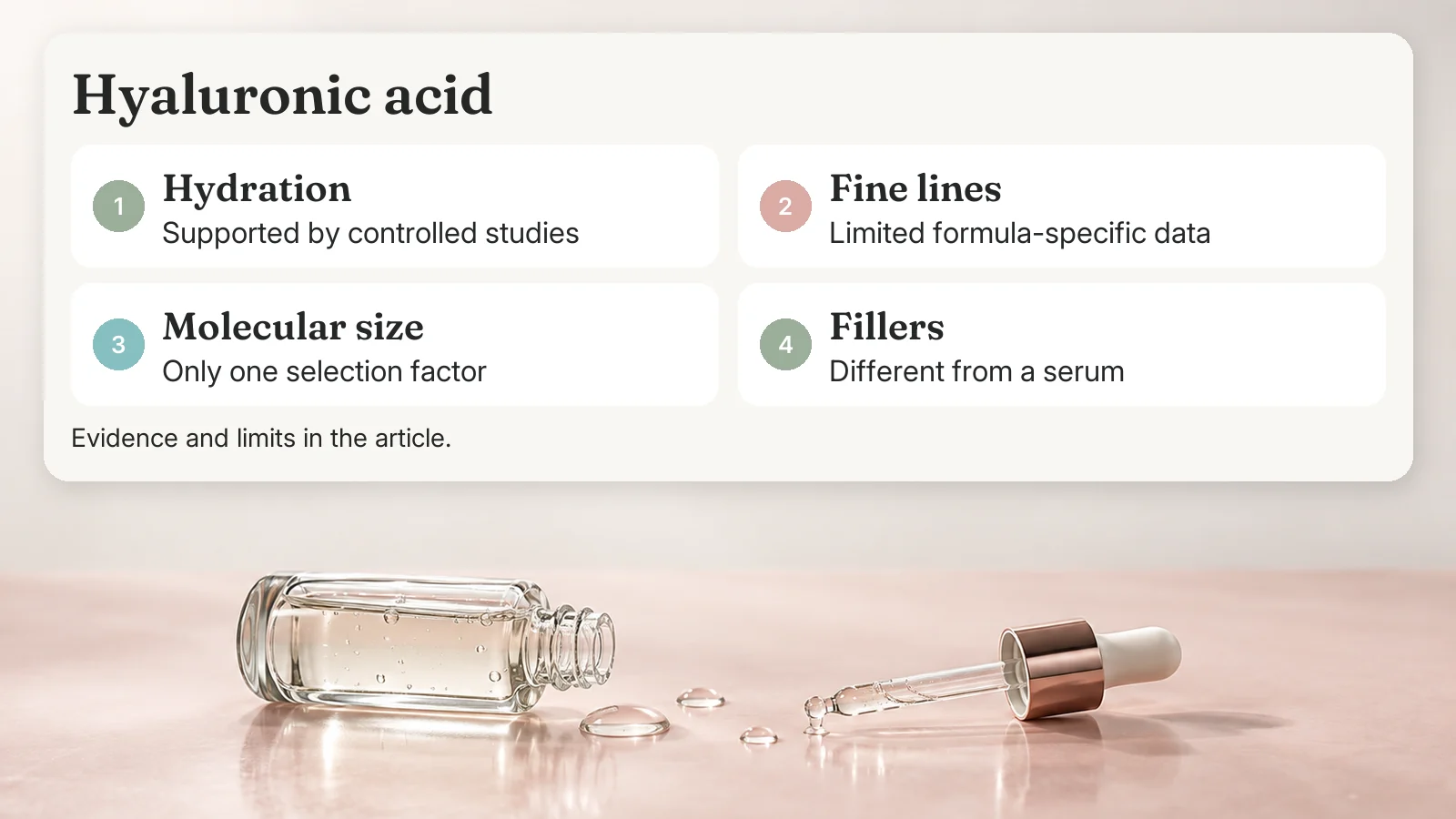
Hyaluronic acid helps cosmetic formulas hold water. Controlled studies of products applied to the skin support improved hydration, with more limited findings for fine lines. Results depend on the complete formula and the measurements used. A serum does not have the same purpose as an injectable filler; this guide covers topical skincare only. [1, 2]
In this article
What does hyaluronic acid do in skincare?
Hyaluronic acid occurs naturally in the material surrounding cells and interacts with water. In skincare it is used for its moisture-holding properties. Although its name contains “acid,” the goal here is hydration rather than exfoliation. The review behind this guide discusses topical products, which should be considered separately from injections and oral supplements. [1]
You may see several molecular weights advertised on a serum. This describes the size of the hyaluronic acid chains. Molecular size influenced some outcomes in controlled studies, but it does not tell you everything about a finished cream or lotion. The base formula and other ingredients matter too. [2, 3]
Start with a specific question about your routine: does your skin feel uncomfortable after cleansing, or are you looking for a lighter moisturizing texture? Those observations can help define a cosmetic goal. They cannot diagnose a skin disorder or a lack of a particular molecule.
The niacinamide guide covers different evidence about tone and barrier-related outcomes. Do not transfer those findings to a hyaluronic acid serum simply because both ingredients appear in moisturizing products. A clear goal makes the evidence easier to assess.
What do the studies actually show?
The clearest supported expectation is improved hydration with specific topical formulas. Evidence for fine lines comes from narrower settings, including creams used around the eyes. A higher hydration reading does not establish complete barrier repair, a change in facial volume or the same effect from every serum containing this ingredient. [3, 2]
Hydration in older adults
A 2024 controlled trial studied lotions on the legs of 36 older adults with dry skin. After four weeks, the low-molecular-weight formula produced higher hydration measurements than the high-molecular-weight version and the vehicle, the comparison base without the active ingredient. [3]
However, the groups did not differ significantly in water loss through the skin or in clinical symptom scores. That distinction matters: the study supports a hydration finding, not every possible claim about the skin barrier. Older leg skin also differs from the facial skin on which you might use a serum. [3]
Fine-line measurements
In another study, 76 women used eye-area creams containing 0.1% hyaluronic acid at different molecular weights. Hydration and elasticity measurements improved. Two lower-molecular-weight formulas also reduced wrinkle depth at day 60. These are findings for those creams and that application area, not a prediction for all facial serums. [2]
A temporarily more comfortable or supple feeling is not the same outcome as added facial volume. If you expect a serum to change the shape of your face, these moisturizing studies do not support that expectation.
A 24-hour result
A one-day study on the forearms of 20 women measured increased hydration after 24 hours with a fluid containing hyaluronic acid, glycerin and a plant extract. Because several ingredients were present, the result cannot be assigned to hyaluronic acid alone. A forearm measurement also does not promise an identical feeling on your face throughout the day. [4]
How can you fit a serum into your routine?
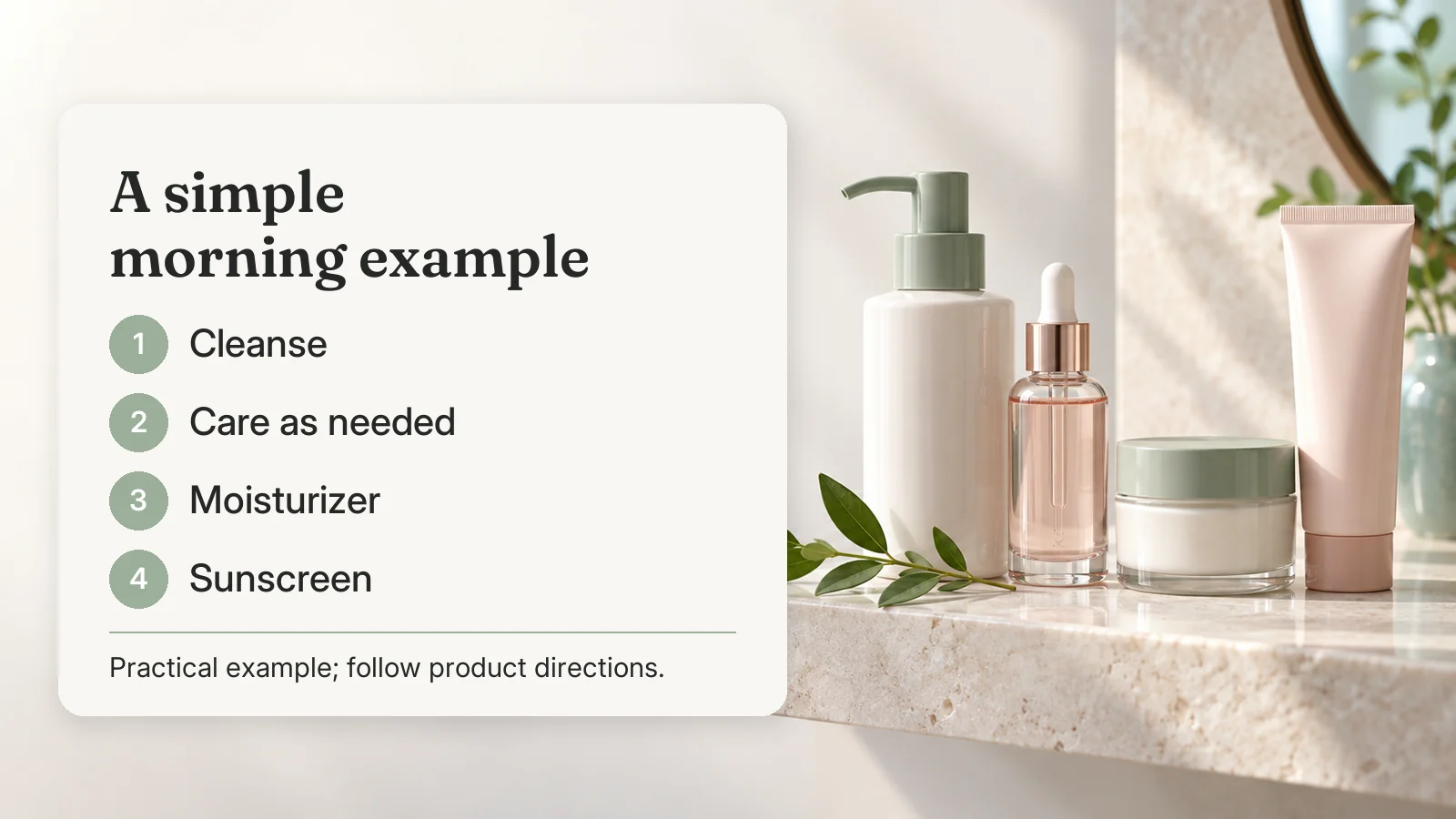
A practical approach is to introduce the product as your only new step and follow its directions. A leave-on serum can fit after cleansing and before moisturizer. If your moisturizer already meets your needs, adding a separate hyaluronic acid serum is not necessary just because a particular ingredient has become popular.
- Name the goal. Decide whether you want a lighter texture, more comfort or help with a specific appearance concern.
- Read the instructions. A rinse-off product and a leave-on serum are not used in the same way.
- Change one thing at a time. Starting another new active alongside the serum makes your observations harder to interpret.
- Assess the texture. Stickiness or pilling can be a reason to reconsider the amount and the layers you use.
- Keep sun protection separate. A moisturizing serum does not replace sunscreen. [5]
Does skin have to be damp?
The controlled studies reviewed here do not establish a universal advantage for damp over dry skin across all hyaluronic acid products. Applying to slightly damp skin can be a practical preference. Follow the label if it gives a different instruction; these studies do not require repeated misting before or after every application.
Choose a method you can comfortably repeat. If very wet skin makes the serum difficult to spread, you do not need to turn application into an elaborate water-spraying ritual. Consistent use according to the product instructions is a more useful starting point for judging your experience.
Is a higher percentage better?
Positive findings with 0.1% in one trial do not establish a universal ideal percentage. Different studies used different formulas, so a higher advertised number cannot be ranked against a lower number without a suitable comparison. “Multiple molecular weights” is also a description rather than independent proof of superiority. [2, 1]
Consider the other ingredients, texture and fit with your routine. A product without a prominently displayed percentage is not automatically ineffective, and a product that advertises one has not answered every question about performance.
What should you expect over the weeks?
Separate an immediate sensory impression from changes measured over time. The research includes one day, four weeks and 60 days, but these are study timelines rather than deadlines for your own results. Your first practical goal is comfortable use; later, assess whether the need that prompted you to try the product has changed. [4, 3, 2]
| Period | Useful observation | Limitation |
|---|---|---|
| First applications | Texture, comfort, fit with other products | Personal experience is not a clinical effectiveness test |
| First weeks | Whether your moisturizing needs feel different | Other changes can obscure the picture |
| Around four weeks | Reconsider the original hydration goal | The trial involved older leg skin |
| Around two months | Review expectations about fine lines | The eye-area study tested particular creams |
You could keep a short weekly note about dryness, frequency of use and any other product changes. If you take photographs, use similar lighting and framing. This is a practical record, not a medical assessment; daily close-ups in changing light may exaggerate small differences.
A pleasant first application does not predict a long-term change in deep wrinkles. Conversely, not noticing a difference after one use does not disprove the research. Instrument-measured hydration, visible appearance and personal comfort answer different questions.
What about other active ingredients?
Think about whole formulas when combining skincare, not just the names on the front of the packaging. The studies reviewed here did not test every possible serum pairing. A moisturizing product should not be treated as a shield that makes an irritating active harmless or allows you to increase its frequency automatically.
| Existing step | Practical consideration |
|---|---|
| Niacinamide | Decide whether you actually need two serums |
| Vitamin C | Follow both labels and simplify if application is uncomfortable |
| Retinol | Avoid starting both products on the same day; see hyaluronic acid and retinol together |
| Salicylic acid | Reassess burning or peeling instead of covering it with more serum |
| Sunscreen | Keep the protective step distinct from moisturizing |
The retinol guide explains a different purpose and different tolerance questions. Likewise, if salicylic acid leaves your skin uncomfortable, adding a hydrating layer is not a reason to continue an irritating routine unchanged.
Do you need another bottle?
If your moisturizer feels too heavy, adding another product may not solve that texture problem. First consider whether the existing formula suits you. If your routine already feels comfortable, keeping it simple is a valid choice; a study showing benefit does not make a separate serum compulsory for everyone.
When reviewing the result, consider how regularly you used it and whether you changed other steps. If there is no meaningful benefit for your goal, reconsider the product rather than continually adding more layers. Persistent dryness deserves an assessment beyond counting how many moisturizing products you own.
Who should seek medical advice?
Good tolerance in a small study does not mean every formulation will suit every person. Burning, itching or pronounced redness should not be interpreted as a necessary stage of hydration. Stop the product and seek advice if symptoms persist, particularly if you have an existing skin condition or previous reactions to cosmetics. [3]
Trying a product on a small area can be a practical precaution, but an at-home trial is not a diagnostic allergy test. If you are receiving treatment for a skin condition, discuss new steps with your dermatologist rather than using the ingredient name as a blanket assurance.
The studies here were not designed to establish safety in pregnancy or breastfeeding. Consider the complete ingredient list and where the product will be used with your clinician. A multi-ingredient serum cannot be assessed solely by the words “hyaluronic acid.”
How should you choose and store it?
Choose according to the role you want the product to fill: a moisturizer or an optional lightweight serum. Read the directions, expiry information and storage instructions. Molecular-weight claims can be part of the description, but they should not replace practical questions about the complete formula and whether you will use it comfortably.
Keeping the dropper clean, closing the cap and avoiding mixing different products in a spare bottle are practical handling suggestions. These studies do not establish that one packaging type is always best. If smell, color or texture changes unexpectedly, check the manufacturer’s guidance before continuing.
Frequently asked questions
Will hyaluronic acid exfoliate my skin?
Hydration is the purpose of the formulas discussed here. Do not transfer exfoliation claims from salicylic acid simply because both names include “acid.” Flaking after a product is not evidence that hyaluronic acid is doing its intended job. Consider the whole formula and other products, and seek advice for persistent symptoms. [1]
Can a serum replace moisturizer?
An ingredient name alone cannot answer that. The studies used creams, lotions and multi-ingredient fluids, not identical versions of every thin serum. If your current moisturizer works for you, you do not need to stop it. If you prefer one step, assess a complete formula against your needs and its directions. [2, 4]
Is low molecular weight always preferable?
Some lower-molecular-weight formulas performed better on particular measurements. That does not establish superiority across all products and skin types. Hydration on older leg skin and wrinkle depth around the eyes are different outcomes. Matching a molecular-weight claim on a label does not show that your product matches the tested formula. [3, 2]
Must I use it every day?
One study used cream twice daily, but that does not mean everyone needs that schedule. Follow the product instructions and choose a sustainable routine. If your skin feels comfortable without another serum, there is no need to add one solely because an ingredient is widely discussed. [2]
References
- Bravo B, Correia P, Gonçalves Junior JE, Sant’Anna B, Kerob D. Benefits of topical hyaluronic acid for skin quality and signs of skin aging: From literature review to clinical evidence. Dermatol Ther. 2022;35(12):e15903. PubMed · DOI
- Pavicic T, Gauglitz GG, Lersch P, et al. Efficacy of cream-based novel formulations of hyaluronic acid of different molecular weights in anti-wrinkle treatment. J Drugs Dermatol. 2011;10(9):990-1000. PubMed
- Muhammad P, Novianto E, Setyorini M, et al. Effectiveness of topical hyaluronic acid of different molecular weights in xerosis cutis treatment in elderly: a double-blind, randomized controlled trial. Arch Dermatol Res. 2024;316(6):329. PubMed · DOI
- Milani M, Sparavigna A. The 24-hour skin hydration and barrier function effects of a hyaluronic 1%, glycerin 5%, and Centella asiatica stem cells extract moisturizing fluid: an intra-subject, randomized, assessor-blinded study. Clin Cosmet Investig Dermatol. 2017;10:311-315. PubMed · DOI
- Abdel Azim S, Bainvoll L, Vecerek N, DeLeo VA, Adler BL. Sunscreens part 1: Mechanisms and efficacy. J Am Acad Dermatol. 2025;92(4):677-686. PubMed · DOI