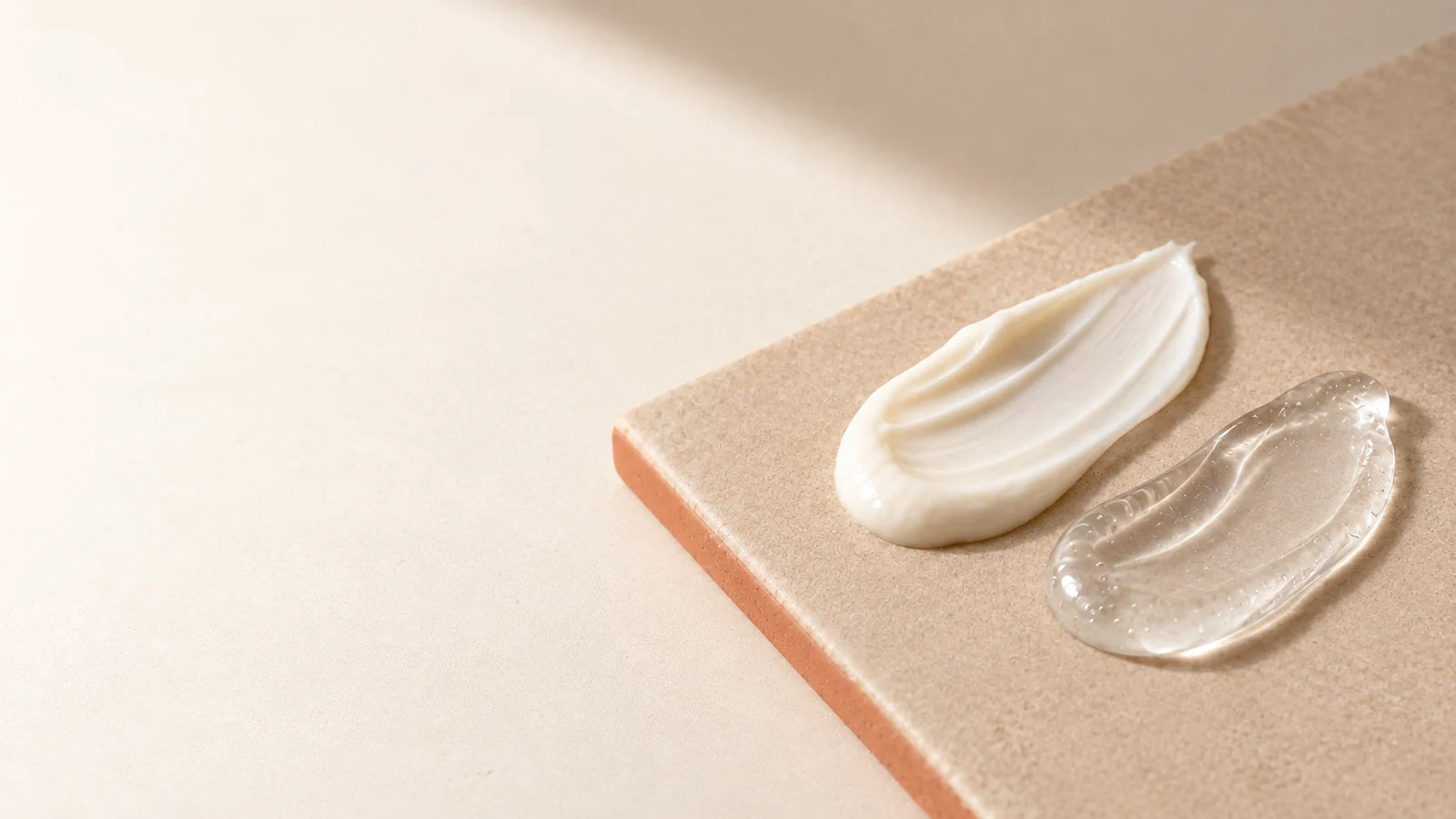
A moisturizer helps your skin hold water and feel softer, using humectants that draw water in, emollients that soften and occlusives that cover the surface. [1] The whole formula decides the result: in one trial, some simple creams increased water loss on healthy skin, while a urea cream reduced it. [2] Texture, in a large eczema trial, changed comfort rather than results. [3]
In this article
What does a moisturizer do?
A moisturizer helps the stratum corneum, the outermost layer of skin, hold water. Many studies have found that moisturizers improve transepidermal water loss, the water that evaporates through the skin’s surface. The effect depends on the ingredients, and dryness and barrier problems are linked but are not the same thing. [1, 4]
The skin barrier guide explains what that outer layer is made of and what tends to strain it.
Humectants, emollients and occlusives
Most moisturizers combine three kinds of ingredients. [1]
| Type | What it does | Common examples |
|---|---|---|
| Humectant | Draws water from deeper skin into the outer layer | Glycerin, urea, hyaluronic acid |
| Emollient | Blends into the outer layer and softens it | Squalane, plant oils |
| Occlusive | Covers the surface of the outer layer | Petrolatum, dimethicone |
In a review of 52 moisturizers marketed for acne-prone skin, more than half relied on dimethicone, glycerin or both for their moisturizing effect. [5] The hyaluronic acid guide, panthenol guide and squalane guide look at single ingredients in more detail.
Can a moisturizer make skin worse?
It can. In a randomized trial, 78 volunteers with normal skin applied one of five preparations to one forearm for seven weeks. Simplified creams with few ingredients, and a lipid-free gel, increased water loss and the skin’s reaction to an irritant; an ordinary cream with 5% urea did the opposite. None of them irritated skin in a short test, so the problem stayed invisible at first. [2]
An older review adds that emulsifiers can weaken the barrier, that petrolatum repaired lipid-depleted skin right away, and that ingredients considered inactive can have larger effects than expected. [4] The trial used experimental formulas on forearms, so it cannot rank products on a shelf, but it shows why the word “moisturizer” on a label is not a promise.
Do you need a moisturizer?
If your skin feels dry, tight or rough, a moisturizer is the basic tool, and the strongest evidence for moisturizers comes from eczema. For skin that already feels comfortable, no study in our sources shows that everyone must use one; in practice, many people still like one after cleansing or alongside drying products.
In a Cochrane review of 77 trials with 6,603 people with eczema, moisturizers reduced severity compared with control treatments (high-quality evidence) and reduced flares (moderate-quality evidence), with no difference in side effects. They also lengthened the time to a flare and reduced the amount of corticosteroid cream needed. In trials comparing moisturizer with none, the drop in one severity score (SCORAD) was significant but smaller than the threshold considered clinically important, and many trials carried a risk of bias. [6]
Eczema is a medical condition; a moisturizer supports a dermatologist’s plan rather than replacing it. For dry skin (xerosis), a German expert consensus advises products with both water-binding and lipid-replenishing ingredients, with more lipid the drier the skin looks. [7]
How to choose a moisturizer
To choose a moisturizer, start with a texture you will actually use and the ingredients your skin needs, then read the full formula rather than the front label. In eczema research, no moisturizer has been shown to be reliably better than another, so fit, comfort and tolerance often decide. [6, 3]
Cream, lotion, gel or ointment?
In the largest trial of textures, 550 children aged 6 months to 12 years with eczema were randomly given a lotion, cream, gel or ointment to use twice daily and as needed. Over 16 weeks, eczema severity did not differ between the four (p = 0.77), and overall side effects were similar. Stinging was less common with ointment (9%) than with lotion (20%), cream (17%) or gel (19%). [3]
The authors concluded that people should be able to choose the type they can use effectively. [3] The trial involved children’s body skin, and we found no independent study comparing textures on the face. Expert consensus suggests richer, more lipid-based formulas the drier the skin looks. [7] In practice, oily skin often prefers gels or light lotions and dry skin creams, but that is preference, not proof.
Which ingredients are worth knowing?
- Glycerin: When the barrier was damaged by tape stripping or detergent washing, glycerin sped recovery and gave the highest hydration readings. [8]
- Urea: In double-blind studies, urea moisturizers reduced water loss in people with atopic dermatitis and ichthyosis, [4] and a 5% urea cream lowered water loss on normal skin in the forearm trial. [2] Expert consensus rates urea’s evidence the best for dry skin. [7]
- Hyaluronic acid: In 36 people aged 60 to 80 with dry skin, a low-molecular-weight lotion on the legs raised hydration more than a high-molecular-weight one and the base after four weeks; water loss did not differ. [9]
- Petrolatum: On barrier-damaged skin, petrolatum sped repair rather than delaying it, settling between skin cells instead of forming an airtight film. [10] A review also corrects the belief that it causes acne. [11]
- Dimethicone: Very common, yet our sources contain no clinical study of its effect. [5]
- Plant oils: Not all are gentle. In 19 adults, olive oil on the forearm reduced barrier integrity and caused mild redness over four weeks, while sunflower seed oil did not. [12]
The ceramides guide, centella guide, allantoin guide and ectoin guide cover four more popular additions.
Choosing by skin type
Skin-type advice is mostly practical, because few studies compare moisturizers by skin type.
- Dry skin: A richer cream with water-binding and lipid ingredients; expert consensus supports more lipid the drier the skin. [7]
- Oily or acne-prone skin: A light lotion or gel; we found no independent study comparing moisturizer types in oily skin.
- Sensitive skin: There is no agreed definition; impaired barrier function and reactive blood vessels are the findings most often linked with it. [13] In practice, fewer ingredients and no fragrance make reactions easier to trace.
- Combination skin: In practice, a light formula all over, with a richer one on dry areas if needed.
What does non-comedogenic mean?
“Non-comedogenic” claims that a product will not clog pores, but no single agreed test stands behind it. The idea grew from rabbit-ear tests of raw ingredients and a human model in which substances were applied under occlusion to the upper backs of young men for a month; the rabbit model is more sensitive than human skin. [14] When finished products containing supposedly comedogenic ingredients were tested on the backs of 6 people, they were not necessarily comedogenic. [15]
In a study of 910 adults with acne and 910 controls, overall cosmetic use was linked with lower odds of acne, though some individual products carried higher odds. [16] We found no study showing that the label prevents acne on the face. “Oil-free” and “water-based” are label terms, not tested standards either. The guide to reading an ingredient list helps you look past them.
How do you apply moisturizer?
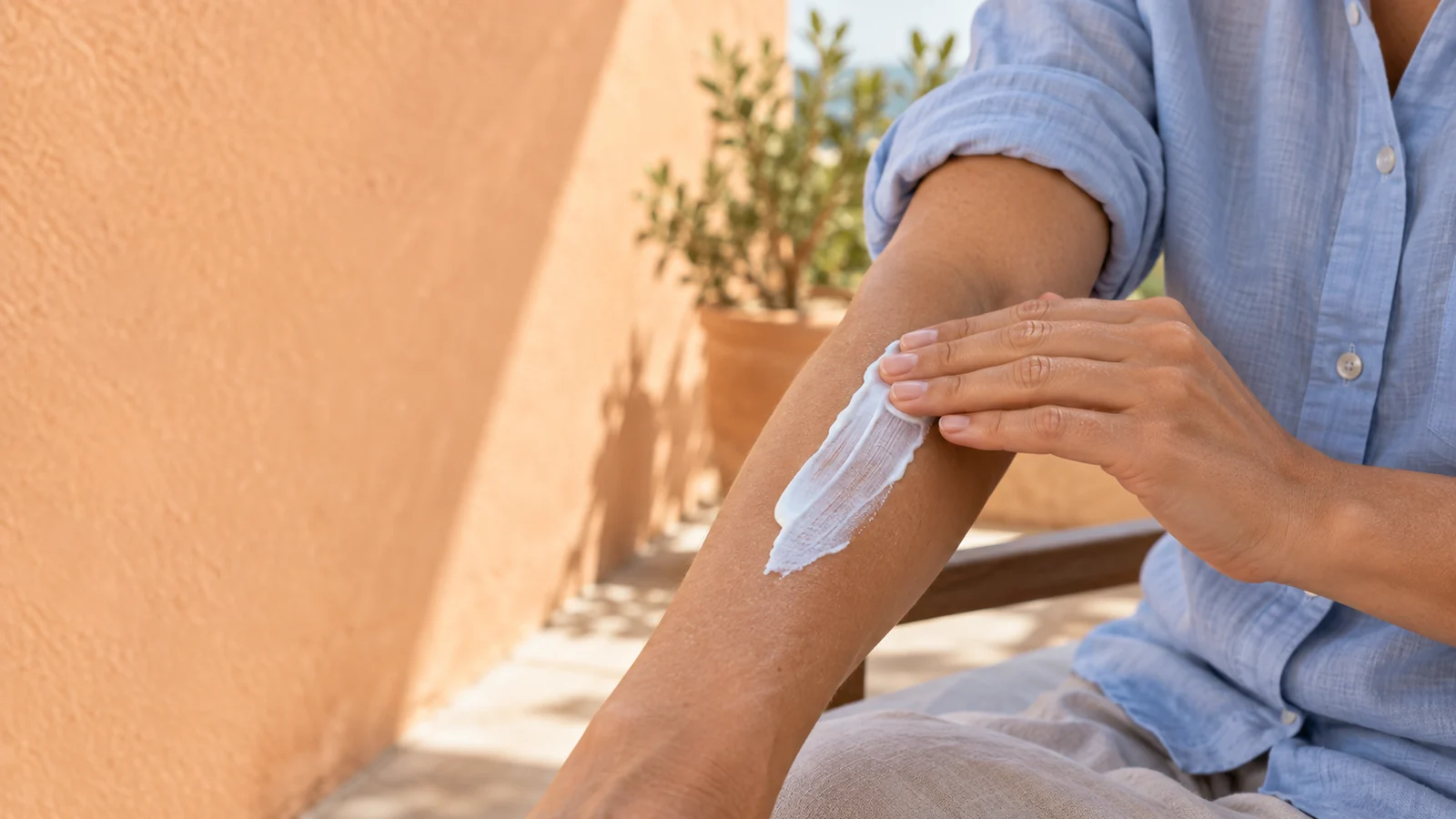
Apply moisturizer to clean skin: after any serum and before sunscreen in the morning, and after cleansing or treatment products in the evening. There is no tested amount for the face. In practice, use enough for a thin, even layer over your face and neck, and add a little more to dry patches.
Does it have to go on right after washing?
Not necessarily. Guidelines often say to apply moisturizer within 3 minutes of bathing, but there is little evidence behind that. In 60 healthy volunteers aged 18 to 25, areas that got moisturizer had higher hydration and lower water loss than untreated areas, and applying it right away or 30 minutes later made no difference. [17] The study used one moisturizer on healthy young skin, not dry or eczema-prone skin.
Can a moisturizer with SPF replace sunscreen?
It is a weaker stand-in. When 84 people applied an SPF 30 sunscreen and, at another visit, an SPF moisturizer, they missed more of the face with the moisturizer (16.6% vs 11.1%), mostly around the eyelids (20.9% vs 14.0%), and did not notice. [18] SPF is tested at 2 mg/cm², while real-world amounts of about 0.39–1.0 mg/cm² have been reported, and applying less lowers protection. [19] The sunscreen guide explains how to apply enough.
Should you moisturize during acne treatment?
Usually, yes. Acne treatments such as retinoids, salicylic acid and alcohol-based preparations can irritate skin and make people stop using them, and some doctors recommend a moisturizer alongside them. A moisturizer does not treat acne itself, but small trials suggest it can make treatment easier to tolerate. [5, 20]
In a split-face study, 30 healthy volunteers applied a retinoid acne gel to the whole face once daily for four weeks and a moisturizing lotion to one half. Researchers and participants rated tolerance better on the moisturized side, and the average worst scores for redness, scaling, dryness, stinging and itching were lower there (0.43 ± 0.34 vs 0.59 ± 0.44). The volunteers did not have acne, the sample was small and the funding is unclear. [20]
In a double-blind study, a ceramide cleanser and lotion also kept water loss lower during a prescription acne treatment. [21] The acne guide and retinol guide explain how to start treatments gently.
How can you tell if a moisturizer suits you?
A moisturizer suits you if your skin feels comfortable a few hours after applying it, without stinging, heaviness or new breakouts, and if dryness eases over the following weeks. Some formula effects stay invisible at first, as the forearm trial showed, so judge over several weeks rather than one day. [2]
| Sign | What it may mean |
|---|---|
| Tightness returns within hours | Formula too light, or cleansing too harsh |
| Stinging on application | An irritating ingredient, or a strained barrier |
| Heaviness, shine or pilling | Texture too rich, or too many layers |
| New clogged pores | Time to try another formula, one change at a time |
| Comfort over several weeks | A good fit worth keeping steady |
If one texture stings, another may suit you better; in the children’s trial, stinging differed between textures even though results did not. [3]
If redness persists despite comfortable moisturizing, the facial redness guide explains why the cause may need a separate assessment.
When should you see a dermatologist?
See a dermatologist if dryness comes with intense itching, cracking, oozing or a spreading rash, or if it keeps returning despite a gentle routine. These can signal eczema, contact allergy or another condition. The mechanisms behind dry, flaky and sensitive skin are not fully understood, and a moisturizer alone may not be enough. [22, 6]
Frequently asked questions
Do you need moisturizer if you have oily skin?
Often it helps, but it is not mandatory. Oil on the surface and the skin’s water-holding barrier are different things, [1] so oily skin can still feel tight after harsh cleansing or drying treatments. We found no independent study comparing moisturizer types for oily skin; in practice, a light gel or lotion is the usual choice.
Can moisturizer cause breakouts?
Some products may, but cosmetics as a group do not seem to. In a large case-control study, overall cosmetic use was linked with lower odds of adult acne, though certain individual products carried higher odds. [16] Pore-clogging tests rely on animal and occluded back models. [14] If breakouts start after a new moisturizer, stop it and reintroduce products one at a time.
Do you need a separate night moisturizer?
Not necessarily. No study in our sources compared day and night moisturizers. In practice, the same product can work morning and evening; some people prefer a richer texture at night and a lighter one under sunscreen. What matters is that the formula suits your skin and that your morning routine still includes proper sun protection.
Is a lotion the same as a moisturizer?
A lotion is one kind of moisturizer, usually thinner than a cream. In the large children’s trial, lotions, creams, gels and ointments worked equally well against eczema, and the main difference was that ointment stung less. [3] Choose by comfort and by how much your skin needs, then check the formula.
References
- Rajkumar J, Chandan N, Lio P, Shi V. The Skin Barrier and Moisturization: Function, Disruption, and Mechanisms of Repair. Skin Pharmacol Physiol. 2023;36(4):174-185. PubMed · DOI
- Buraczewska I, Berne B, Lindberg M, Törmä H, Lodén M. Changes in skin barrier function following long-term treatment with moisturizers, a randomized controlled trial. Br J Dermatol. 2007;156(3):492-498. PubMed · DOI
- Ridd MJ, Santer M, MacNeill SJ, et al. Effectiveness and safety of lotion, cream, gel, and ointment emollients for childhood eczema: a pragmatic, randomised, phase 4, superiority trial. Lancet Child Adolesc Health. 2022;6(8):522-532. PubMed · DOI
- Lodén M. Role of topical emollients and moisturizers in the treatment of dry skin barrier disorders. Am J Clin Dermatol. 2003;4(11):771-788. PubMed · DOI
- Chularojanamontri L, Tuchinda P, Kulthanan K, Pongparit K. Moisturizers for Acne: What are their Constituents? J Clin Aesthet Dermatol. 2014;7(5):36-44. PubMed
- van Zuuren EJ, Fedorowicz Z, Christensen R, Lavrijsen A, Arents BWM. Emollients and moisturisers for eczema. Cochrane Database Syst Rev. 2017;2(2):CD012119. PubMed · DOI
- Augustin M, Wilsmann-Theis D, Körber A, et al. Diagnosis and treatment of xerosis cutis - a position paper. J Dtsch Dermatol Ges. 2019;17 Suppl 7:3-33. PubMed · DOI
- Fluhr JW, Gloor M, Lehmann L, Lazzerini S, Distante F, Berardesca E. Glycerol accelerates recovery of barrier function in vivo. Acta Derm Venereol. 1999;79(6):418-421. PubMed · DOI
- Muhammad P, Novianto E, Setyorini M, et al. Effectiveness of topical hyaluronic acid of different molecular weights in xerosis cutis treatment in elderly: a double-blind, randomized controlled trial. Arch Dermatol Res. 2024;316(6):329. PubMed · DOI
- Ghadially R, Halkier-Sorensen L, Elias PM. Effects of petrolatum on stratum corneum structure and function. J Am Acad Dermatol. 1992;26(3 Pt 2):387-396. PubMed · DOI
- Kamrani P, Hedrick J, Marks JG, Zaenglein AL. Petroleum jelly: A comprehensive review of its history, uses, and safety. J Am Acad Dermatol. 2024;90(4):807-813. PubMed · DOI
- Danby SG, AlEnezi T, Sultan A, et al. Effect of olive and sunflower seed oil on the adult skin barrier: implications for neonatal skin care. Pediatr Dermatol. 2013;30(1):42-50. PubMed · DOI
- Richters R, Falcone D, Uzunbajakava N, Verkruysse W, van Erp P, van de Kerkhof P. What is sensitive skin? A systematic literature review of objective measurements. Skin Pharmacol Physiol. 2015;28(2):75-83. PubMed · DOI
- Mills OH, Kligman AM. A human model for assessing comedogenic substances. Arch Dermatol. 1982;118(11):903-905. PubMed
- Draelos ZD, DiNardo JC. A re-evaluation of the comedogenicity concept. J Am Acad Dermatol. 2006;54(3):507-512. PubMed · DOI
- Singh S, Mann BK, Tiwary NK. Acne cosmetica revisited: a case-control study shows a dose-dependent inverse association between overall cosmetic use and post-adolescent acne. Dermatology. 2013;226(4):337-341. PubMed · DOI
- Nguyen KH, Pham LD, Nguyen TTT, et al. Moisturizing effectiveness of immediate compared with delayed moisturization. J Cosmet Dermatol. 2022;21(10):5134-5140. PubMed · DOI
- Lourenco EAJ, Shaw L, Pratt H, et al. Application of SPF moisturisers is inferior to sunscreens in coverage of facial and eyelid regions. PLoS One. 2019;14(4):e0212548. PubMed · DOI
- Petersen B, Wulf HC. Application of sunscreen—theory and reality. Photodermatol Photoimmunol Photomed. 2014;30(2-3):96-101. PubMed · DOI
- Matsunaga K, Leow YH, Chan R, Kerrouche N, Paliargues F. Adjunctive usage of a non-comedogenic moisturizer with adapalene gel 0.1% improves local tolerance: a randomized, investigator-blinded, split-face study in healthy Asian subjects. J Dermatolog Treat. 2013;24(4):278-282. PubMed · DOI
- Draelos ZD, Baalbaki N, Colon G, Dreno B. Ceramide-Containing Adjunctive Skin Care for Skin Barrier Restoration During Acne Vulgaris Treatment. J Drugs Dermatol. 2023;22(6):554-558. PubMed · DOI
- Fluhr JW, Moore DJ, Lane ME, Lachmann N, Rawlings AV. Epidermal barrier function in dry, flaky and sensitive skin: A narrative review. J Eur Acad Dermatol Venereol. 2024;38(5):812-820. PubMed · DOI