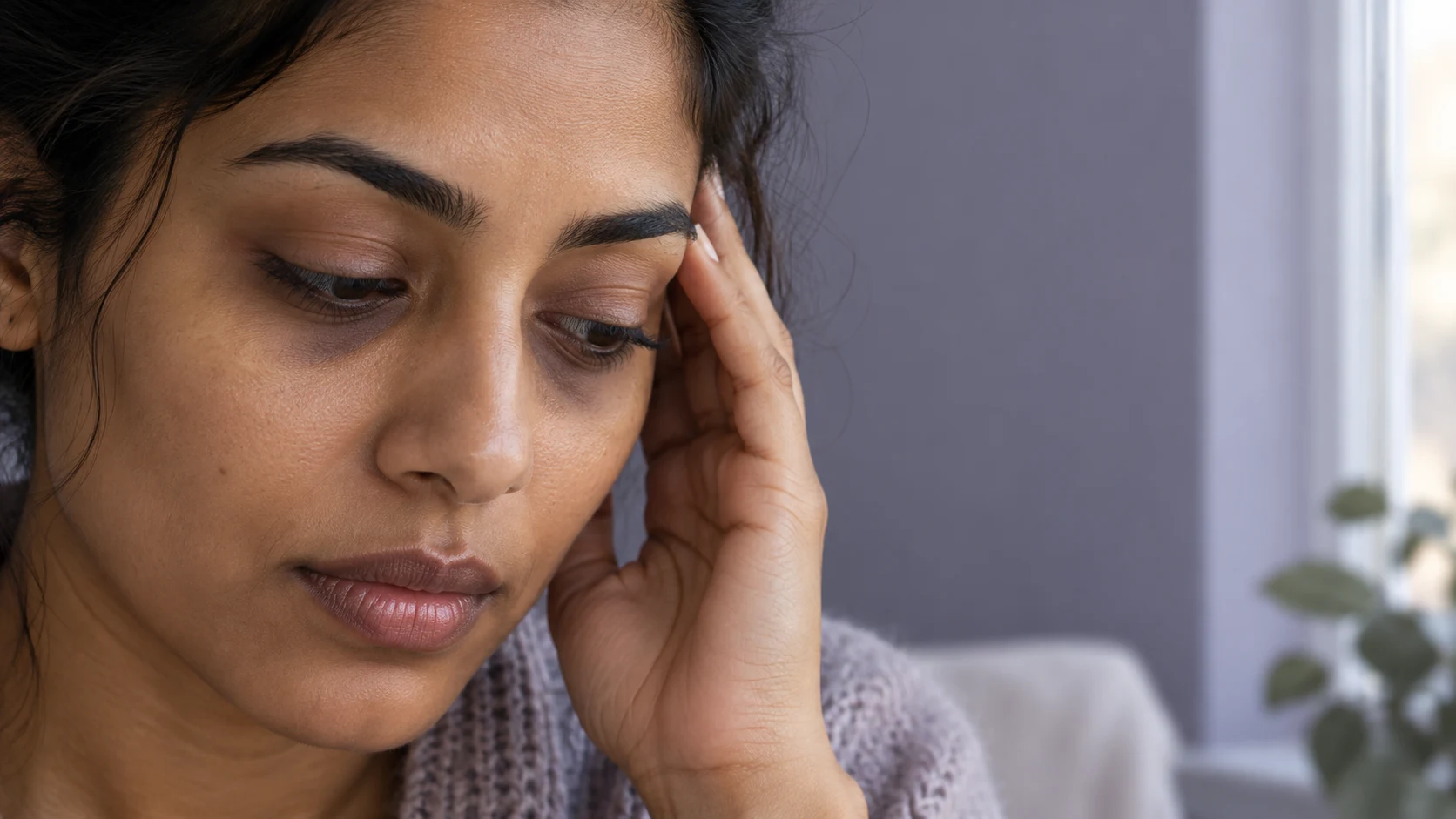
Dark circles around eyes usually have more than one cause. Extra pigment, blood vessels showing through thin skin and shadows from hollows or loose skin often overlap in the same person. [1] Family history, allergies and eye rubbing are common companions. [2] Sleep plays a smaller role than most people assume, and a sudden or one-sided change deserves a doctor’s look.
In this article
What are dark circles around the eyes?
Dark circles are areas of the lower eyelid that look darker than the surrounding skin. A review describes them as a cosmetic concern for many people rather than a medical problem, and notes that a clear definition and their exact causes have not been worked out. [1] In other words, one label covers several different things you might see in the mirror.
Another review defines them as round, even patches of darker color under both eyes and points out how few studies have looked at why they form. [3] That matters for everything that follows: much of what we know comes from small studies and expert reviews, not large trials.
Not every dark mark near the eye belongs here. Sun spots, melasma and brown marks left by breakouts can appear anywhere on the face; our dark spots guide covers them. Bruising after an injury, or darkness that appears overnight with swelling, is a different situation and needs medical attention. Tiny, firm, pearly white bumps under the eye are often milia, which our milia guide covers.
What causes dark under-eye circles?
Dark under-eye circles usually come from several factors at once. Reviews list genetics, excess pigment, darkening after eczema or allergic reactions, puffiness, prominent blood vessels, and shadows from skin laxity and the tear trough (the groove between the lower lid and cheek). [4] Which one dominates varies from person to person.
In a study of 65 people, 78% had a mixed type; circles caused by pigment, vessels or structure alone were in the minority. [5] The sections below take each factor in turn, along with how strong the evidence is.
Brown circles and pigment
Brownish circles involve extra melanin, the pigment that gives skin its color, deposited in the skin. [3] In a comparison of light-skinned adults, people with dark circles had a higher melanin reading under the eyes than people without them. [6] Darkening that lingers after eczema or an allergic skin reaction can add to this type. [4]
Blue or purple circles: vessels and thin skin
Lower eyelid skin is thin and can look translucent over the muscle beneath it. [1] In the same comparison, people with dark circles had thinner under-eye skin, a higher hemoglobin reading and signs of wider or more numerous capillaries. [6] Classification studies group these blue-to-purple circles as the vascular type. [5]
Shadows, hollows and age
Some dark circles are not a color at all but a shadow. As skin loosens and the tear trough deepens, light falls differently on the area. [1] In the 65-person study, ultrasound showed protruding fat pads in the 14 people who had under-eye bags. [5] No study shows this type responding to a cream or serum.
Family history
In a study of 200 dermatology patients in India, the most common type was the constitutional, or inherited, type (51.5%), and 63% of patients reported a family history. [2] A study of 116 patients in Iran also found family history significantly linked with dark circles. [7] Both were cross-sectional: they show an association, not how much genes contribute.
Allergies, eczema and eye rubbing
A study comparing 126 children with allergic rhinitis (hay fever) and 123 healthy children found darker and larger under-eye circles in the children with allergies. [8] Rubbing stands out too: 32.5% of the 200 patients in India rubbed their eyes often, [2] and the Iranian researchers named rubbing as one of two key factors. [7] The link with atopy (a tendency toward eczema, asthma and hay fever) is less consistent across studies.
Does lack of sleep cause dark circles?
Acute sleep loss can make circles look darker. When 10 people were photographed after 31 hours without sleep, 40 observers rated their under-eye circles as darker than after normal sleep. [9] That study measured perception, not skin color, and the sample was very small.
For long-lasting circles, the picture changes. Poor sleep habits were common among the 200 patients in India (40%), [2] but in the Iranian study sleep quality was not significantly related to how severe the circles were. [7] Sleep may shift how your eyes look from day to day, but it is rarely the whole explanation.
Can you tell which type you have?
Only roughly. In studies, a doctor sorted dark circles using an examination, a special lamp and ultrasound, so judging the type from color in a mirror is not reliable. [5] Their intensity also varies within the same day and from one day to the next. [6] Still, noticing the color and how it changes with light can help you set realistic expectations.
| Type | Typical look | Main driver |
|---|---|---|
| Pigmented | Brown, gray-brown | Melanin, darkening after inflammation |
| Vascular | Blue, purple, pinkish | Thin skin, visible capillaries |
| Structural | Shadow that shifts with light | Tear trough, laxity, bags |
| Mixed | Several shades together | More than one factor |
How common each type is also depends on who is studied. In the 65-person study from Taiwan, 78% had the mixed type, [5] while in 100 patients in Malaysia the vascular type was most common (51%) and the pigmented type accounted for only 6%. [10] The population and the method clearly shape the result.
How can you reduce dark circles under your eyes?
Dark circles under your eyes rarely vanish, but they can look less noticeable when the approach matches the cause. A systematic review of 39 studies found creams and chemical peels useful for pigment-related circles and fillers for volume loss, while stressing how little high-quality evidence exists. [11] That is why understanding the cause comes first. [4]
Expectations matter too. In practice, change takes weeks rather than days. Photos taken in the same light over several weeks help you separate a real change from the normal day-to-day swing in how dark your circles look. The steps below apply to almost every type.
Sun protection
An expert review calls sun protection a cornerstone of managing darkness around the eyes. [12] In the Iranian study, long hours in the sun were linked with dark circles. [7] However, no controlled study has directly measured whether sunscreen lightens under-eye circles.
The eye area is also easy to miss. In a study of 84 people, 14.0% of the eyelid region was left uncovered after applying sunscreen, compared with 20.9% after an SPF moisturizer. [13] Sunglasses and a wide-brimmed hat help cover this spot in practice. Our sunscreen guide explains amount and reapplication.
Stop rubbing
Because frequent eye rubbing is linked with dark circles, cutting back is a sensible first step. [7] If your eyes itch often, an allergy may be behind it, and treating that with a clinician can make rubbing less tempting. Skipping harsh cleansers and strong acids around the eyes also protects the skin; the skin barrier guide explains why.
Concealer and color correction
A review lists makeup among the least invasive options for dark circles. [14] In practice, a peach or salmon-toned corrector makes blue and purple shades less visible, and a concealer one shade lighter than your skin tone softens brown shades. Makeup does not change the skin, but it can make daily life easier.
In-office procedures
Lasers, fillers, chemical peels and surgery are medical procedures carried out by clinicians. [14] In a study of 90 patients, a 20% glycolic acid peel every three weeks led to more than 50% improvement in 73.34% of them, but this group also had the most side effects. [15] A review stresses that safety comes first so these treatments do not worsen pigmentation. [12] This guide does not recommend any procedure.
What helps dark circles under eyes?
What helps dark circles under eyes, according to research, rests on small studies. A review of popular eye cream ingredients found retinoids, vitamin C and caffeine promising for hyperpigmentation, but named the shortage of clinical trials focused on the eye area as a major limitation. [16] Treat the options below as possibilities, not solutions.
Which ingredient might help also depends on the type. The studies below mostly measured pigment- or vessel-related darkness; there is no data showing creams changing shadows or hollows. In practice, test a new eye product on a small area for a few days, choose a fragrance-free formula and keep it away from the lash line. If you are pregnant or breastfeeding, ask your clinician before starting a retinol product.
Vitamin C
In a split-face study of 14 people, a 10% sodium ascorbate lotion differed from the plain base in a redness reading after six months, but not in melanin; a second vitamin C form showed no difference at all. [17] In the 90-patient study, 26.67% of those using 20% vitamin C improved by more than half, which was less than with either peel, and there was no placebo group. [15] For forms and storage, see the vitamin C guide.
Caffeine and vitamin K
An eye pad with 3% caffeine and 1% vitamin K was placed under one eye of 11 women for four weeks, with a water-only pad under the other eye; darkness and wrinkle depth decreased on the treated side. [18] The study was tiny and the placebo was only water, so the effect of the oily base cannot be separated out.
Retinol
A gel with vitamin K, 0.1% retinol and vitamins C and E was used for eight weeks by 57 people; 27 of them (47%) had less vessel-related darkness, while pigment did not clearly change. [19] There was no control group and four ingredients were combined. Because eye skin is delicate, retinol is usually introduced slowly; the retinol guide explains how. For hydration around the eyes, see the hyaluronic acid guide.
Cold spoons, tea bags and cucumbers
Chilled spoons, cold tea bags, cucumber slices and plant oils are popular home remedies. No study has tested them directly. A cold compress may make morning puffiness feel better for a while, but there is no reason to expect it to change pigment or shadows. Keep oils and homemade mixtures out of your eyes.
When should you see a doctor?
Most dark circles are harmless. Still, a review notes that dermatitis, allergies, systemic illness, sleep disorders or nutritional deficiencies can all lead to darkness around the eyes, and it encourages a full medical history and examination before any cosmetic treatment. [12] The Iranian study also found links with some underlying conditions. [7]
- The darkness appeared suddenly or affects only one eye
- There is swelling, pain, redness, discharge or a change in vision
- The skin around your eyes itches, flakes or cracks
- You also feel unusually tired, weak or look pale
- The circles appear in a child or after an injury
Frequently asked questions
How do you get rid of dark undereye circles?
Usually you can make them less visible rather than get rid of them entirely. The realistic steps are sun protection, less rubbing, managing allergies and a well-matched concealer. For pigment-related circles, creams and in-office peels showed benefit in a systematic review, though the evidence was low quality. [11] Shadows from hollows tend to need a clinician’s assessment.
What do dark circles around the eyes mean?
Most of the time they reflect your skin and facial structure, not an illness. Inherited pigment, thin skin over visible vessels and shadows are the usual explanations. [1] Less often, dermatitis, allergies, systemic illness or nutritional deficiencies are involved, which is why a review recommends a medical history before treatment. [12] New or one-sided darkness should be checked.
Why are some dark circles very dark?
Several factors often stack up. People with dark circles showed both more melanin and more hemoglobin under the eyes, plus thinner skin, in a comparison study. [6] Periorbital darkening is also more common in people with darker skin tones, according to a review. [12] If very dark circles appeared recently, itch, or come with swelling, see a doctor.
References
- Roh MR, Chung KY. Infraorbital dark circles: definition, causes, and treatment options. Dermatol Surg. 2009;35(8):1163-1171. PubMed · DOI
- Sheth PB, Shah HA, Dave JN. Periorbital hyperpigmentation: a study of its prevalence, common causative factors and its association with personal habits and other disorders. Indian J Dermatol. 2014;59(2):151-157. PubMed · DOI
- Freitag FM, Cestari TF. What causes dark circles under the eyes? J Cosmet Dermatol. 2007;6(3):211-215. PubMed · DOI
- Sarkar R, Ranjan R, Garg S, Garg VK, Sonthalia S, Bansal S. Periorbital Hyperpigmentation: A Comprehensive Review. J Clin Aesthet Dermatol. 2016;9(1):49-55. PubMed
- Huang YL, Chang SL, Ma L, Lee MC, Hu S. Clinical analysis and classification of dark eye circle. Int J Dermatol. 2014;53(2):164-170. PubMed · DOI
- Mac-Mary S, Zornoza Solinis I, Predine O, et al. Identification Of Three Key Factors Contributing To The Aetiology Of Dark Circles By Clinical And Instrumental Assessments Of The Infraorbital Region. Clin Cosmet Investig Dermatol. 2019;12:919-929. PubMed · DOI
- Heidari F, Ebrahim Zadeh M, Haji Abole Zadeh M, Namiranian N. The Frequency of Periorbital Hyperpigmentation Risk Factors. J Cosmet Dermatol. 2025;24(2):e70036. PubMed · DOI
- Chen CH, Lin YT, Wen CY, et al. Quantitative assessment of allergic shiners in children with allergic rhinitis. J Allergy Clin Immunol. 2009;123(3):665-71, 671.e1-6. PubMed · DOI
- Sundelin T, Lekander M, Kecklund G, Van Someren EJ, Olsson A, Axelsson J. Cues of fatigue: effects of sleep deprivation on facial appearance. Sleep. 2013;36(9):1355-1360. PubMed · DOI
- Fatin AM, Mathana Sundram TK, Tan SSE, et al. Classification and characteristics of periorbital hyperpigmentation. Skin Res Technol. 2020;26(4):564-570. PubMed · DOI
- Michelle L, Pouldar Foulad D, Ekelem C, Saedi N, Mesinkovska NA. Treatments of Periorbital Hyperpigmentation: A Systematic Review. Dermatol Surg. 2021;47(1):70-74. PubMed · DOI
- Roberts WE. Periorbital hyperpigmentation: review of etiology, medical evaluation, and aesthetic treatment. J Drugs Dermatol. 2014;13(4):472-482. PubMed
- Lourenco EAJ, Shaw L, Pratt H, et al. Application of SPF moisturisers is inferior to sunscreens in coverage of facial and eyelid regions. PLoS One. 2019;14(4):e0212548. PubMed · DOI
- Vrcek I, Ozgur O, Nakra T. Infraorbital Dark Circles: A Review of the Pathogenesis, Evaluation and Treatment. J Cutan Aesthet Surg. 2016;9(2):65-72. PubMed · DOI
- Dayal S, Sahu P, Jain VK, Khetri S. Clinical efficacy and safety of 20% glycolic peel, 15% lactic peel, and topical 20% vitamin C in constitutional type of periorbital melanosis: a comparative study. J Cosmet Dermatol. 2016;15(4):367-373. PubMed · DOI
- Hamie H, Yassine R, Shoukfeh R, Turk D, Huq F, Moossavi M. A review of the efficacy of popular eye cream ingredients. Int J Womens Dermatol. 2024;10(2):e156. PubMed · DOI
- Ohshima H, Mizukoshi K, Oyobikawa M, et al. Effects of vitamin C on dark circles of the lower eyelids: quantitative evaluation using image analysis and echogram. Skin Res Technol. 2009;15(2):214-217. PubMed · DOI
- Ahmadraji F, Shatalebi MA. Evaluation of the clinical efficacy and safety of an eye counter pad containing caffeine and vitamin K in emulsified Emu oil base. Adv Biomed Res. 2015;4:10. PubMed · DOI
- Mitsuishi T, Shimoda T, Mitsui Y, Kuriyama Y, Kawana S. The effects of topical application of phytonadione, retinol and vitamins C and E on infraorbital dark circles and wrinkles of the lower eyelids. J Cosmet Dermatol. 2004;3(2):73-75. PubMed · DOI