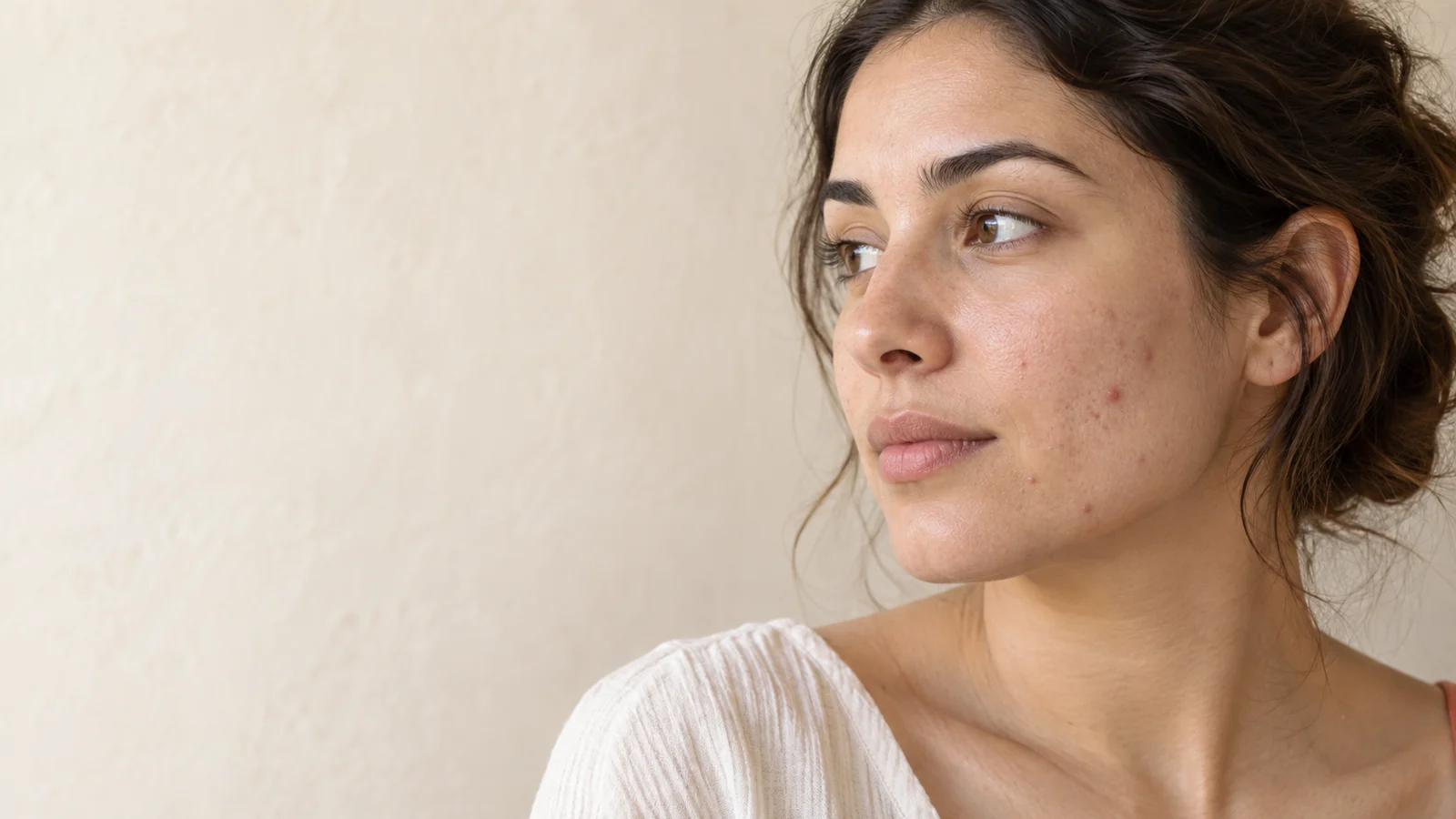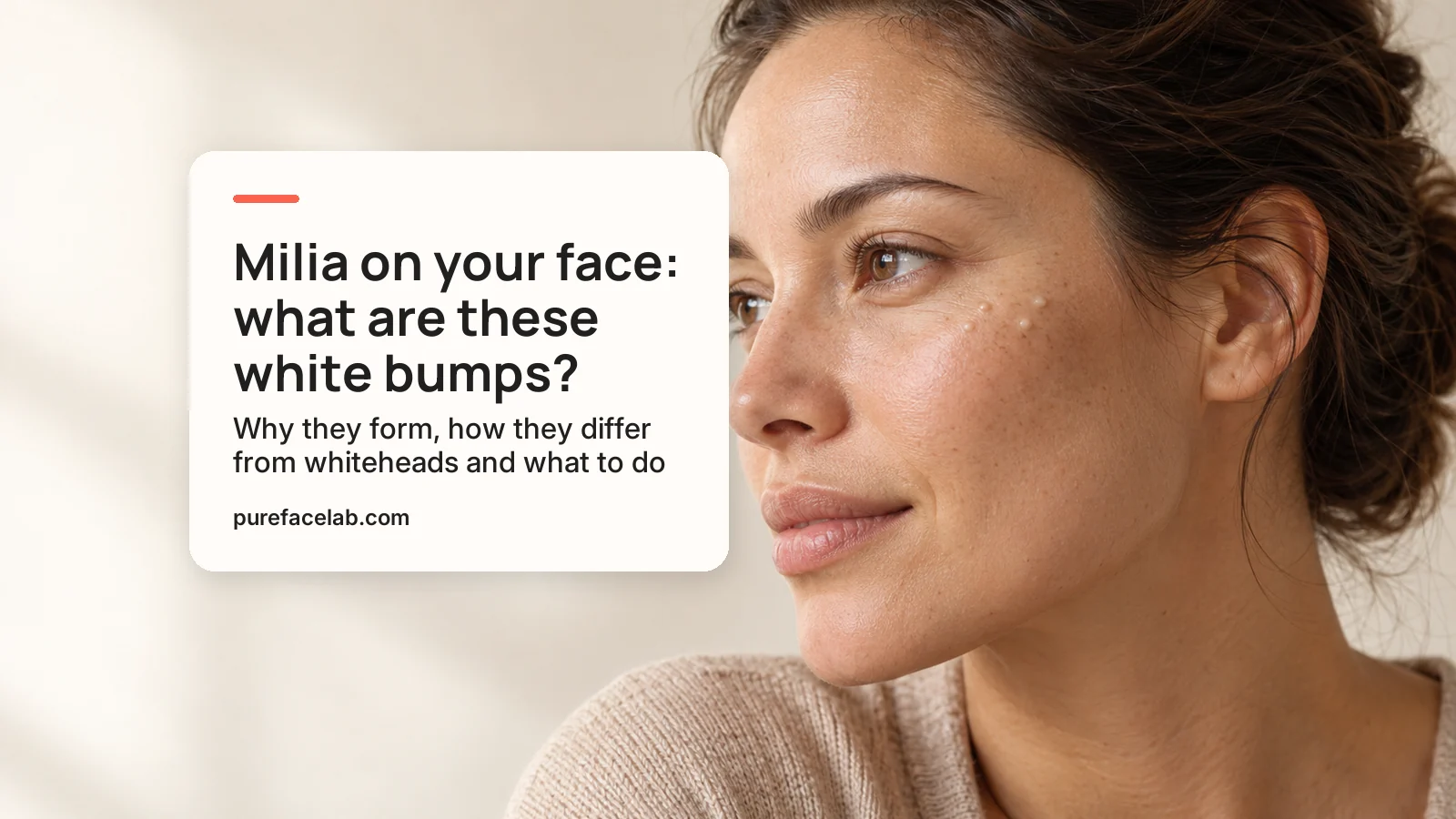
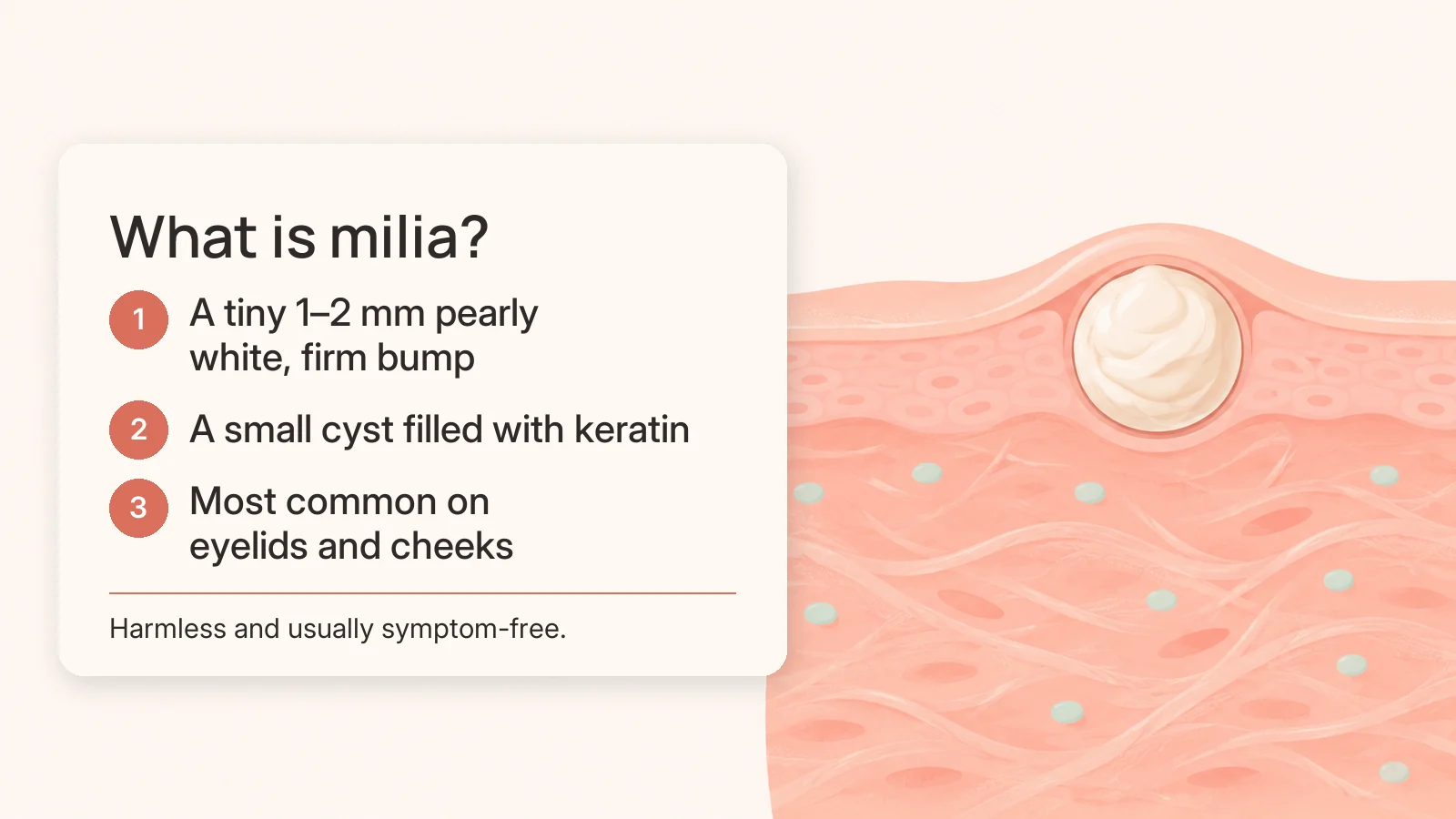
Milia on the face are tiny, harmless cysts filled with keratin, a protein from the skin’s outer layer. They look like firm, pearly white bumps of 1–2 mm. [1, 2] In newborns they usually clear within the first month. [3] In older children and adults they may stay, and removing them is a job for a dermatologist. [1]
In this article
What are milia on the face?
Milia (a single one is called a milium) are small, benign cysts that sit just under the surface of the skin and are filled with keratin. On the face they show up as tiny, firm, white bumps, typically 1–2 mm across and usually smaller than 3 mm. [1, 2]
They are pearly white or white-yellow, smooth and dome-shaped, and can look slightly bluish on darker skin. They usually cause no symptoms, and no wider health complications have been reported. [1]
Under a microscope, a milium is a closed cyst with a wall of layered skin cells and a keratin core: a sealed pocket, not an open pore. [2] The type doctors see most often favors the cheeks and eyelids. [4]
Milia or whitehead?
From a distance, a milium can look like a whitehead, but they are different things. A milium is a small keratin-filled cyst. [1] A whitehead, or closed comedone, is a form of acne: a plug that forms when cells build up inside the duct of a hair follicle and its oil gland. [5]
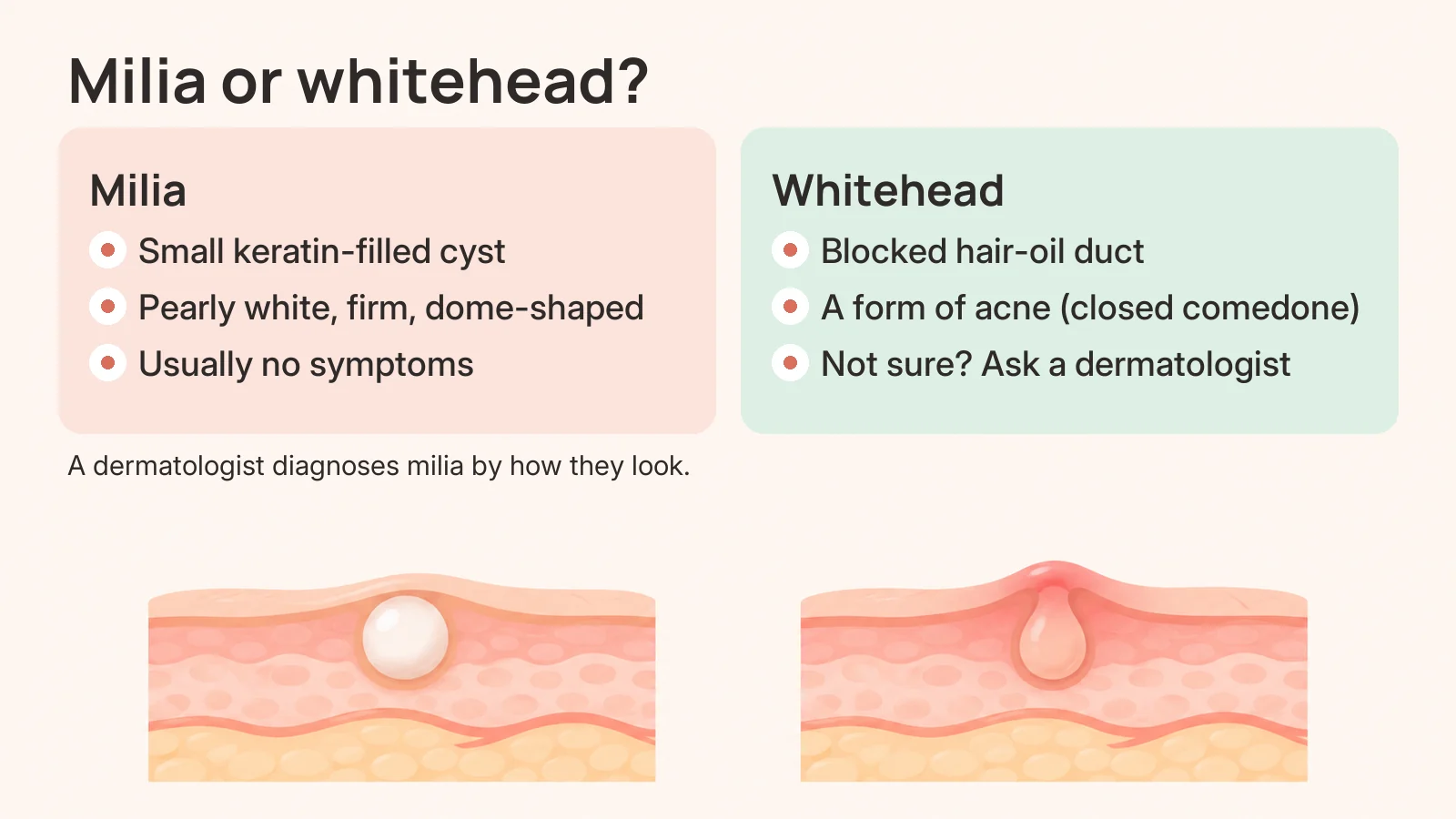
None of our sources explains how to tell them apart at home. Doctors diagnose milia by how they look, and comedonal acne is one of the conditions they rule out. [1] Not sure? Ask a dermatologist. The acne guide covers whiteheads; the blackheads guide covers open comedones.
Why do milia form?
Nobody knows exactly why most milia form, and few studies have looked at where they come from. [6, 2] Doctors sort them into two groups: primary milia, which appear on their own, and secondary milia, which follow skin damage, a skin disease or certain medicines. [1]
Most primary milia are the ones babies are born with. [1] In newborns, they are linked to skin structures that are not yet mature. [3] Rarer primary types include milia en plaque (many milia on a raised, reddish patch) and multiple eruptive milia, which appear suddenly in large numbers over weeks to months. [1]
Primary milia are thought to grow from tiny vellus hair follicles (the ones that make fine, almost invisible hairs), and secondary milia more often from sweat ducts. [1, 2] For milia that simply turn up on an adult face, our sources give no cause; we found no study blaming diet, hormones or makeup.
Secondary milia after procedures, injuries and medicines
Secondary milia are thought to form while sweat ducts or hair follicles repair themselves after blistering or injury. [2] They have been described after dermabrasion, radiotherapy, burns and skin grafts, [1] rarely after freezing treatment with liquid nitrogen (cryotherapy), [7] and after skin injury or light-triggered skin inflammation. [8]
The clearest numbers come from CO2 laser resurfacing. In 500 patients treated with an older, fully ablative laser, acne flares, milia and dermatitis together affected 10–15%, with no separate figure for milia. [9] After fractional laser, milia appeared in 6.9% of 97 patients, [10] and after fractional or combined laser treatments in 5.1% of 100 patients. [11] None had a control group, and rates depend on the device and aftercare. We found no source on chemical peels.
Some medicines are also listed, such as long-term steroid (cortisone) creams on thinned skin and non-steroidal anti-inflammatory drugs. [1] In one report, 2 patients developed milia after two weeks of a very strong steroid ointment. [12] Another describes a 17-year-old with about 20 milia, mostly under the lower eyelids, in the second month of isotretinoin, a prescription acne medicine taken by mouth. [13]
Single case reports do not prove cause; if milia appear while you take a prescription medicine, talk to the prescribing doctor before changing anything. None of this means skincare retinol causes milia; retinoid creams are listed among treatment options. [1]
Do heavy creams cause milia?
We found no study that tested whether thick creams, eye creams or sunscreen cause milia, and no source linking sun damage to milia. The only related data come from laser aftercare: milia appeared in 11.8% of patients who used a petrolatum-based ointment for the first 24 hours, compared with 1.5% in a group that did not. [11]
That comparison is weak: the groups also had different laser treatments, were not randomized and had no true control group, and the data come from healing laser wounds, not everyday skin. [11] In practice, if new milia follow a switch to a very rich cream, trying a lighter texture is a reasonable experiment, not a proven fix. The moisturizer guide explains textures.
Where do milia show up? Eyelids, under the eyes and nose
Milia are most common on the face. In adults, milia that appear on their own tend to show up on the eyelids, cheeks and forehead, and sometimes in the genital area; less often on the upper body, arms or legs. [1]
Many people first notice them just below the eyes; our sources do not explain why milia favor this area. Other bumps appear around the eyes too, so a bump on the eyelid rim, or one that changes, is worth showing to a dermatologist. If what bothers you under your eyes is darkness rather than bumps, see the dark circles guide.
Milia in babies: how common, and do they go away?
Milia are common and harmless in newborns. They usually disappear on their own within the first month without leaving marks, though they can last into the second or third month. No treatment is needed. [3, 1]
How common they are depends on the study:
| Where | Babies | When examined | Milia |
|---|---|---|---|
| United States | 594 | First 48 hours | 8% |
| Spain | 1,000 | First 3 days | 16.6% |
| Brazil | 2,530 | First 72 hours | 17.3% |
| Australia | 420 | First week | 36% |
The figures come from four studies. [14, 15, 16, 17] The Spanish one reported “skin cysts”; the Australian one dates from 1990 and mostly included olive-skinned babies. Reviews give higher figures: up to 40–50% [1] or up to 50%. [3] No study explains the spread, so no single number is “the” answer.
In babies, milia appear most on the nose, forehead, cheeks and chin, and also on the eyelids and scalp. [3, 1, 15] In babies born early, they may appear later. [1] Similar cysts on the gums and roof of the mouth are called Epstein pearls and Bohn nodules. [1]
In practice, leave them alone: no squeezing, scrubbing or oils. No study has tested any product for baby milia. Unsure? Ask your pediatrician.
How to get rid of milia on your face
Milia are harmless, so removing them is a cosmetic choice, not a medical need. [2] If they bother you, a dermatologist can remove them with simple in-office methods. No study has compared these methods, so nobody can say which works best. [2]
Do milia go away on their own?
In babies, they usually do. In older children and adults it is less predictable: milia other than newborn milia, including secondary milia, may not go away on their own. [1] Some case reports describe milia fading within a few months, [2] including one man whose milia after cryotherapy on the back of his hand cleared while doctors simply watched. [7] How many adult milia clear by themselves, and how fast, has not been measured.
How does a dermatologist remove milia?
The most common method is simple: the doctor makes a tiny nick in the skin with a sterile blade or needle, then presses the cyst out with a small tool such as a comedone extractor, a curette (a small scoop) or forceps. [1, 4] Other options include destroying the cyst with an electric current (electrodesiccation or electrocautery), lasers, freezing (cryotherapy) and dermabrasion. [1, 2, 4]
Support comes from individual cases. A 3 mm milium on a 74-year-old woman’s lower lip came out whole with forceps, with little pain or bleeding. [4] Four patients with unusual or widespread milia improved clearly after several CO2 laser sessions, with no return over 12–36 months. [8] In the isotretinoin case, the milia cleared fully after manual extraction. [13]
None had a comparison group, so they show that a method can work, not how often, or how often milia return.
Can retinoid creams help?
Topical retinoids, creams related to vitamin A, are listed as an option, especially when there are many milia. [1, 4] One review names tretinoin, a prescription retinoid. [2] But we found no controlled study testing retinoids on milia, so this rests on clinical experience rather than trial results.
We found no study on over-the-counter retinol or creams sold for milia either. The retinol guide explains how cosmetic retinol differs from prescription retinoids.
Should you squeeze or pop milia at home?
It is better not to. No study has tested home removal, so nobody knows how safe or effective it is. Our sources describe removal only as a procedure a doctor carries out with sterile tools. [1, 4] Even in a clinic, many techniques struggle to hold the tiny cyst in place, and removal around the eyes and mouth can be difficult and painful. [4]
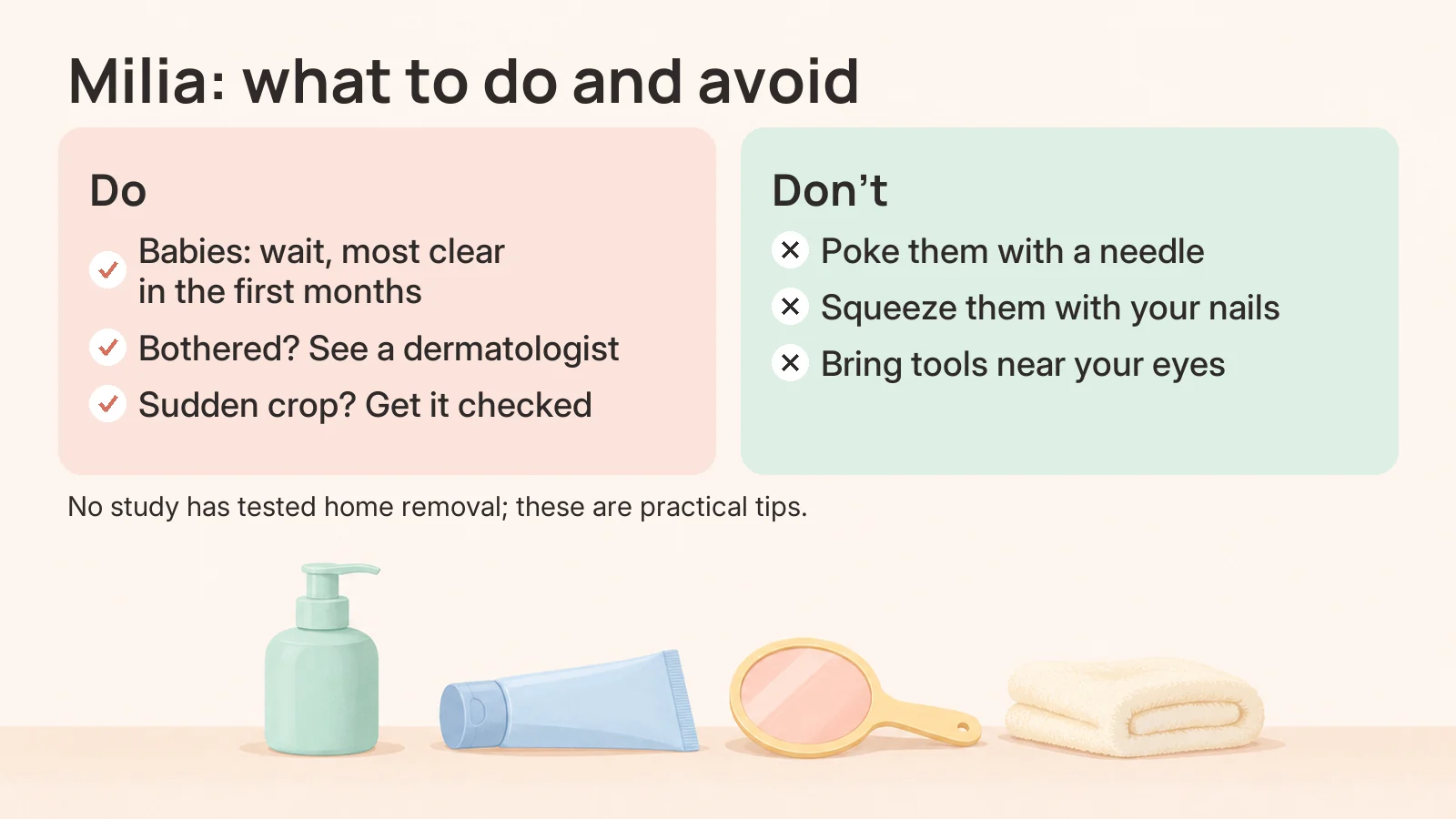
These are practical tips, not study results:
- Don’t poke milia with a needle.
- Don’t squeeze them with your nails.
- Don’t bring tools near your eyes.
- Bothered by them? See a dermatologist.
- Many appeared suddenly? Get them checked.
- In babies, wait: most clear in the first months.
Hard scrubbing can leave skin sore; the skin barrier guide explains why harsh steps backfire.
When should you see a dermatologist?
See a dermatologist if milia bother you, if you are not sure the bumps are milia, or if many appear at once. Doctors diagnose milia by how they look. If milia are widespread and persistent, especially alongside other skin changes, a doctor may check for an underlying inherited skin condition; in older children, they ask about past injuries or blistering. [1]
Many milia can also follow blistering skin diseases, often on old blister sites. [2] For a baby, your pediatrician is the right first stop.
Frequently asked questions
Are milia common in adults?
Milia can appear at any age, but none of our sources measured how common they are in adults. [1] In adults, the type doctors see most is benign primary milia, which favors the cheeks and eyelids. [4] There is no clear difference by race or sex, except that milia en plaque is more common in women. [1]
Are milia pimples?
No. Milia are tiny keratin cysts, while pimples are part of acne. [1, 5] When doctors diagnose milia, they rule out look-alikes: comedonal acne, enlarged oil glands (sebaceous hyperplasia, clusters of white-yellow bumps around the upper lip and nose), flat warts and a rare condition with calcium deposits in the skin. [1]
Can glycolic acid get rid of milia?
We found no study that tested glycolic acid, or any other exfoliating acid, on milia. The only cream our sources mention for milia is a retinoid, and even that has no controlled trial behind it. [1] If you use an exfoliating acid for other reasons, the salicylic acid guide covers strength, frequency and irritation.
What are white bumps on a baby’s face if not milia?
They may be enlarged oil glands, a newborn rash or heat rash; a pediatrician can tell these apart. In one US study, enlarged oil glands (sebaceous hyperplasia) were seen in 42.6% of newborns and erythema toxicum, a common newborn rash, in 7%, compared with 8% for milia. [14] Heat rash (miliaria) is a different condition from milia, even though both are linked to immature skin. [3]
References
- Gallardo Avila PP, Mendez MD. Milia. In: StatPearls. StatPearls Publishing; 2023. PubMed
- Patsatsi A, Uy CDC, Murrell DF. Multiple milia formation in blistering diseases. Int J Womens Dermatol. 2020;6(3):199-202. PubMed · DOI
- O’Connor NR, McLaughlin MR, Ham P. Newborn skin: Part I. Common rashes. Am Fam Physician. 2008;77(1):47-52. PubMed
- Janeczek M, Hoss E, Ochoa S. Forceps for Milia Extraction. Cutis. 2022;109(5):E28-E29. PubMed · DOI
- Cunliffe WJ, Holland DB, Jeremy A. Comedone formation: etiology, clinical presentation, and treatment. Clin Dermatol. 2004;22(5):367-374. PubMed · DOI
- Berk DR, Bayliss SJ. Milia: a review and classification. J Am Acad Dermatol. 2008;59(6):1050-1063. PubMed · DOI
- Beutler BD, Cohen PR. Cryotherapy-induced milia en plaque: case report and literature review. Dermatol Online J. 2014;21(2). PubMed
- Pozo Jd, Castiñeiras I, Fernández-Jorge B. Variants of milia successfully treated with CO(2) laser vaporization. J Cosmet Laser Ther. 2010;12(4):191-194. PubMed · DOI
- Nanni CA, Alster TS. Complications of carbon dioxide laser resurfacing. An evaluation of 500 patients. Dermatol Surg. 1998;24(3):315-320. PubMed · DOI
- Neaman KC, Baca ME, Piazza RC, VanderWoude DL, Renucci JD. Outcomes of fractional CO2 laser application in aesthetic surgery: a retrospective review. Aesthet Surg J. 2010;30(6):845-852. PubMed · DOI
- Duplechain JK, Rubin MG, Kim K. Novel post-treatment care after ablative and fractional CO2 laser resurfacing. J Cosmet Laser Ther. 2014;16(2):77-82. PubMed · DOI
- Iacobelli D, Hashimoto K, Kato I, Ito M, Suzuki Y. Clobetasol-induced milia. J Am Acad Dermatol. 1989;21(2 Pt 1):215-217. PubMed · DOI
- AlQaydi F, AlMarzouqi E. Isotretinoin-Associated Eruptive Milia: A Rare Adverse Effect. Cureus. 2026;18(1):e102725. PubMed · DOI
- Kanada KN, Merin MR, Munden A, Friedlander SF. A prospective study of cutaneous findings in newborns in the United States: correlation with race, ethnicity, and gestational status using updated classification and nomenclature. J Pediatr. 2012;161(2):240-245. PubMed · DOI
- Monteagudo B, Labandeira J, Cabanillas M, Acevedo A, León-Muiños E, Toribio J. Prevalence of milia and palatal and gingival cysts in Spanish newborns. Pediatr Dermatol. 2012;29(3):301-305. PubMed · DOI
- Reginatto FP, DeVilla D, Muller FM, et al. Prevalence and characterization of neonatal skin disorders in the first 72h of life. J Pediatr (Rio J). 2017;93(3):238-245. PubMed · DOI
- Rivers JK, Frederiksen PC, Dibdin C. A prevalence survey of dermatoses in the Australian neonate. J Am Acad Dermatol. 1990;23(1):77-81. PubMed · DOI