Yes, they can share a routine; the most practical split is vitamin C in the morning and retinol at night. If you want to use them at the same time and your skin tolerates it, you can try; separate the times if you get irritated.
Can you use retinol and vitamin C together? Yes. No study shows that they cancel each other out, but the evidence for the pair is limited to one very small study [1]. The easiest arrangement is vitamin C (L-ascorbic acid) in the morning with your sunscreen and retinol in the evening. That split does not come from a head-to-head comparison; it comes from what each ingredient is like.
In this article
- Can you use retinol and vitamin C together?
- Why vitamin C in the morning and retinol at night?
- What is the benefit of using them together?
- Example routines
- What happens when you use them?
- How should you store the products?
- Who should be careful?
- Common myth: do they cancel each other out?
- Frequently asked questions
- References
Can you use retinol and vitamin C together?
Yes, and the first thing to say is what the evidence does not contain: no study in our sources shows that retinol and vitamin C neutralize each other.
What it does contain is one small piece of positive evidence. Two double-blind, vehicle-controlled studies in post-menopausal women tested a preparation containing both retinol and vitamin C — on aged skin (8 people, elbow, 3 months) and on sun-damaged facial skin (11 people, 6 months). It produced changes in the epidermis (a more compact stratum corneum, increased cell proliferation) and in the dermis (a fall in the type III to type I procollagen ratio); the authors suggest the combination may partly reverse age-related changes [1]. Very small samples, and biopsy findings rather than measurements of what you would see. That is why we call the evidence for the pair Limited.
So if they do not fight each other, why does everyone separate them? Three real reasons, none of which is “they cancel out”:
- The formulas want different things. L-ascorbic acid has to sit in a formula with a pH below 3.5 to get into skin at all [2]. That is an unusually acidic environment to share with another active.
- Both molecules are fragile. Retinoids are chemically unstable and very sensitive to light, oxygen and heat [3]; in 12 commercial products, retinoid content fell by 0% to 80% at 25 °C and 40% to 100% at 40 °C over six months, with light-driven degradation more pronounced than heat [4]. Vitamin C is water-soluble and unstable in its own right, which is what makes it hard to formulate [5].
- Irritation adds up. Burning, flaking and dermatitis are what limit retinoid use in the first place [6]; a low-pH serum on top of that is asking a lot of one evening.
How each one is used on its own is in our retinol guide.
Why vitamin C in the morning and retinol at night?
Because each ingredient has a time of day that suits it, and they are not the same time.
Vitamin C belongs to the morning. A solution of 15% L-ascorbic acid, 1% alpha-tocopherol and 0.5% ferulic acid applied to human skin for four days gave significant protection against UV irradiation, measured by redness, sunburn cells, thymine dimers and p53; the authors note the mechanism differs from sunscreens and is expected to complement them [7]. An antioxidant is most useful when it is already in place before your skin meets daylight. Few participants, short experiment.
Retinol belongs to the evening. Retinoids degrade in light [4, 3]. Putting one on in the morning means part of it breaking down before it has done anything, and the irritation it can cause is easier to live with overnight.
Put those two facts side by side and the split writes itself. More on how to use a vitamin C serum on its own.
What is the benefit of using them together?
They reach similar-looking results by different routes, which is the honest case for having both in a routine.
| Retinol | Vitamin C | |
|---|---|---|
| Route | The retinoid pathway; precursor to retinoic acid [8] | Antioxidant and collagen cofactor [9] |
| Measured on | Fine wrinkles, hyperpigmentation [10] | Wrinkles, roughness, pigmentation [11] |
| Time of day | Evening | Morning |
On retinol: a network meta-analysis of 23 randomized controlled trials and 3,905 participants found that isotretinoin, retinol and tretinoin significantly improved fine wrinkles, with tretinoin and retinol standing out for hyperpigmentation. The authors note limited ethnic diversity, possible commercial bias and differences in assessment methods [10]. Four weeks of retinol increased epidermal thickness and collagen type I and III levels, in the same direction as retinoic acid but generally smaller; twelve weeks significantly reduced wrinkles on facial image analysis [8].
On vitamin C: a systematic review of 7 publications and 139 volunteers found treated skin looked smoother and less wrinkled, supported by biopsy data, with significant lightening on objective pigment measurements; long-term use may be needed for a clear change [11]. Its role is as an antioxidant and a cofactor in collagen synthesis [9].
What our sources do not offer is a study comparing “both” against “one of them”. Nobody can tell you how much the second ingredient adds.
Example routines
| Steps | |
|---|---|
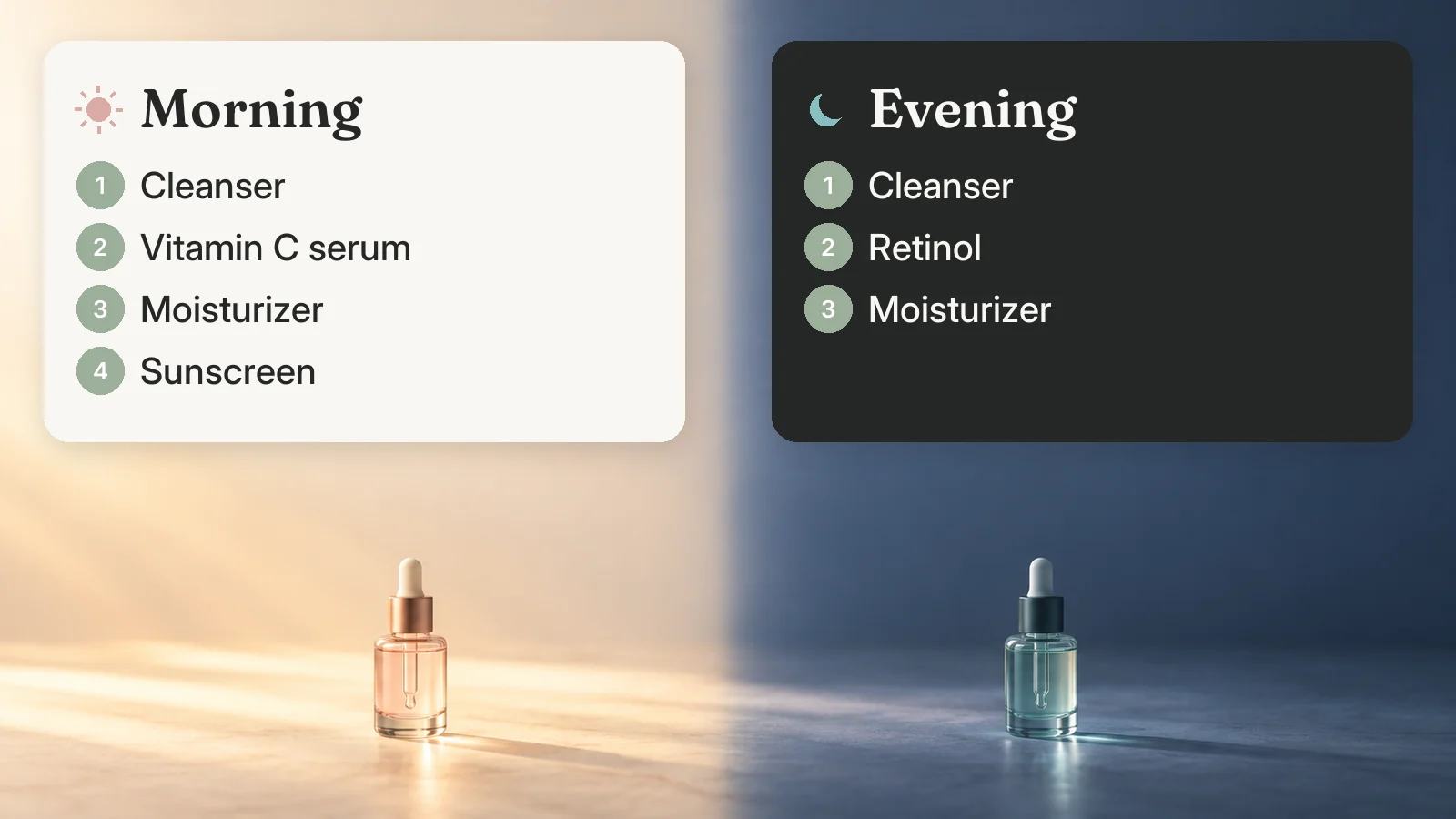
| Morning | Cleanser → vitamin C serum → moisturizer → sunscreen |
| Evening | Cleanser → retinol → moisturizer |
Do not treat the sunscreen as optional. In an Australian trial with 903 adults under 55, the daily-use group showed no detectable increase in skin aging over 4.5 years — 24% less than the group who used it when they felt like it. Some data were missing [12].
If retinol is new to you, build up rather than starting at full strength. In a 12-week study, 45 women used escalating doses (retinol 0.25% → 0.5% → 1%, or tretinoin 0.025% → 0.05% → 0.1%) with a moisturizer; effectiveness was similar in both groups and the retinol group showed marked improvement in dryness [13]. Two or three nights a week is a reasonable start.
If you want both in the same evening: no study in our sources compares the order, so we will not invent one. The practical rule is the lighter, water-based texture first. If you get irritated, stop stacking them and go back to the morning-and-night split.
What happens when you use them?
Most of what you notice early on comes from the retinol. Dryness, flaking and redness are the typical first-weeks reactions [6]; in a 12-week study comparing 0.3% and 0.5% retinol serums in 37 volunteers, side effects were mostly mild to moderate irritation, more frequent and more intense on the 0.5% side [14].
Vitamin C is gentler: the 5% cream used for 6 months on the décolletage was well tolerated [15]. Stinging does happen, an unavoidable consequence of the low pH L-ascorbic acid needs; lowering the percentage or frequency usually settles it.
Timelines, as the studies measured them:
| What | When it was measured |
|---|---|
| Wrinkles (retinol) | 12 weeks [8] |
| Fine lines, roughness (vitamin C, face) | 3 months [16] |
| Overall score (vitamin C, décolletage) | 6 months [15] |
How should you store the products?
This pair is unusually demanding about storage, because both molecules are fragile in the same ways: light, air and heat [4, 3, 5].
- Retinol: opaque packaging, ideally an airless pump, somewhere cool and dark. In the 12-product study, some products contained less retinoid than their labels stated [4]; the number of products was limited and results depended on the formula.
- Vitamin C: a dark or opaque bottle, cap closed tightly, away from the window. If the serum has clearly darkened from pale yellow to brown, it has most likely oxidized.
Neither belongs on a sunny bathroom windowsill.
Who should be careful?
Three groups, and in each case the caution is about retinol or about a condition that needs a doctor, not about the pairing itself.
- Sensitive skin and rosacea: irritation reactions are what limit retinoid use [6]. Keep the two ingredients at separate times, lower the retinol frequency, and ask a dermatologist first.
- Pregnancy and breastfeeding: retinol is not recommended. A meta-analysis covering 654 exposed and 1,375 unexposed pregnancies found no significant increase in major congenital malformations or miscarriage after first-trimester exposure to a topical retinoid, but the authors say the statistical power is not enough to justify use in pregnancy [17]. For vitamin C there is no pregnancy-specific study in our sources; most skincare products act locally [18]. Talk to your doctor.
- Melasma: a systematic review of 35 randomized controlled trials gave a strong clinical recommendation only for cysteamine, triple combination therapy and tranexamic acid [19]. See a dermatologist rather than layering serums.
Common myth: do they cancel each other out?
No study in our sources shows this, and it is the single most repeated claim about this pair. On the contrary, a preparation containing both retinol and vitamin C was studied and produced measurable tissue changes [1].
The things worth watching are less dramatic and more useful: whether your skin gets irritated when you stack two demanding actives, and whether either product is still intact by the time you use it. Storage and tolerance are the real variables, not a chemical feud.
Frequently asked questions
Can I use retinol and vitamin C on the same night?
You can if your skin tolerates it, but the evidence for the pair is limited to one very small study [1]. If you get irritated, split them between morning and evening.
Which one goes first?
No study in our sources compares the order. The practical rule is the lighter, water-based texture first.
Can I use vitamin C at night and retinol in the morning?
We would not. Retinol degrades in light [4], so the morning is the worst slot for it. Vitamin C at night is defensible; retinol in the morning is not.
Can I add niacinamide to the routine?
Yes. Niacinamide combines easily with both — see retinol and niacinamide and our guide to niacinamide.
Can you use this pair during pregnancy?
Retinol is not recommended in pregnancy; the evidence is not strong enough to justify it [17]. For vitamin C, ask your doctor [18].
References
- Seité S, Bredoux C, Compan D, et al. Histological evaluation of a topically applied retinol-vitamin C combination. Skin Pharmacol Physiol. 2005;18(2):81-87. PubMed · DOI
- Pinnell SR, Yang H, Omar M, et al. Topical L-ascorbic acid: percutaneous absorption studies. Dermatol Surg. 2001;27(2):137-142. PubMed · DOI
- Zhong J, Zhao N, Song Q, Du Z, Shu P. Topical retinoids: Novel derivatives, nano lipid-based carriers, and combinations to improve chemical instability and skin irritation. J Cosmet Dermatol. 2024;23(10):3102-3115. PubMed · DOI
- Temova Rakuša Ž, Škufca P, Kristl A, Roškar R. Retinoid stability and degradation kinetics in commercial cosmetic products. J Cosmet Dermatol. 2021;20(7):2350-2358. PubMed · DOI
- Stamford NP. Stability, transdermal penetration, and cutaneous effects of ascorbic acid and its derivatives. J Cosmet Dermatol. 2012;11(4):310-317. PubMed · DOI
- Mukherjee S, Date A, Patravale V, Korting HC, Roeder A, Weindl G. Retinoids in the treatment of skin aging: an overview of clinical efficacy and safety. Clin Interv Aging. 2006;1(4):327-348. PubMed · DOI
- Murray JC, Burch JA, Streilein RD, Iannacchione MA, Hall RP, Pinnell SR. A topical antioxidant solution containing vitamins C and E stabilized by ferulic acid provides protection for human skin against damage caused by ultraviolet irradiation. J Am Acad Dermatol. 2008;59(3):418-425. PubMed · DOI
- Kong R, Cui Y, Fisher GJ, et al. A comparative study of the effects of retinol and retinoic acid on histological, molecular, and clinical properties of human skin. J Cosmet Dermatol. 2016;15(1):49-57. PubMed · DOI
- Al-Niaimi F, Chiang NYZ. Topical Vitamin C and the Skin: Mechanisms of Action and Clinical Applications. J Clin Aesthet Dermatol. 2017;10(7):14-17. PubMed
- Lin L, Chen X, Liu C, et al. Comparative efficacy of topical interventions for facial photoaging: a network meta-analysis. Sci Rep. 2025;15(1):26889. PubMed · DOI
- Correia G, Magina S. Efficacy of topical vitamin C in melasma and photoaging: A systematic review. J Cosmet Dermatol. 2023;22(7):1938-1945. PubMed · DOI
- Hughes MC, Williams GM, Baker P, Green AC. Sunscreen and prevention of skin aging: a randomized trial. Ann Intern Med. 2013;158(11):781-790. PubMed · DOI
- Draelos ZD, Peterson RS. A Double-Blind, Comparative Clinical Study of Newly Formulated Retinol Serums vs Tretinoin Cream in Escalating Doses: A Method for Rapid Retinization With Minimized Irritation. J Drugs Dermatol. 2020;19(6):625-631. PubMed · DOI
- Zasada M, Budzisz E, Erkiert-Polguj A. A Clinical Anti-Ageing Comparative Study of 0.3 and 0.5% Retinol Serums: A Clinically Controlled Trial. Skin Pharmacol Physiol. 2020;33(2):102-116. PubMed · DOI
- Humbert PG, Haftek M, Creidi P, et al. Topical ascorbic acid on photoaged skin. Clinical, topographical and ultrastructural evaluation: double-blind study vs. placebo. Exp Dermatol. 2003;12(3):237-244. PubMed · DOI
- Traikovich SS. Use of topical ascorbic acid and its effects on photodamaged skin topography. Arch Otolaryngol Head Neck Surg. 1999;125(10):1091-1098. PubMed · DOI
- Kaplan YC, Ozsarfati J, Etwel F, Nickel C, Nulman I, Koren G. Pregnancy outcomes following first-trimester exposure to topical retinoids: a systematic review and meta-analysis. Br J Dermatol. 2015;173(5):1132-1141. PubMed · DOI
- Bozzo P, Chua-Gocheco A, Einarson A. Safety of skin care products during pregnancy. Can Fam Physician. 2011;57(6):665-667. PubMed
- Austin E, Nguyen JK, Jagdeo J. Topical Treatments for Melasma: A Systematic Review of Randomized Controlled Trials. J Drugs Dermatol. 2019;18(11):1156-1171. PubMed