Yes, you can use them together. Two studies of products that combined both ingredients in one formula reported visible improvements [1, 2]. No study has tested two separate products used together. Practical tip: retinol at night; hyaluronic acid before it, after it, or in the morning.
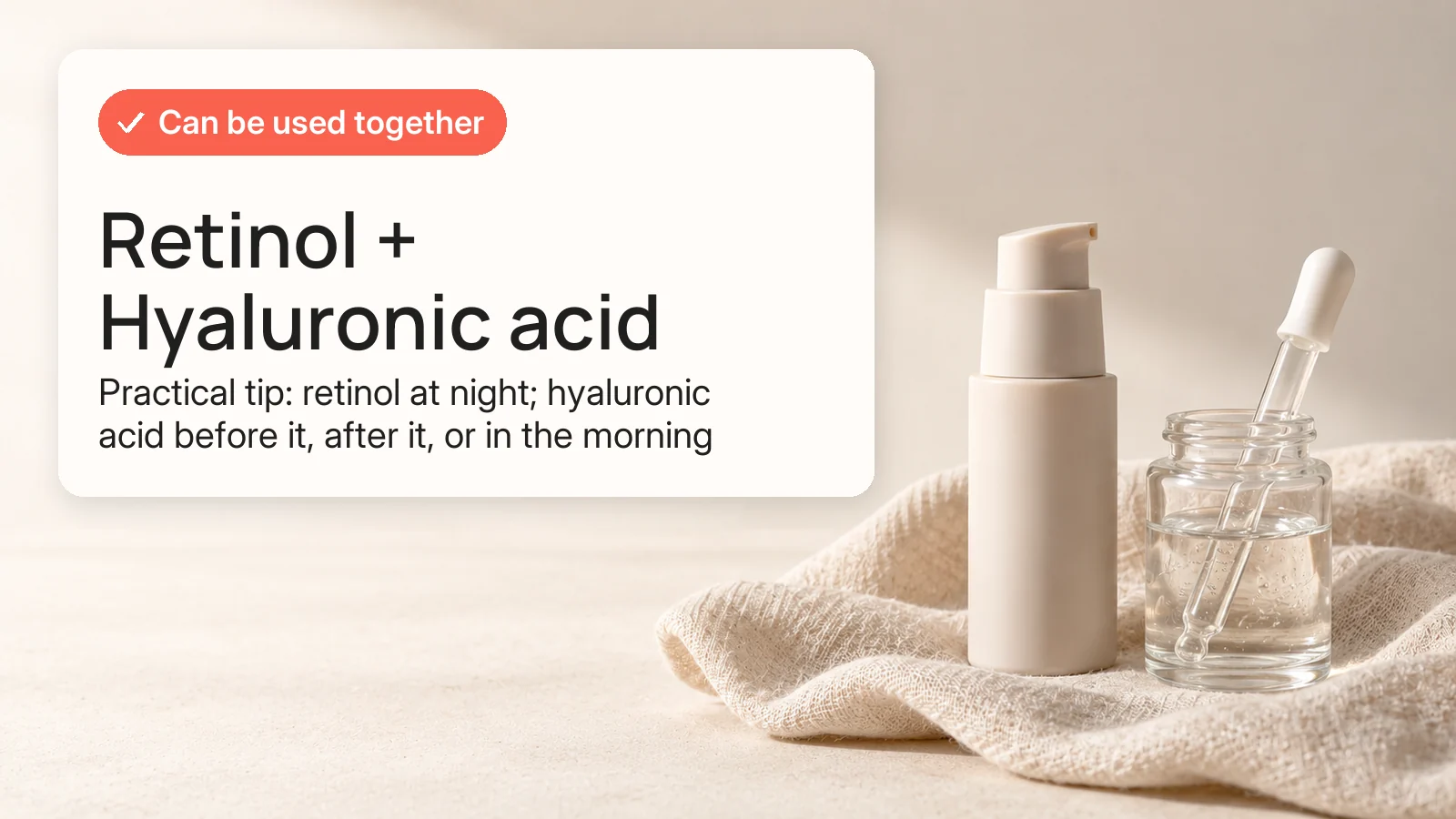
Can you use hyaluronic acid with retinol? Yes. Retinol (a vitamin A derivative) and hyaluronic acid (a water-binding moisture ingredient) were combined in the products tested in two studies, and wrinkle appearance improved; in the larger one the products were very well tolerated [1, 2]. No study has compared application orders, so the order is a practical choice.
In this article
- Can you use hyaluronic acid with retinol?
- What does pairing hyaluronic acid and retinol do?
- Hyaluronic acid before or after retinol?
- A skin care routine with retinol and hyaluronic acid
- What should you expect in the first weeks?
- Who should be careful?
- Myth check: does hyaluronic acid block retinol?
- Frequently asked questions
- References
Can you use hyaluronic acid with retinol?
Yes. You can use hyaluronic acid with retinol: studies of formulas containing both reported better-looking skin and no problem specific to the pair. One limit matters, though. These studies tested a single product with both ingredients plus other actives, not two separate serums layered at home.
- After a wrinkle injection: In a double-blind study, people given botulinum toxin between the brows used a regimen with retinol, adenosine and hyaluronic acid for 2 months. It beat placebo, and crow’s feet improved independently of the injection [1].
- Retinal plus hyaluronic acid fragments: In an open multicenter study without a control group, 1,462 people used 0.05% retinaldehyde (retinal, a retinol relative) with hyaluronic acid fragments for 90 days. Wrinkles decreased significantly; the products were very well tolerated [2].
A twist: in lab and tissue models, retinol raised the skin’s own hyaluronic acid production, and a vehicle-controlled human study found more hyaluronic acid in the epidermis (outer living skin layer) of retinol-treated skin [3]. With prescription retinoic acid, the epidermal hyaluronic acid network thickened by 31% over 6 months in 14 people [4]. These are tissue measurements, not moisture or wrinkle outcomes.
Limits: The first study involved injections; the second had no control group and used retinal. Our retinol guide and hyaluronic acid guide cover each ingredient alone.
What does pairing hyaluronic acid and retinol do?
Hyaluronic acid and retinol do different jobs. Retinol has controlled-trial support for softening the look of wrinkles but can dry and irritate skin; hyaluronic acid supports hydration. Pairing them aims to keep skin comfortable while it adjusts to retinol, although that benefit of hyaluronic acid has not been tested directly.
- Retinol: In a network meta-analysis (a study pooling many trials) of 23 randomized controlled trials and 3,905 participants, retinol significantly improved fine wrinkles [5]. Burning and peeling limit retinoid use, but retinol is markedly less irritating than prescription tretinoin [6].
- Hyaluronic acid: In 76 women, 0.1% hyaluronic acid creams increased hydration and elasticity around the eyes over 60 days [7]. On the legs of older adults with dry skin, a low molecular weight lotion raised hydration at 4 weeks, with no difference in water loss [8].
- Moisture support with retinoids: In a study of 45 women, retinol strength was stepped up alongside a moisturizer, and dryness improved markedly in the retinol group [9]. In three split-face studies with prescription tretinoin, the moisturized side eased the adjustment period [10], reduced dryness and flaking [11] or kept irritation mostly mild [12].
None of these moisturizers was reported to contain hyaluronic acid, and the studies were small, mostly with manufacturer ties. Moisture support can ease retinoid adjustment; that hyaluronic acid prevents retinol irritation is unproven. See our moisturizer guide.
Retinol or hyaluronic acid?
Retinol or hyaluronic acid? Usually both, because they target different things.
| Retinol | Hyaluronic acid | |
|---|---|---|
| Main goal | Wrinkle appearance, tone [5] | Hydration and elasticity readings [7, 8] |
| Evidence | Moderate; meta-analysis | Moderate for hydration; small trials |
| Tolerance | Dryness, irritation possible [6] | Generally well tolerated [8] |
| Timing | Night | Morning or night |
| Pregnancy | Not recommended | Ask your doctor |
Our wrinkles guide compares the studied options for lines.
Hyaluronic acid before or after retinol?
No study has compared hyaluronic acid before or after retinol, so either order is a practical choice. Online advice splits: some say hyaluronic acid first, others retinol first on dry skin. Evidence supports neither over the other, so let your skin’s tolerance decide.
Lab studies with other ingredients show order sometimes matters. On pig skin, moisturizer applied and massaged in before a corticosteroid cream increased penetration, while moisturizer applied afterward reduced it [13]. In a human skin model, moisturizer before or after azelaic acid barely changed penetration [14]. None of this was tested with retinol.
Retinol or hyaluronic acid first? Three practical options:
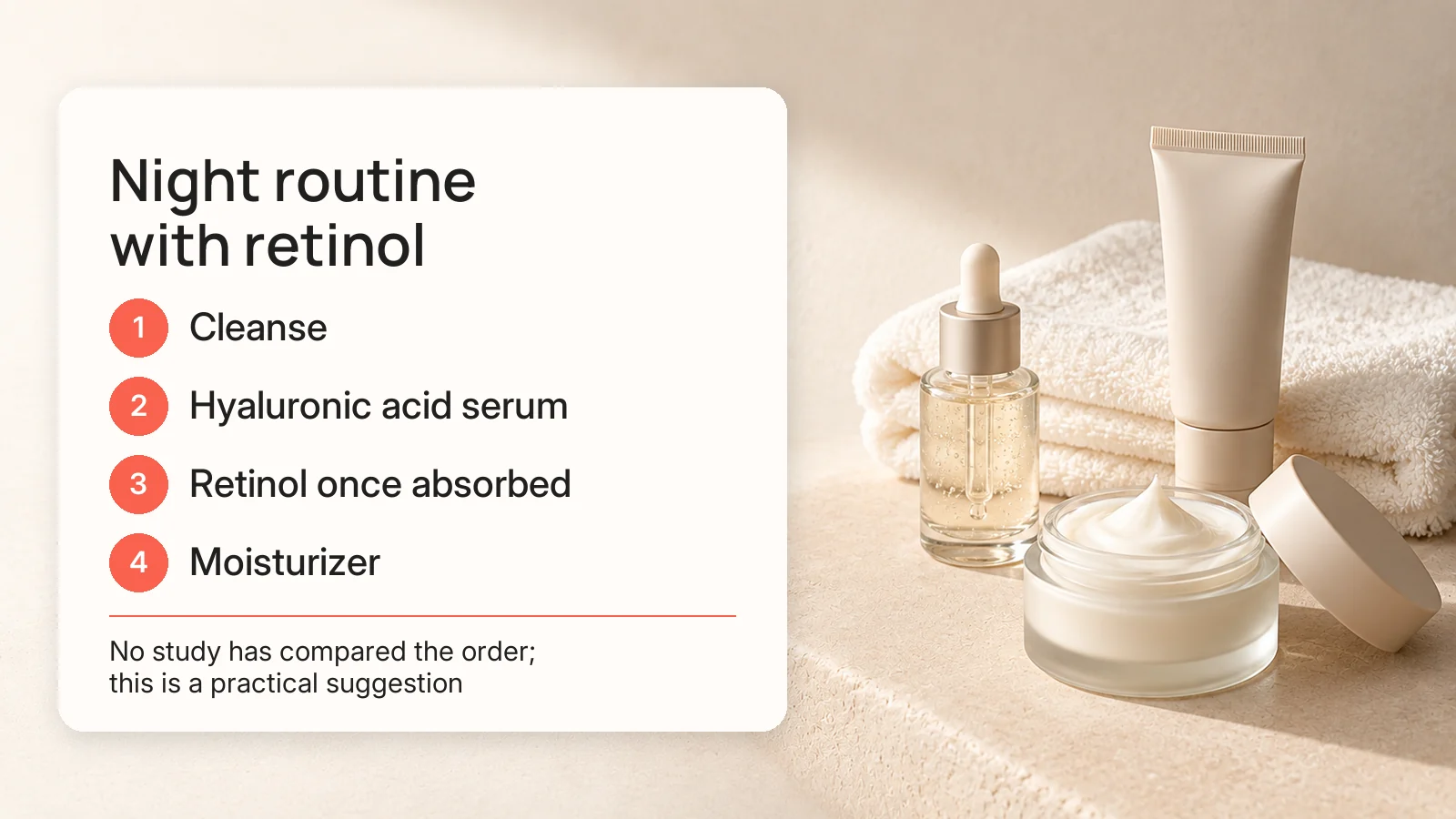
- Hyaluronic acid first: Cleanse → hyaluronic acid serum → retinol once absorbed → moisturizer. Often suggested for dry or sensitive skin.
- Retinol first: Cleanse and pat dry → retinol → hyaluronic acid → moisturizer. An option once your skin tolerates retinol.
- Split the day: Hyaluronic acid and sunscreen in the morning, retinol and moisturizer at night.
What is the retinol sandwich method?
The sandwich method puts retinol between two hydrating layers: moisturizer or hyaluronic acid → retinol → moisturizer. It is a practical option for the drying first weeks. No study has tested it, and whether it weakens retinol is unknown.
Should retinol go on damp skin?
The usual practical advice is to apply retinol to clean, dry skin. That advice is untested, but it has a rationale: covering or hydrating skin often, though not always, increases absorption of what you apply [15]. In the lab, low molecular weight hyaluronic acid increased a model protein’s penetration into normal skin [16].
Neither finding involved retinol. Hyaluronic acid on slightly damp skin is a preference with no proven universal advantage, as our hyaluronic acid guide explains. If you get irritation, pat your face dry and let serum absorb before retinol.
A skin care routine with retinol and hyaluronic acid
If you are new, limit retinol to 2 or 3 nights a week and use hyaluronic acid daily. Retinoids break down with light, oxygen and heat, so retinol belongs in the evening [17]. Morning sunscreen belongs in both routines, which are practical suggestions, not tested protocols.
| Beginner | Experienced | |
|---|---|---|
| Morning | Cleanser → hyaluronic acid → moisturizer → sunscreen | Same |
| Night | 2–3 nights a week: cleanser → hyaluronic acid → retinol → moisturizer. Other nights: no retinol | Cleanser → retinol → hyaluronic acid → moisturizer |
In a trial of 903 adults, daily broad-spectrum sunscreen users showed 24% less skin aging over 4.5 years than discretionary users [18]. See our sunscreen guide.
More actives? See retinol and niacinamide, retinol and vitamin C and retinol with AHA/BHA.
What should you expect in the first weeks?
In the first weeks, retinol can cause dryness, flaking or mild-to-moderate irritation, a phase called retinization (skin adjusting to a retinoid). Hyaluronic acid may make dryness feel better but has not been shown to prevent irritation. If redness or stinging persists, cut back retinol nights instead of adding layers.
- Irritation: In a 37-person study comparing 0.3% and 0.5% retinol serums, side effects were mostly mild-to-moderate irritation, more frequent and intense on the 0.5% side [19]. Retinol is less irritating than tretinoin [6].
- With moisture support: Retinol stepped up with a moisturizer matched tretinoin’s efficacy at 12 weeks [9].
| Time point | What studies measured |
|---|---|
| 15 days | Less dryness and flaking with a moisturizer alongside retinoids [11] |
| 60 days | More hydration and elasticity around the eyes with hyaluronic acid creams [7] |
| 12 weeks | Fewer spots and wrinkles with retinol; irritation mostly mild-to-moderate [19] |
These are measurement points; your experience may differ. If your skin feels tight or raw, see the skin barrier guide.
Who should be careful?
Take extra care if you have sensitive skin, rosacea or eczema, use a prescription retinoid, or are pregnant or breastfeeding. Hyaluronic acid is generally well tolerated; retinol is usually the ingredient that needs caution. With a skin condition, plan your routine with a dermatologist.
- Pregnancy and breastfeeding: Retinol is not recommended in pregnancy. A meta-analysis of 654 pregnancies exposed to topical retinoids in the first trimester found no significant rise in birth defects, but the authors say its statistical power cannot justify use in pregnancy [20]. Ask your doctor about hyaluronic acid products too; see our pregnancy skincare guide.
- Prescription retinoids: Ask your prescriber before adding retinol.
- Sensitive skin: Start one new product at a time.
Myth check: does hyaluronic acid block retinol?
No study shows that it does. The claim that hyaluronic acid keeps retinol from penetrating has never been tested with retinol. In the lab, hyaluronic acid actually increased penetration of a model protein, not retinol, into normal skin [16]. Neither the claim nor its opposite is proven.
Retinol may even raise your skin’s own hyaluronic acid [3]. The two are not rivals.
Frequently asked questions
Do you need to wait between them?
No study shows that waiting improves results. In practice, move on once the first product has absorbed and your skin no longer feels wet or slippery.
Can I use hyaluronic acid with retinol at night?
Yes, before or after retinol; neither order has been tested. Retinol is used at night because retinoids degrade in light [17]. Finish with a moisturizer if your skin feels dry.
Is one product with both enough?
It can be. The studied products combined both in one formula [1, 2], though results belong to each whole formula. Add a moisturizer if dryness persists.
Is hyaluronic acid a retinol?
No. Hyaluronic acid is a water-binding molecule found naturally in skin, while retinol belongs to the retinoid family of vitamin A derivatives [6]. Despite its name, hyaluronic acid is not an exfoliating acid.
Can you use them while pregnant?
Retinol is not recommended during pregnancy. Our sources contain no pregnancy-specific study of hyaluronic acid products, so review the whole product with your doctor, including while planning a pregnancy or breastfeeding.
References
- Ascher B, Fanchon C, Kanoun-Copy L, Bouloc A, Benech F. A skincare containing retinol adenosine and hyaluronic acid optimises the benefits from a type A botulinum toxin injection. J Cosmet Laser Ther. 2012;14(5):234-238. PubMed · DOI
- Cordero A, Leon-Dorantes G, Pons-Guiraud A, et al. Retinaldehyde/hyaluronic acid fragments: a synergistic association for the management of skin aging. J Cosmet Dermatol. 2011;10(2):110-117. PubMed · DOI
- Li WH, Wong HK, Serrano J, et al. Topical stabilized retinol treatment induces the expression of HAS genes and HA production in human skin in vitro and in vivo. Arch Dermatol Res. 2017;309(4):275-283. PubMed · DOI
- Lundin A, Berne B, Michaëlsson G. Topical retinoic acid treatment of photoaged skin: its effects on hyaluronan distribution in epidermis and on hyaluronan and retinoic acid in suction blister fluid. Acta Derm Venereol. 1992;72(6):423-427. PubMed
- Lin L, Chen X, Liu C, et al. Comparative efficacy of topical interventions for facial photoaging: a network meta-analysis. Sci Rep. 2025;15(1):26889. PubMed · DOI
- Mukherjee S, Date A, Patravale V, Korting HC, Roeder A, Weindl G. Retinoids in the treatment of skin aging: an overview of clinical efficacy and safety. Clin Interv Aging. 2006;1(4):327-348. PubMed · DOI
- Pavicic T, Gauglitz GG, Lersch P, et al. Efficacy of cream-based novel formulations of hyaluronic acid of different molecular weights in anti-wrinkle treatment. J Drugs Dermatol. 2011;10(9):990-1000. PubMed
- Muhammad P, Novianto E, Setyorini M, et al. Effectiveness of topical hyaluronic acid of different molecular weights in xerosis cutis treatment in elderly: a double-blind, randomized controlled trial. Arch Dermatol Res. 2024;316(6):329. PubMed · DOI
- Draelos ZD, Peterson RS. A Double-Blind, Comparative Clinical Study of Newly Formulated Retinol Serums vs Tretinoin Cream in Escalating Doses: A Method for Rapid Retinization With Minimized Irritation. J Drugs Dermatol. 2020;19(6):625-631. PubMed · DOI
- Draelos ZD, Ertel KD, Berge CA. Facilitating facial retinization through barrier improvement. Cutis. 2006;78(4):275-281. PubMed
- Laquieze S, Czernielewski J, Rueda MJ. Beneficial effect of a moisturizing cream as adjunctive treatment to oral isotretinoin or topical tretinoin in the management of acne. J Drugs Dermatol. 2006;5(10):985-990. PubMed
- Schorr ES, Sidou F, Kerrouche N. Adjunctive use of a facial moisturizer SPF 30 containing ceramide precursor improves tolerability of topical tretinoin 0.05%: a randomized, investigator-blinded, split-face study. J Drugs Dermatol. 2012;11(9):1104-1107. PubMed
- Rost DL, Barbalho GN, Andrade JFM, Cunha-Filho M, Gelfuso GM, Gratieri T. The Influence of Moisturizer Co-Application Protocols on In Vitro Penetration of Betamethasone in Porcine Skin. Pharmaceutics. 2025;17(7). PubMed · DOI
- Del Rosso JQ, Lehman PA, Raney SG. Impact of order of application of moisturizers on percutaneous absorption kinetics: evaluation of sequential application of moisturizer lotions and azelaic acid gel 15% using a human skin model. Cutis. 2009;83(3):119-124. PubMed
- Zhai H, Maibach HI. Effects of skin occlusion on percutaneous absorption: an overview. Skin Pharmacol Appl Skin Physiol. 2001;14(1):1-10. PubMed · DOI
- Witting M, Boreham A, Brodwolf R, et al. Interactions of hyaluronic Acid with the skin and implications for the dermal delivery of biomacromolecules. Mol Pharm. 2015;12(5):1391-1401. PubMed · DOI
- Zhong J, Zhao N, Song Q, Du Z, Shu P. Topical retinoids: Novel derivatives, nano lipid-based carriers, and combinations to improve chemical instability and skin irritation. J Cosmet Dermatol. 2024;23(10):3102-3115. PubMed · DOI
- Hughes MC, Williams GM, Baker P, Green AC. Sunscreen and prevention of skin aging: a randomized trial. Ann Intern Med. 2013;158(11):781-790. PubMed · DOI
- Zasada M, Budzisz E, Erkiert-Polguj A. A Clinical Anti-Ageing Comparative Study of 0.3 and 0.5% Retinol Serums: A Clinically Controlled Trial. Skin Pharmacol Physiol. 2020;33(2):102-116. PubMed · DOI
- Kaplan YC, Ozsarfati J, Etwel F, Nickel C, Nulman I, Koren G. Pregnancy outcomes following first-trimester exposure to topical retinoids: a systematic review and meta-analysis. Br J Dermatol. 2015;173(5):1132-1141. PubMed · DOI