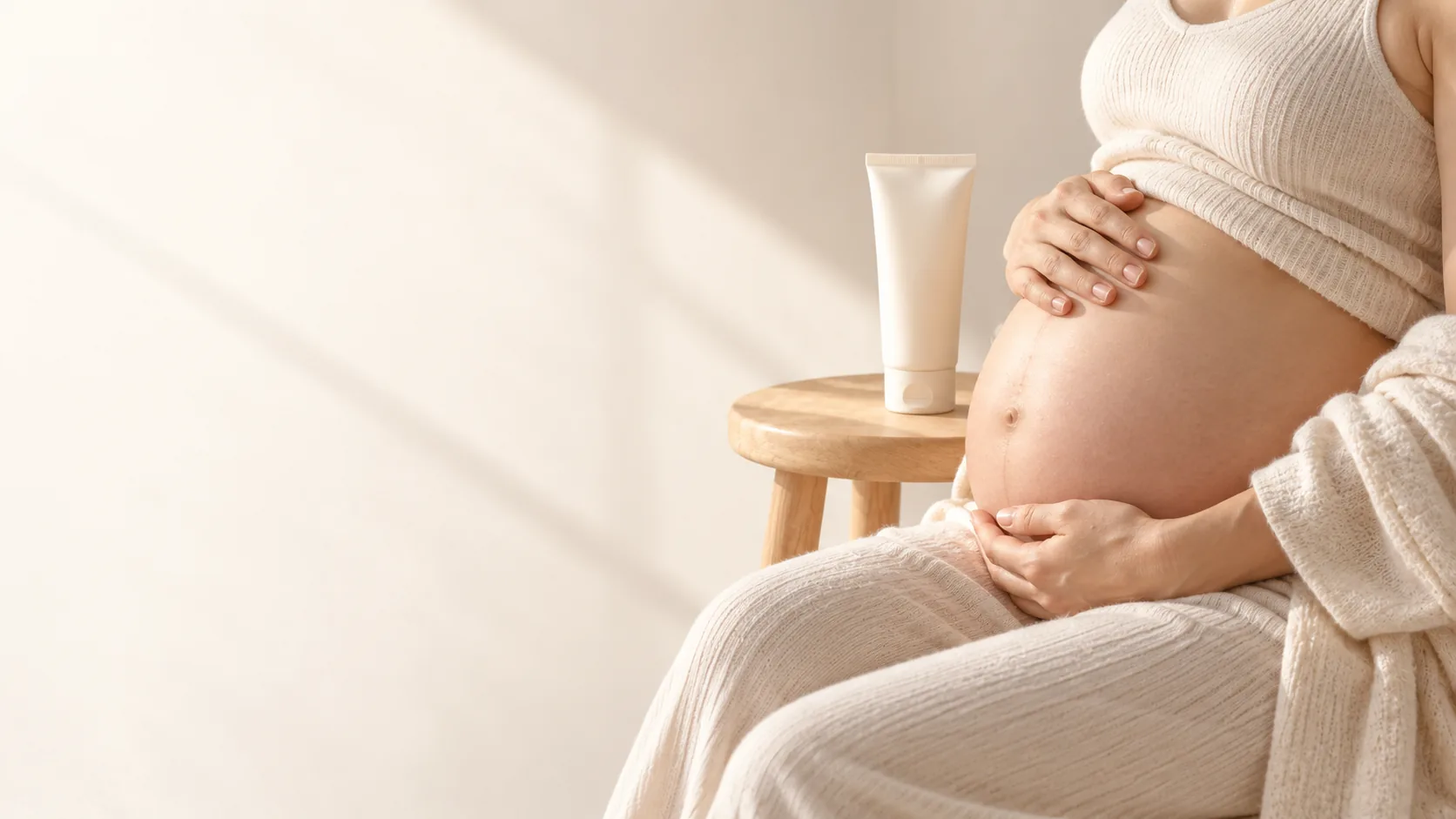
Pregnancy safe skincare usually means a simple routine: gentle cleansing, moisturizer and sunscreen. The clearest ingredient to avoid is the retinoid family; oral retinoids are linked to serious birth defects. [1, 2] Pregnant people are rarely included in controlled trials, so most evidence is observational. [3] Check any new product with your obstetrician, midwife or dermatologist.
In this article
- Can you keep up skincare during pregnancy?
- How does your skin change during pregnancy?
- Why does acne flare in pregnancy?
- What skincare should you avoid during pregnancy?
- Skin care products safe in pregnancy: what does the evidence say?
- Does sunscreen prevent the mask of pregnancy?
- What does a pregnancy safe skincare routine look like?
- Does anything change while breastfeeding?
- When should you see a doctor?
- Frequently asked questions
- References
Can you keep up skincare during pregnancy?
Yes. Skincare during pregnancy can continue; the question is which active ingredients stay in the routine. According to a clinical review, most skincare products used in pregnancy act locally and reach very low levels in the body. The exceptions it names are hydroquinone, which is absorbed relatively well, and tretinoin, where the evidence is disputed. [4]
The bigger issue is the evidence itself. Pregnant people are rarely enrolled in trials, for ethical and practical reasons, so safety information rests mostly on observational studies, case reports and extrapolation from people who are not pregnant. [3] A review of cosmetic procedures in pregnancy found no controlled trials and relied on case reports and series. [5]
So when this guide says “no data,” read it as “not studied,” not as “harmful” or “safe.”
What does “pregnancy safe” on a label mean?
A “pregnancy safe” claim on packaging is usually the manufacturer’s own assessment, not proof that the product was tested in pregnant people. The ingredient list tells you more: look for vitamin A derivatives such as retinol, retinal or retinyl palmitate, hydroquinone, and the salicylic acid concentration. A photo of that list gives your obstetrician or midwife something concrete to assess.
How does your skin change during pregnancy?
Pregnancy brings hormonal, vascular and immune changes that can alter skin biology, how much of a product the skin absorbs, and how easily it reacts. [3] The changes people ask about most are melasma, acne, dryness and stretch marks; not everyone gets them.
The mask of pregnancy (melasma)
Melasma is a pigment disorder that shows up as symmetric brown-gray patches on the face; when it appears during pregnancy it is often called the mask of pregnancy. In a cross-sectional study of 450 pregnant women in central Türkiye, 37.8% had melasma, most often on the central face. [6]
A personal or family history of melasma, Fitzpatrick skin type IV (olive skin that tans easily), and lower education and income were linked to it; as a cross-sectional study, it cannot show cause and effect. [6]
A review reports that melasma affects 36.4% to 75% of pregnant women across studies. Up to 30% of cases reportedly persist after delivery, and melasma often returns or worsens in later pregnancies. [7] The dark spots guide covers pigment types in more detail.
Dryness, itching and sensitivity
The sources behind this guide did not measure how often skin becomes dry in pregnancy. The review only notes that pregnancy changes can affect absorption and the tendency to react to products. [3] In practice, a fragrance-free moisturizer and short, lukewarm washes are reasonable first steps. Widespread itching or itching with a rash needs a medical assessment, not a new cream.
Stretch marks
Stretch marks develop in 50% to 90% of pregnant women. A Cochrane review of six trials with 800 women found no significant difference in stretch mark development between women using creams with active ingredients and those using a placebo or nothing. [8]
The authors found no high-quality evidence that any topical product prevents stretch marks; the trials were few and differed from each other. [8] A cream may feel comforting, but you do not need an expensive product to prevent them.
Why does acne flare in pregnancy?
Pregnancy acne can appear, or existing acne can change, as hormonal and physiologic shifts during pregnancy contribute to breakouts. Acne is common during pregnancy and breastfeeding. [9] The exact mechanism is still unclear, not everyone breaks out, and even among pregnant people with acne, mild acne is the most common picture. [10]
A multicenter study in Türkiye looked at 295 pregnant women with acne at any stage of pregnancy. 167 (56.6%) had mild and 87 (29.5%) moderate acne; six had severe and five (1.7%) very severe acne. Acne on the trunk (back and chest) was more common in the third trimester. [10]
Women who had irregular periods, polycystic ovary syndrome (PCOS), excess hair growth or a higher body mass index before pregnancy tended to have more severe acne. The authors describe it as similar to adult female acne. [10] Because only women who already had acne were included, the study does not show how many pregnant people get acne.
The menstrual cycle and skin guide covers hormone-linked breakouts outside pregnancy and the acne guide general acne care; in pregnancy, choose products with your doctor.
What skincare should you avoid during pregnancy?
The clearest skincare to avoid during pregnancy is the retinoid family: oral retinoids are linked to birth defects and are not used in pregnancy. [1, 2] For topical retinoids and retinol, no large risk signal has appeared, but the evidence is not strong enough to show they are safe. [11, 12] Hydroquinone and salicylic acid peels also call for caution.
| Ingredient | What the source says | Evidence type | Limitation |
|---|---|---|---|
| Oral retinoids (isotretinoin) | Teratogenic; contraindicated in pregnancy and when planning one [2] | Observational study, review | Prescription drug; not recommended here |
| Topical retinoids and retinol | No significant risk increase, but too little power [11, 12] | Meta-analyses of observational data | Mostly prescription retinoids |
| Hydroquinone | Relatively high systemic absorption [4] | Brief clinical review | From 2011 |
| Salicylic acid peels | Avoid or use with caution [5] | Case-based review | In-clinic procedure, not home care |
| Elective cosmetic procedures | Deferred during pregnancy [3] | Narrative review | No procedure-by-procedure data |
Why is retinol off the list?
In a study of 154 pregnancies exposed to oral isotretinoin, the relative risk of selected major birth defects was 25.6, and affected infants showed a typical pattern involving the face and skull, heart and nervous system. [1] This concerns a prescription drug taken by mouth, not retinol applied to the skin.
The picture for topical retinoids is less clear. A meta-analysis comparing 654 pregnancies exposed in the first trimester with 1,375 unexposed pregnancies found no significant increase in major birth defects or miscarriage. [11] A newer meta-analysis covering 3.6 million pregnancies also found no significant link, although one large registry study drove much of the result. [12]
The authors say these results can reassure women exposed by accident, but they lack the statistical power to justify use during pregnancy. [11] That is why our retinol guide also advises against retinol in pregnancy. If you used retinol before you knew you were pregnant, tell your doctor. “Plant-based alternatives” lack pregnancy data too; see the bakuchiol guide.
Salicylic acid: face wash or peel?
With salicylic acid, strength and use matter. In 2016, a European Chemicals Agency committee proposed classifying salicylic acid as a reproductive toxicant, based on developmental effects in animal studies. [13]
A risk assessment comparing blood levels argued that concentrations allowed in EU cosmetics leave an acceptable safety margin, but it was a modeling study, not a pregnancy outcome study. [13] Separately, the review of cosmetic procedures recommends avoiding salicylic acid peels or using them with caution. [5]
An acne review lists keratolytics (agents such as salicylic acid that loosen the top layer of skin) among topical options for mild to moderate acne in pregnancy. [9] A wash-off cleanser and an in-clinic peel are different exposures; check your product with the salicylic acid guide and your doctor.
Skin care products safe in pregnancy: what does the evidence say?
No list of skin care products has been proven safe in pregnancy; some ingredients simply have more observational data and expert review than others. The table shows what each source says and where its limits are. No row is a safety verdict; decide with your doctor.
| Ingredient | What the source says | Evidence type | Limitation |
|---|---|---|---|
| Azelaic acid | Named as a baseline topical option for pregnancy acne [2, 9] | Narrative reviews | No dose or trimester detail |
| Azelaic acid 20% | In 26 pregnant patients, more improvement than other topical groups; no difference in side effects [14] | Retrospective chart review | Small group; infant outcomes not measured |
| Broad-spectrum sunscreen | New melasma in 2.7% of 185 pregnant women [15] | Uncontrolled open study | One product; historical comparison |
| Photoprotection in general | Recommended from the first trimester [7] | Narrative review | Based on observational data |
| Glycolic and lactic acid peels | Considered safe [5], yet elective procedures are deferred in pregnancy [3] | Case-based reviews | In-clinic procedure; no data on home products |
| Niacinamide, vitamin C, hyaluronic acid | No pregnancy-specific study in our sources | — | Absence of data is not proof of safety |
In some countries, 20% azelaic acid is prescription-only; the azelaic acid guide covers the ingredient. Reviews also mention benzoyl peroxide and some antibiotics, but those are medicines and fall outside this guide. [2]
We found no pregnancy studies on niacinamide or vitamin C; the general point that most products act locally proves nothing about a single ingredient. [4] For home acid products, the glycolic acid guide likewise makes no pregnancy verdict.
Does sunscreen prevent the mask of pregnancy?
Sunscreen may lower the risk of melasma in pregnancy, but the data behind this are uncontrolled. In a 12-month study with 200 pregnant women, participants used a broad-spectrum SPF 50+ sunscreen. Among the 185 who finished the study, only five new cases of melasma appeared (2.7%). [15]
The comparison was a 53% rate from the same investigators’ earlier study under usual conditions; there was no concurrent control group and only one product. [15] A review also highlights photoprotection, including sunscreen from the first trimester, as the key step to reduce melasma. [7]
In practice, daily broad-spectrum sunscreen, reapplication, a hat and shade are a reasonable approach. Our sources hold no study comparing mineral and chemical filters in pregnancy; for amounts, see the sunscreen guide.
What does a pregnancy safe skincare routine look like?
A pregnancy safe skincare routine is mostly a short one: fewer products mean fewer ingredients to check and fewer chances of irritation. These steps are practical suggestions, not study findings; adapt them with your obstetrician, midwife or dermatologist.
- Gentle cleanser: Morning and evening.
- Moisturizer: Plain and fragrance-free; see the moisturizer guide.
- Sunscreen: Broad-spectrum every morning.
- Set aside retinoids: Retinol, retinal or retinyl derivatives.
- Ask before adding actives: Especially for acne or dark spots.
- One new product at a time: So you can tell what caused a reaction.
Does anything change while breastfeeding?
Yes. Breastfeeding is not assessed the same way as pregnancy; a review notes that the two are often lumped together although their pharmacology and safety questions differ. During breastfeeding, many treatments may be considered after an individual risk assessment when systemic exposure is expected to be minimal and the treated area does not touch the baby directly. [3]
Some acne treatments are also unsuitable while breastfeeding. [9] In practice, keep products off the breast area and ask before adding a new active after birth. These sources give no breastfeeding list for individual cosmetic ingredients.
When should you see a doctor?
See a doctor rather than trying new cosmetics if you have painful, widespread or scarring acne, rapidly spreading dark patches, intense itching or a rash. Women with irregular periods, PCOS or excess hair growth before pregnancy tended to have more severe acne during pregnancy. [10] If you used a retinoid or a prescription skin medicine before you knew you were pregnant, mention it.
Frequently asked questions
Is azelaic acid safe during pregnancy?
It has not been proven safe, but reviews name it as a topical option for pregnancy acne. [2, 9] The only comparative data in pregnancy come from a retrospective review with 26 people using 20% azelaic acid; side effects did not differ from other topical groups, and infant outcomes were not measured. [14]
Can I use AHA and BHA while pregnant?
Our sources give no clear yes for home products; ask your doctor. For peels, a review considered glycolic and lactic acid peels safe but advised avoiding or using caution with salicylic acid peels. [5] For everyday salicylic acid products, see the section above.
Which facial cleanser is safe for pregnancy?
No study in our sources compared facial cleansers in pregnancy. In practice, a gentle, fragrance-free cleanser is a sensible choice. If it contains salicylic acid, note the concentration and ask your doctor; a wash-off product differs from a peel. [13, 5]
I used salicylic acid in the first trimester. Should I worry?
Our sources do not measure pregnancy outcomes after cosmetic salicylic acid, so tell your doctor. A model-based risk assessment found an acceptable margin of safety at the levels allowed in EU cosmetics, but it was not a pregnancy study. [13] Your doctor can weigh the product, amount and timing.
References
- Lammer EJ, Chen DT, Hoar RM, et al. Retinoic acid embryopathy. N Engl J Med. 1985;313(14):837-841. PubMed · DOI
- Chien AL, Qi J, Rainer B, Sachs DL, Helfrich YR. Treatment of Acne in Pregnancy. J Am Board Fam Med. 2016;29(2):254-262. PubMed · DOI
- Kovacs T, Nadir U, Goldenberg M, et al. Cosmetic Dermatology in Pregnancy and Lactation: A Risk-Benefit Framework for Clinical Practice. Int J Dermatol. 2026;. PubMed · DOI
- Bozzo P, Chua-Gocheco A, Einarson A. Safety of skin care products during pregnancy. Can Fam Physician. 2011;57(6):665-667. PubMed
- Trivedi MK, Kroumpouzos G, Murase JE. A review of the safety of cosmetic procedures during pregnancy and lactation. Int J Womens Dermatol. 2017;3(1):6-10. PubMed · DOI
- Toktaş D, Atilla R. Prevalence of melasma in pregnant women and its relationship with body perception: a cross-sectional study in Türkiye. Sao Paulo Med J. 2026;144(3):e20263641. PubMed · DOI
- Zhao L, Fu X, Cheng H. Prevention of Melasma During Pregnancy: Risk Factors and Photoprotection-Focused Strategies. Clin Cosmet Investig Dermatol. 2024;17:2301-2310. PubMed · DOI
- Brennan M, Young G, Devane D. Topical preparations for preventing stretch marks in pregnancy. Cochrane Database Syst Rev. 2012;11(11):CD000066. PubMed · DOI
- Ly S, Kamal K, Manjaly P, Barbieri JS, Mostaghimi A. Treatment of Acne Vulgaris During Pregnancy and Lactation: A Narrative Review. Dermatol Ther (Heidelb). 2023;13(1):115-130. PubMed · DOI
- Kutlu Ö, Karadağ AS, Ünal E, et al. Acne in pregnancy: A prospective multicenter, cross-sectional study of 295 patients in Turkey. Int J Dermatol. 2020;59(9):1098-1105. PubMed · DOI
- Kaplan YC, Ozsarfati J, Etwel F, Nickel C, Nulman I, Koren G. Pregnancy outcomes following first-trimester exposure to topical retinoids: a systematic review and meta-analysis. Br J Dermatol. 2015;173(5):1132-1141. PubMed · DOI
- Alali AB, Alhammad FA, Almohammed Saleh JA, et al. Topical retinoids and risk of major congenital malformations and spontaneous abortion: a systematic review and meta-analysis. Front Drug Saf Regul. 2026;6:1864872. PubMed · DOI
- Labib R, Bury D, Boisleve F, et al. A kinetic-based safety assessment of consumer exposure to salicylic acid from cosmetic products demonstrates no evidence of a health risk from developmental toxicity. Regul Toxicol Pharmacol. 2018;94:245-251. PubMed · DOI
- Hasanbeyzade S. Retrospective Analysis of Efficacy and Side Effects of Topical 4% Erythromycin Versus 1% Clindamycin Versus 20% Azelaic Acid During Pregnancy. J Cosmet Dermatol. 2025;24(9):e70410. PubMed · DOI
- Lakhdar H, Zouhair K, Khadir K, et al. Evaluation of the effectiveness of a broad-spectrum sunscreen in the prevention of chloasma in pregnant women. J Eur Acad Dermatol Venereol. 2007;21(6):738-742. PubMed · DOI