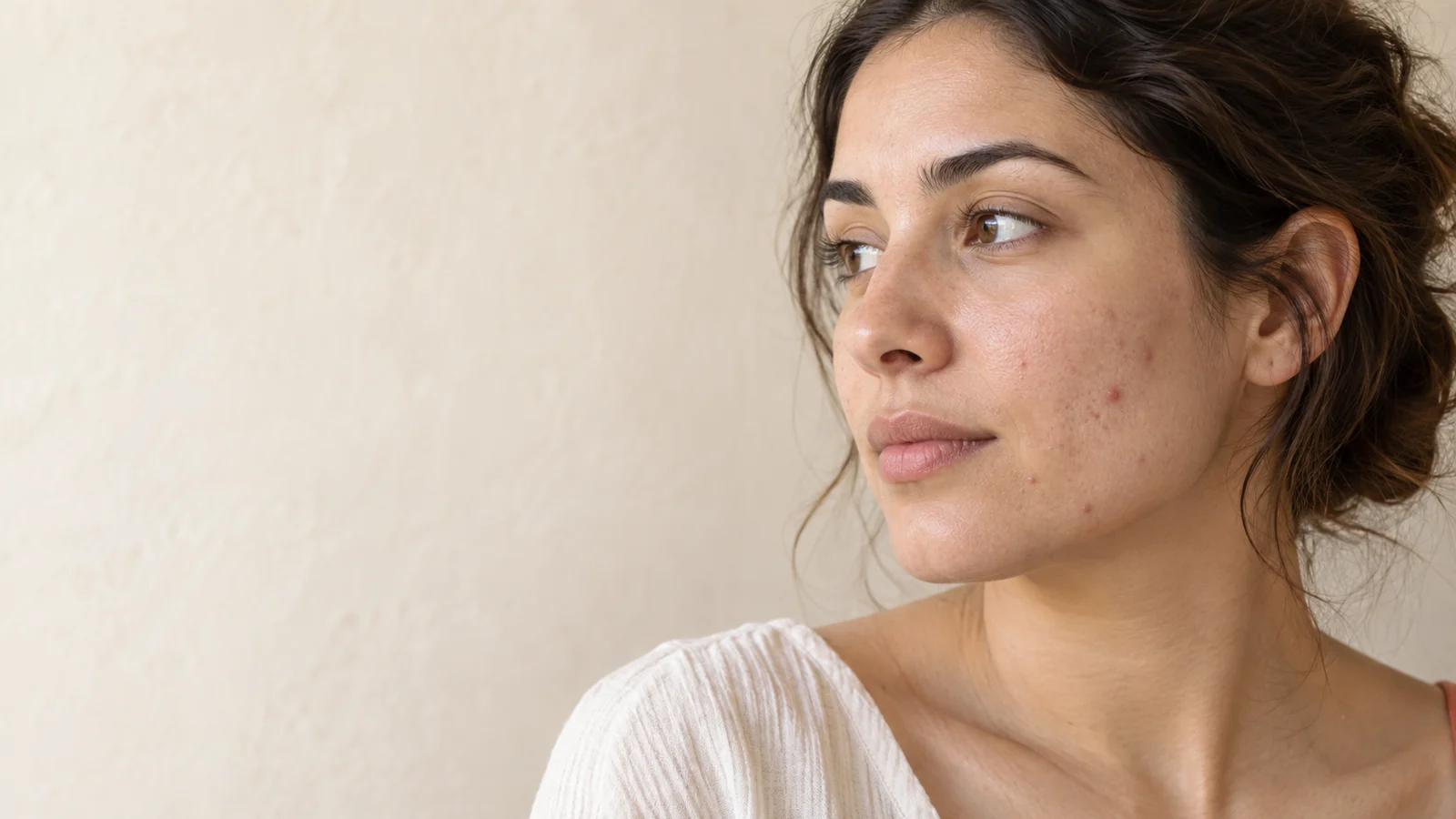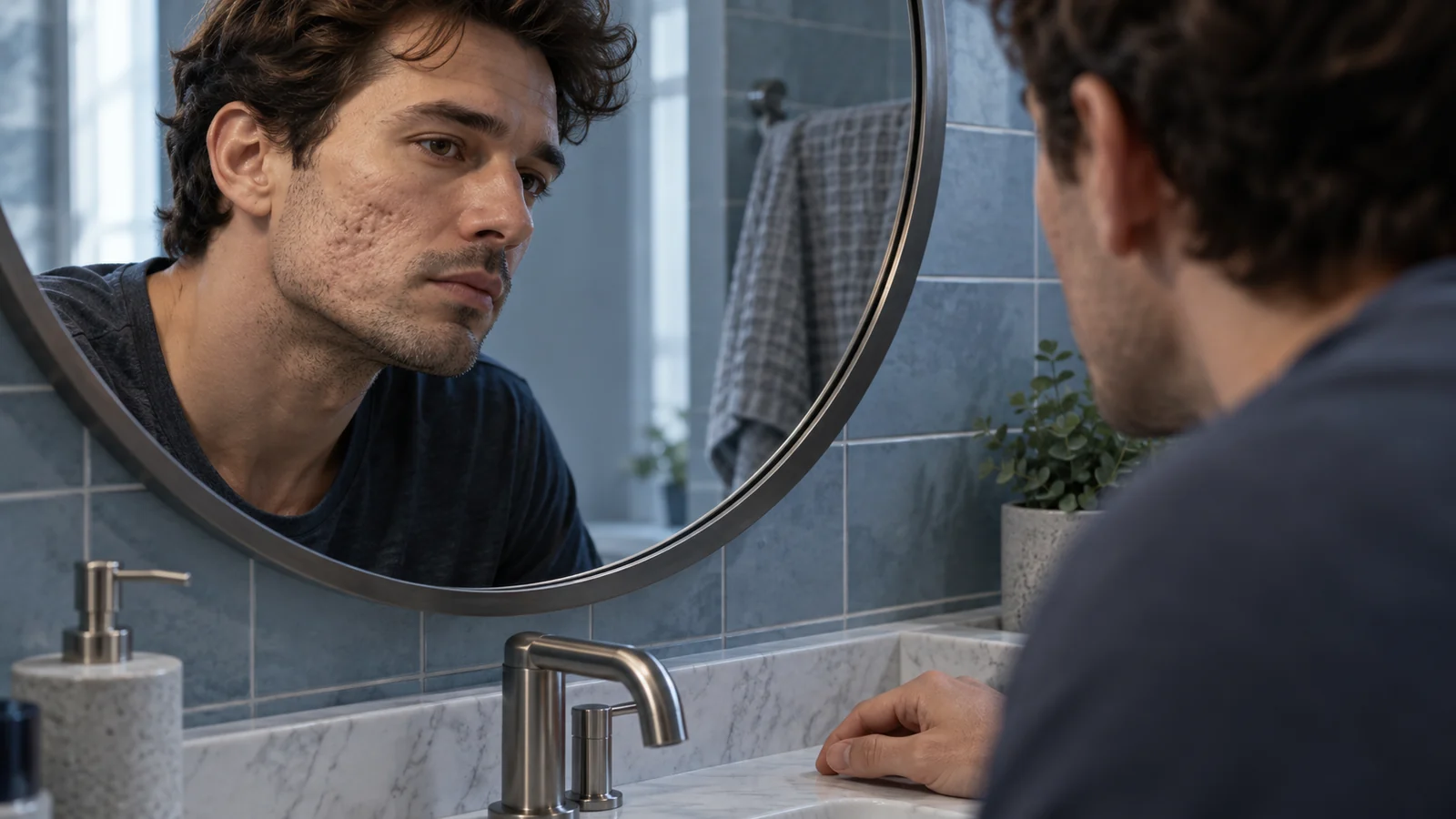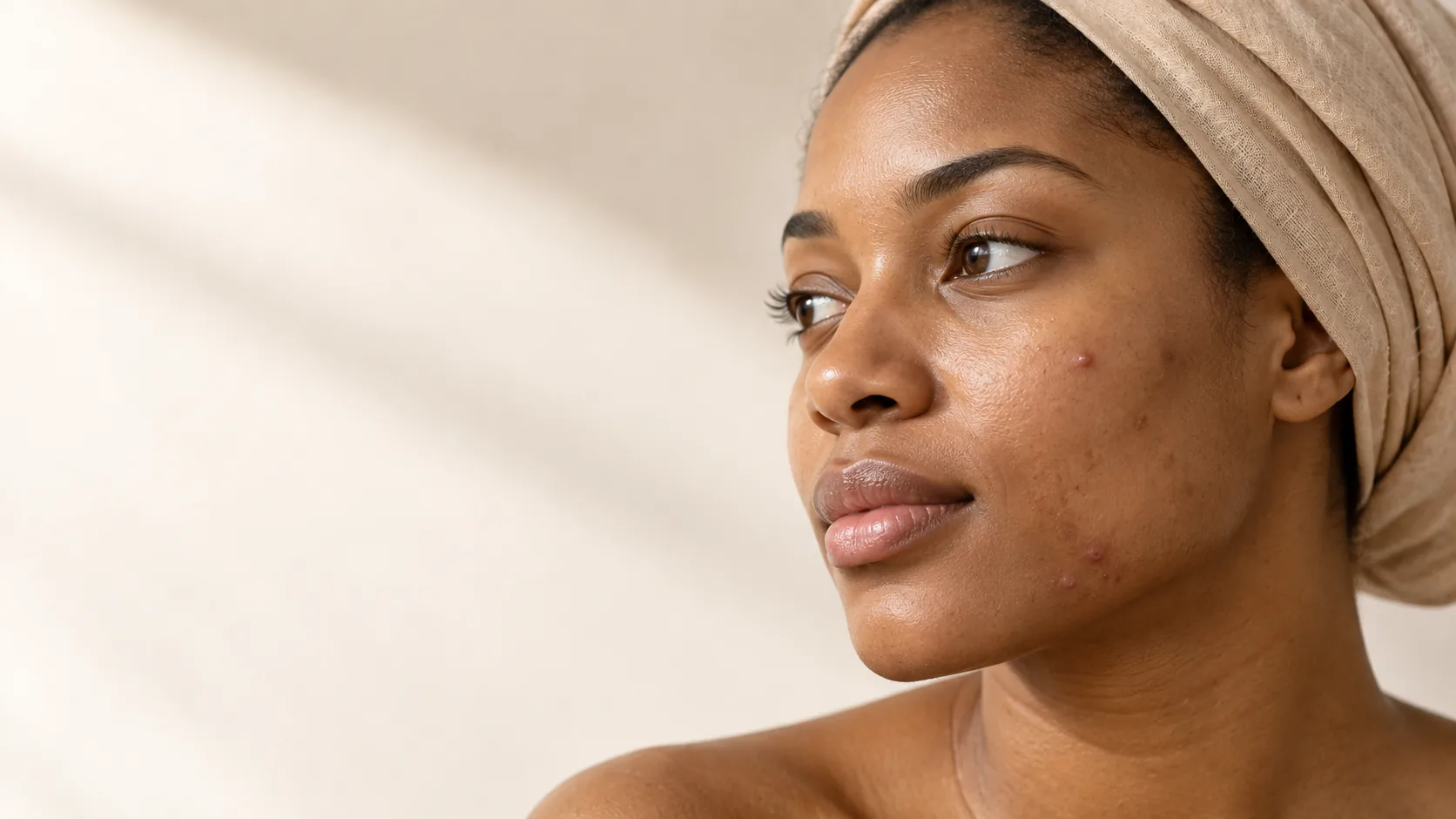
Hormonal acne is an everyday name, not a separate diagnosis: it usually means adult acne, most often in women, that is linked to hormones, especially androgens (male-type hormones). [1, 2] Contrary to the stereotype, one study that mapped lesions found acne only on the jawline in 11.2% of adult women. [3] See a doctor if you also have irregular periods, excess hair growth or scarring acne.
In this article
What is hormonal acne?
Hormonal acne is not a medical diagnosis of its own. The term mostly describes adult female acne, which an expert review splits into two subtypes: persistent acne that continues from the teenage years, and late-onset acne that first appears in adulthood. Both tend to be chronic and can weigh on mood and confidence. [1]
In a survey of 1,013 adults aged 20 and older, women reported acne more often than men in every age group after the teen years: 50.9% versus 42.5% in their 20s, and 26.3% versus 12.0% in their 40s. The figures reflect how participants saw their own skin, not a clinical exam. [4]
The word “hormonal” points to the mechanism. A systematic review of adult female acne found that androgens play a particularly important role: they enlarge the oil glands and raise sebum (skin oil) output. A family history of acne was also more common in adults with acne. [2] Our acne guide covers how acne forms in general; this page focuses on the hormone side.
What does hormonal acne look like?
Hormonal acne is usually described as inflamed pimples on the lower face, deeper tender bumps, and flares that come and go with the menstrual cycle. None of these signs proves a hormonal cause on its own, because the same picture appears in acne without any measured hormone problem. The table sums up what one review and one survey reported. [1, 5]
| Feature | What studies reported |
|---|---|
| Location | Expert review: inflammatory lesions more prominent on the lower chin, jawline and neck [1] |
| Lesion type | Papules, pustules and nodules (deep, painful bumps); comedones more often closed [1] |
| Severity | Mostly mild to moderate, but can be slow to respond to treatment [1] |
| Link with the cycle | 44% of 400 women surveyed reported a flare before their period [5] |
How common premenstrual flares are, and when they tend to start, is covered in our period acne guide.
Is hormonal acne on the chin a sure sign?
No. Among 374 women aged 25 and older seen by dermatologists, 89.8% had acne in several facial zones, such as cheeks, forehead, jawline and temples. Acne confined to the jawline was a small subset of 11.2%, and 93.7% of the women had comedones as well. [3] The authors wrote that the stereotype of hormonal, jawline-only inflammatory acne did not fit most of this group.
A study of 280 adults with acne in India pointed the same way. The cheeks were the most common site (81%), followed by the chin (67%) and the jawline area (58.3%). [6] So spots on your chin do not, on their own, reveal a hormone disorder. For the evidence on “face mapping”, see the acne guide.
How do you know if you have hormonal acne?
There is no reliable way to tell at home. Even the endocrine expert group that studied this question states that adult female acne is diagnosed mainly through a clinical exam. [7] What helps in practice is a simple log of where spots appear, how they relate to your cycle and any other symptoms you notice. It is not a test, but it gives a doctor something concrete.
| Note down | Why it helps |
|---|---|
| Where the spots are, and what they feel like | Tells a doctor whether they are surface or deep and painful |
| Cycle day | Shows whether flares follow your cycle |
| Period pattern | Irregular or infrequent periods need their own assessment |
| Facial or body hair, hair thinning | Doctors ask about these alongside acne |
| New products or medicines | Helps separate a reaction from a flare |
What causes hormonal acne?
Hormonal acne is driven by the way androgens act on oil glands, but that does not always mean high hormone levels in your blood. A systematic review linked adult acne mainly with androgen excess, a family history of acne and a high-glycemic diet. [2]
An evidence review of skin signs of excess androgens notes that many people with such signs, acne included, have normal serum androgen levels; local factors inside the hair follicle and oil gland also play a part. [8] In the Indian study, hormones were tested only in women with extra hair growth, obesity, hair loss or irregular periods, and lab signs of androgen excess turned up in just 3.08%. [6] The authors of a small Brazilian trial likewise describe adult female acne as mostly normoandrogenic, meaning androgen levels are in the normal range. [9]
The menstrual cycle plays a role too: in a survey of 400 women, 44% reported a flare before their period, and this was more common after age 33. [5] That was self-reported, with no lesion counts.
Can a hormonal imbalance cause acne?
Some hormone disorders do make acne more likely. The best-known example is polycystic ovary syndrome (PCOS). A meta-analysis of 60 studies found acne in 43% of women with PCOS and 21% of women without it. The studies varied widely and showed publication bias, and the rate ranged from 36% to 76% depending on the diagnostic criteria used. Acne was found in 59% of adolescents and 42% of adults with PCOS. [10] In other words, acne can be one sign of PCOS, but acne alone does not mean you have it.
Excess hair growth (hirsutism) is more strongly tied to high androgens than acne is. Rarer causes include nonclassic congenital adrenal hyperplasia (an inherited adrenal hormone disorder) and androgen-producing tumors, which is why a careful history and full skin exam matter. [8]
When should you see a doctor?
See a doctor if your acne comes with irregular or infrequent periods, noticeable hair growth on the face or body, or thinning scalp hair. The Endocrine Society guideline diagnoses PCOS when two of three features are present: androgen excess, ovulation problems and polycystic ovaries on ultrasound, after other causes of androgen excess are ruled out. [11] No skincare routine can make that assessment.
Experts do not fully agree on which tests to run. An endocrine task force from the Androgen Excess and PCOS Society recommends measuring blood androgens in every woman with adult acne; dermatology guidelines take a different approach. [7] Your history and exam decide what is ordered for you.
Waiting also has a cost. In a study of 1,972 people with acne, the modifiable risk factor for scarring was the delay between the start of acne and the first effective treatment. [12] If marks or scars have already formed, the acne scars guide explains what can help.
How to get rid of hormonal acne: which skincare has evidence?
None of the sources behind this guide tested a cosmetic ingredient on “hormonal acne” specifically; the evidence comes from acne studies in general. Still, the large international study found that many adult women respond well to standard first-line acne treatment. [3] The table shows what each ingredient has behind it, and where the evidence stops.
| Ingredient | Evidence | Limits |
|---|---|---|
| Salicylic acid | Conditional recommendation in the 2024 acne guideline [13] | Cochrane rates the evidence low or very low quality [14] |
| Azelaic acid | More effective than a placebo base across 16 acne trials [15] | Tested at 15–20%, a prescription strength in many countries |
| Niacinamide | 4% gel reduced acne grade about as much as an antibiotic gel in 80 people [16] | Single center, 8 weeks; overall evidence low quality [14] |
| Topical retinoids | Strong recommendation in the guideline [13] | Applies to prescription retinoids; no study in this list tested retinol for acne |
Azelaic acid has also been tried in this exact setting. Thirty-eight adult women with no signs of androgen excess used either 15% azelaic acid gel or a combined birth control pill for six months. Acne-specific quality of life improved significantly in both groups, with larger gains in two domains for the pill. The trial was small and measured quality of life, not lesion counts. [9]
To look at each ingredient more closely, see the Salicylic acid, Azelaic acid and Niacinamide guides. Our retinol guide explains what retinol can and cannot be expected to do, and the tea tree oil guide covers a plant-based option many people ask about.
How do you keep the routine simple?
Adult skin can be more prone to irritation and slower to respond, so the expert review recommends a simple routine tailored to the person. [1] In practice, a few principles help:
- Start with one active ingredient. If you add several new products at once, you cannot tell which one caused stinging or dryness.
- Cleanse gently and moisturize. Harsh cleansers or frequent washing can add dryness and irritation.
- Give it time. The studies cited here ran from 8 weeks to 6 months; judging a product after a few days is not realistic. [16, 9]
- Wear sunscreen in the daytime, especially if spots tend to leave dark marks.
How do doctors treat hormonal acne?
When hormonal acne needs more than skincare, treatment is a medical decision. Options a doctor may weigh include combined birth control pills, hormone-blocking medicines such as spironolactone and, for severe acne, oral retinoids. The summary below is here to help you ask informed questions, not to choose a treatment yourself. [7, 13]
- Combined birth control pills: In a Cochrane review of 31 trials, all nine placebo-controlled trials with usable data showed fewer facial acne lesions than placebo. How the pill compares with other acne treatments remains unclear. [17]
- Spironolactone: In a double-blind trial of 410 adult women with acne, 82% on the drug reported improvement at 24 weeks versus 63% on placebo; at 12 weeks the difference was not significant. Headaches were more common with the drug. [18]
- Oral retinoids: The 2024 acne guideline strongly recommends one for acne that is severe, scarring or not responding to standard treatment. [13]
Each has its own safety questions, including pregnancy, that only your prescriber can weigh. The expert review also stresses that childbearing age and skin sensitivity shape treatment choices in adult women. [1] This guide gives no dosing, usage or medication advice.
Does diet affect hormonal acne?
Possibly, but the effect is modest, and no study in our sources tested a “hormonal acne diet”. A systematic review of 34 studies found that a high glycemic index and glycemic load were linked to acne in a modest but significant way; results for dairy were mixed. [19]
The randomized trial behind that link involved 43 males aged 15 to 25. A low-glycemic-load diet reduced lesion counts more over 12 weeks, but the effect of weight loss could not be separated out. [20] That makes it hard to apply directly to adult women. The proposed mechanism, in which high-glycemic eating raises insulin and IGF-1 and in turn sebum and androgen production, is an explanatory model rather than experimental proof. [2]
In practice, cutting out dairy or whole food groups is not supported by these data; talk to a doctor or dietitian before major restrictions.
Frequently asked questions
What hormone causes acne?
Androgens are the hormones most closely tied to acne. They enlarge oil glands and increase sebum, which helps set the stage for breakouts. [2] Still, many women with acne have normal androgen levels in blood tests, because local factors in the skin also matter. [8]
What are the types of hormonal acne?
There is no official classification, but reviews describe two patterns by timing. Persistent acne continues from the teenage years; late-onset acne first appears in adulthood. Adult acne often shows inflamed papules, pustules or nodules and closed comedones. [1] In the Indian study, 73.2% had persistent and 26.8% late-onset acne. [6]
What can you take for hormonal acne?
Nothing in our sources shows that a supplement, herbal tea or “hormone-balancing” product reduces hormonal acne; none of the studies in this guide tested them. Medicines that act on hormones do have trial evidence, but they are prescription drugs that a doctor chooses based on your health and plans.
References
- Dréno B, Layton A, Zouboulis CC, et al. Adult female acne: a new paradigm. J Eur Acad Dermatol Venereol. 2013;27(9):1063-1070. PubMed · DOI
- Telkkälä A, Sinikumpu SP, Huilaja L. Etiology of Adult Female Acne-Systematic Review. Health Sci Rep. 2025;8(5):e70697. PubMed · DOI
- Dréno B, Thiboutot D, Layton AM, et al. Large-scale international study enhances understanding of an emerging acne population: adult females. J Eur Acad Dermatol Venereol. 2015;29(6):1096-1106. PubMed · DOI
- Collier CN, Harper JC, Cafardi JA, et al. The prevalence of acne in adults 20 years and older. J Am Acad Dermatol. 2008;58(1):56-59. PubMed · DOI
- Stoll S, Shalita AR, Webster GF, Kaplan R, Danesh S, Penstein A. The effect of the menstrual cycle on acne. J Am Acad Dermatol. 2001;45(6):957-960. PubMed · DOI
- Khunger N, Kumar C. A clinico-epidemiological study of adult acne: is it different from adolescent acne? Indian J Dermatol Venereol Leprol. 2012;78(3):335-341. PubMed · DOI
- Carmina E, Dreno B, Lucky WA, et al. Female Adult Acne and Androgen Excess: A Report From the Multidisciplinary Androgen Excess and PCOS Committee. J Endocr Soc. 2022;6(3):bvac003. PubMed · DOI
- Schmidt TH, Shinkai K. Evidence-based approach to cutaneous hyperandrogenism in women. J Am Acad Dermatol. 2015;73(4):672-690. PubMed · DOI
- Rocha M, Sanudo A, Bagatin E. The effect on acne quality of life of topical azelaic acid 15% gel versus a combined oral contraceptive in adult female acne: A randomized trial. Dermatoendocrinol. 2017;9(1):e1361572. PubMed · DOI
- Ramezani Tehrani F, Behboudi-Gandevani S, Bidhendi Yarandi R, Saei Ghare Naz M, Carmina E. Prevalence of acne vulgaris among women with polycystic ovary syndrome: a systemic review and meta-analysis. Gynecol Endocrinol. 2021;37(5):392-405. PubMed · DOI
- Legro RS, Arslanian SA, Ehrmann DA, et al. Diagnosis and treatment of polycystic ovary syndrome: an Endocrine Society clinical practice guideline. J Clin Endocrinol Metab. 2013;98(12):4565-4592. PubMed · DOI
- Tan J, Kang S, Leyden J. Prevalence and Risk Factors of Acne Scarring Among Patients Consulting Dermatologists in the USA. J Drugs Dermatol. 2017;16(2):97-102. PubMed
- Reynolds RV, Yeung H, Cheng CE, et al. Guidelines of care for the management of acne vulgaris. J Am Acad Dermatol. 2024;90(5):1006.e1-1006.e30. PubMed · DOI
- Liu H, Yu H, Xia J, et al. Topical azelaic acid, salicylic acid, nicotinamide, sulphur, zinc and fruit acid (alpha-hydroxy acid) for acne. Cochrane Database Syst Rev. 2020;5(5):CD011368. PubMed · DOI
- King S, Campbell J, Rowe R, Daly ML, Moncrieff G, Maybury C. A systematic review to evaluate the efficacy of azelaic acid in the management of acne, rosacea, melasma and skin aging. J Cosmet Dermatol. 2023;22(10):2650-2662. PubMed · DOI
- Khodaeiani E, Fouladi RF, Amirnia M, Saeidi M, Karimi ER. Topical 4% nicotinamide vs. 1% clindamycin in moderate inflammatory acne vulgaris. Int J Dermatol. 2013;52(8):999-1004. PubMed · DOI
- Arowojolu AO, Gallo MF, Lopez LM, Grimes DA. Combined oral contraceptive pills for treatment of acne. Cochrane Database Syst Rev. 2012;2012(7):CD004425. PubMed · DOI
- Santer M, Lawrence M, Renz S, et al. Effectiveness of spironolactone for women with acne vulgaris (SAFA) in England and Wales: pragmatic, multicentre, phase 3, double blind, randomised controlled trial. BMJ. 2023;381:e074349. PubMed · DOI
- Meixiong J, Ricco C, Vasavda C, Ho BK. Diet and acne: A systematic review. JAAD Int. 2022;7:95-112. PubMed · DOI
- Smith RN, Mann NJ, Braue A, Mäkeläinen H, Varigos GA. A low-glycemic-load diet improves symptoms in acne vulgaris patients: a randomized controlled trial. Am J Clin Nutr. 2007;86(1):107-115. PubMed · DOI