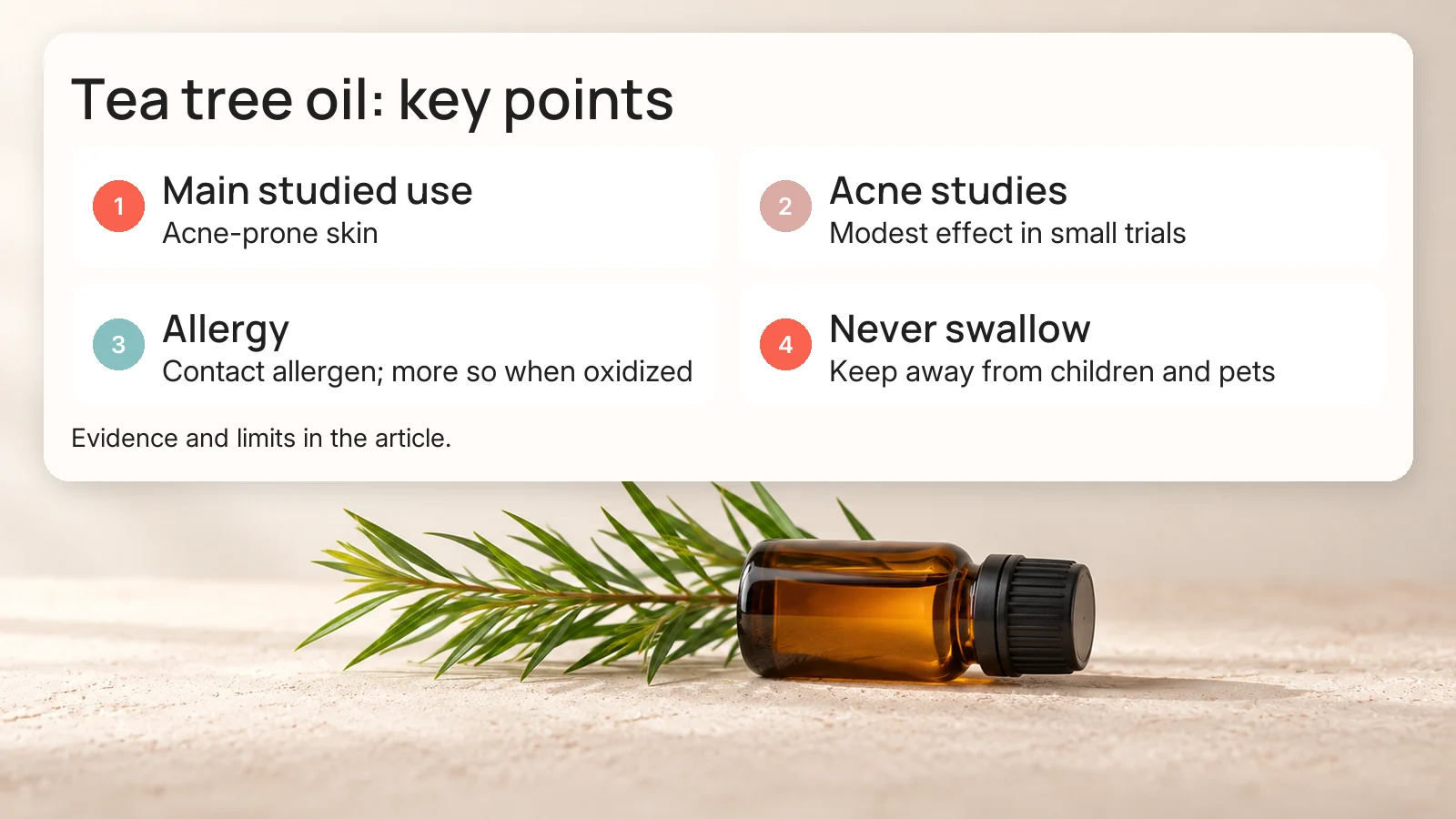
What is tea tree oil used for? On skin, it is mostly used for acne-prone skin, where studies show a modest reduction in acne severity. [1] It is also a known contact allergen, and old or oxidized oil is more likely to cause reactions. [2] Undiluted oil can irritate, and tea tree oil should never be swallowed. [3, 4]
In this article
- What is tea tree oil?
- What is tea tree oil used for?
- How to use tea tree oil on your skin
- What should you expect when using it?
- Why do allergy and oxidation matter?
- Who should be careful with tea tree oil?
- Can you combine tea tree oil with other ingredients?
- How to choose and store tea tree oil
- Frequently asked questions
- References
What is tea tree oil?
Tea tree oil is an essential oil made mostly of compounds called monoterpenes. Its main component is terpinen-4-ol, alongside several other terpenes such as gamma-terpinene and alpha-terpinene. [2, 4]
The share of terpinen-4-ol varies. In one laboratory sample it made up 42% of the oil. [5] Three batches that met the international ISO 4730 standard contained 30–40%. [6] So two bottles labeled “tea tree oil” are not necessarily identical, and a skincare product may contain only a small amount of the oil.
What is tea tree oil used for?
Tea tree oil is used in many ways, but for skin its main studied use is acne-prone skin. A systematic review of 46 randomized trials found studies in dentistry (18), dermatology (9), infections (9), eye care (6) and foot care (3). The overall quality of this research was poor to moderate, and more evidence is needed for acne. [7]
This guide covers tea tree oil uses on the face and acne-prone skin; mouth and eyelid uses are outside its scope.
What does tea tree oil do?
In the lab, it slows the growth of Cutibacterium acnes, a bacterium involved in acne. At 2%, all three tested batches suppressed its growth, and the lowest concentration that stopped growth was 0.25% for each; earlier studies reported a range of 0.05–1.25%. [6] That study used a single laboratory strain, not bacteria from patients.
It may also calm inflammation in cells. Water-soluble components of the oil reduced several inflammatory signals in human immune cells by about 50%, and prostaglandin E2 by about 30%. Of the individual components, only terpinen-4-ol had this effect. The emulsified oil itself was toxic to those cells at 0.016%. [5]
Lab studies do not show what happens on your face. A review of clinical trials concluded that a local anti-inflammatory effect on skin, if there is one, is not yet clear. [7]
Tea tree oil for acne
The clinical evidence for acne is small but fairly consistent:
- Meta-analysis: Seven clinical studies with 445 patients, published up to August 2025, linked tea tree oil with lower acne severity than control groups (pooled odds ratio 0.74; 95% CI 0.63–0.88). Side effects were mostly local and mild. The authors called the effect “modest.” [1]
- Placebo trial: In 60 people with mild to moderate acne, a 5% tea tree oil gel beat a placebo gel over 45 days for total lesion count and severity, by 3.55 and 5.75 times respectively. Side effects were similar in both groups. [8]
- Cochrane review: Based on that single trial, the review saw a possible benefit in lesion count (mean difference −7.53) and severity score, but rated the evidence low quality. [9]
- Comparison trial: In 124 people, a 5% tea tree oil gel and a 5% benzoyl peroxide lotion both reduced inflamed and non-inflamed lesions, including open and closed comedones. Tea tree oil worked more slowly but caused fewer side effects. [10]
These studies have clear limits. The meta-analysis pooled only seven small studies with non-standard formulas, varied controls and no long-term follow-up. [1] The “times more effective” figures in the placebo trial are relative improvements, not absolute effect sizes. [8] The comparison trial was single-blind, from 1990, and its abstract gives no lesion numbers; benzoyl peroxide is mentioned here only as the comparator. [10]
So tea tree oil may help mild acne a little, but it is not a treatment for acne as a disease. The acne guide covers the options with stronger evidence, and the salicylic acid guide covers a common alternative.
Hair, nails and fungal skin
Many people search for tea tree oil for dandruff, nail fungus or athlete’s foot. The review of 46 trials also covered foot care and other uses, but this guide does not assess them. [7] If you suspect a fungal infection of the skin or nails, see a doctor for diagnosis rather than treating it yourself.
How to use tea tree oil on your skin
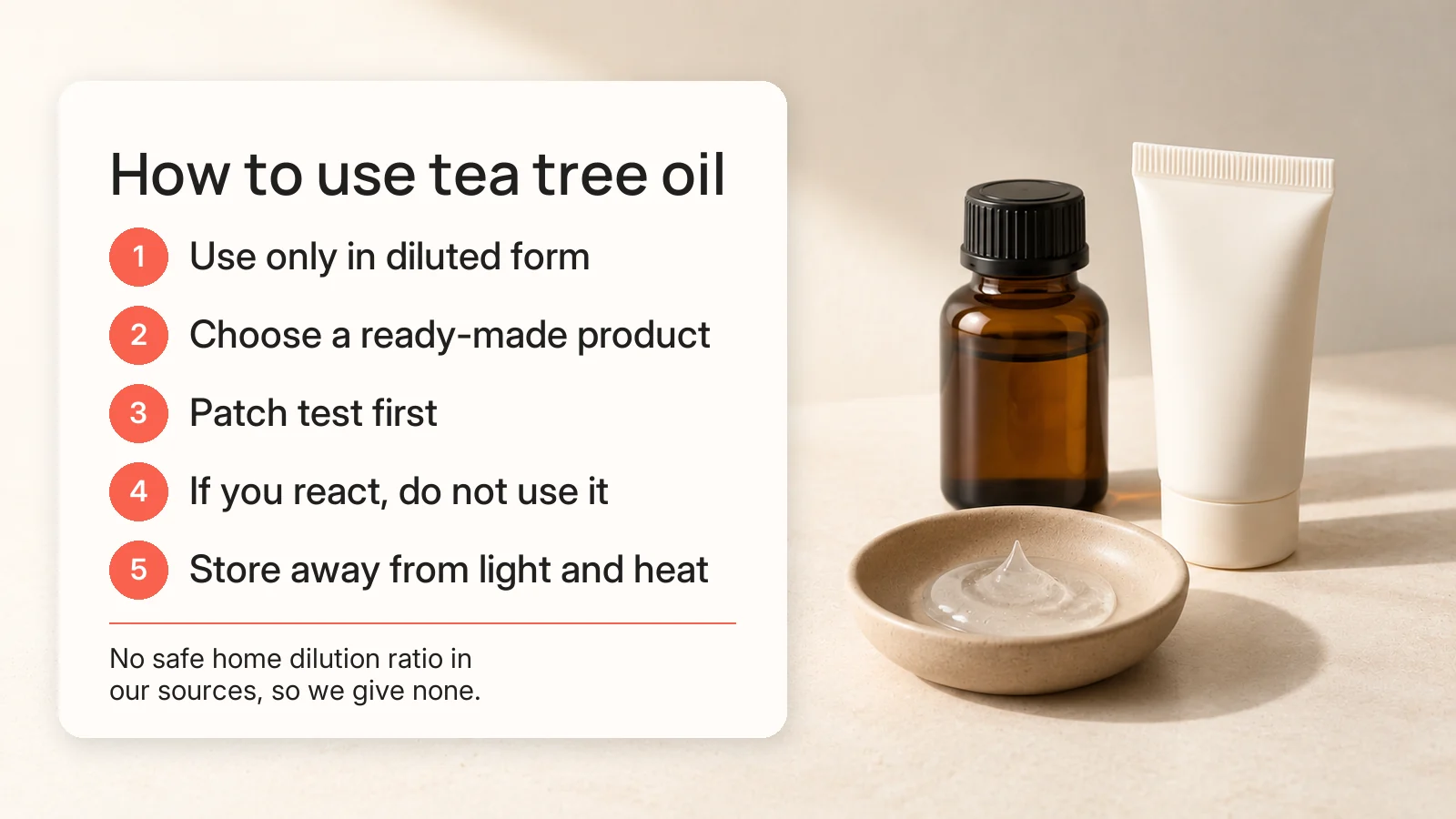
Use tea tree oil only in diluted form, ideally in a ready-made skincare product, and patch test first. Undiluted oil and some formulas at 5% or more can irritate skin and eyes. [3] Most allergic reactions reported in the literature came from applying pure oil, while cosmetics caused a minority. [2]
In clinical trials, side effects were mostly mild, except when concentrations of 25% or more were applied to skin. [7] A review also noted that avoiding swallowing, using only diluted oil on skin and using properly stored oil can reduce side effects. [11] None of our sources gives a safe dilution ratio for mixing at home, so we do not give one.
In practice, a finished product keeps the amount consistent, unlike a home mixture. The guide to reading an ingredient list explains what a label can tell you.
Can you put tea tree oil directly on your skin?
It is better not to. Undiluted tea tree oil can irritate skin and eyes, [3] and most published allergic reactions involved pure oil. [2] An older scientific committee opinion, from 2004, stated that the sparse data suggested undiluted tea tree oil was not safe to sell as a consumer product. [3]
Dabbing pure oil on a pimple is a common tip online, but it runs against these findings.
How do you patch test it?
In practice, a patch test is simple:
- Apply a small amount of the product to a patch of skin on your inner forearm or behind the ear.
- Leave it for a day or two and do not wash that spot.
- Watch for redness, itching, swelling or blisters.
- If you react, do not use it on your face.
A negative test does not rule out a later reaction; allergy can develop with repeated use.
What should you expect when using it?
Expect slow, modest changes rather than fast results. In the comparison trial, tea tree oil reduced lesions but started working more slowly than the benzoyl peroxide lotion. [10] The placebo trial measured results every 15 days over 45 days. [8] In the meta-analysis, short-term tolerance was generally acceptable. [1]
In practice, give a product several weeks before judging it. If irritation keeps building, or itching and redness spread beyond where you applied it, stop: that can signal contact allergy.
Why do allergy and oxidation matter?
Tea tree oil is a skin sensitizer, meaning it can cause an allergy that develops with use. Among essential oils, it has the most published allergic reactions, first reported in 1991. In routine patch testing, 0.1% to 3.5% of people tested reacted, and about 100 allergic patients have been described in case reports. [2]
Those patch test figures come from people already seeing dermatologists, so they do not show how common allergy is in the general public. [2]
Oxidation makes things worse. Fresh oil is a weak to moderate sensitizer, but exposure to light, air or heat creates oxidation products that make it more allergenic. [2, 11] A European scientific committee concluded that these products, including epoxides, are thought to add to the oil’s potential to sensitize skin, and that current use levels can cause contact allergy. [3]
A review of 159 suspected side effect reports in a global database, 16 of them serious, found that oxidized monoterpenes are strong skin irritants. It also noted that contact allergy is hard to predict in advance. [4] Spontaneous reports cannot prove cause or show how often reactions happen.
Who should be careful with tea tree oil?
Anyone with sensitive or allergy-prone skin, a history of fragrance allergy, or eczema should be cautious. Tea tree oil should never be swallowed, it must be kept away from children and pets, and its safety in pregnancy has not been studied. Irritation can increase the risk of becoming sensitized. [3]
Pregnancy and breastfeeding
We found no human study of tea tree oil applied to skin during pregnancy. A developmental toxicity signal comes only from swallowing high doses or from data on individual components. [11] The European committee could not estimate how much reaches the body from cosmetics and could not assess its safety. [3] So we cannot call it safe or harmful in pregnancy. Ask your doctor or midwife before using it.
Never swallow it
Tea tree oil should never be taken by mouth. Swallowing it can cause central nervous system depression and pneumonitis (lung inflammation). [4] It is toxic in high doses when swallowed. [11] This evidence comes from case reports and toxicology reviews. If someone swallows it, contact poison control or emergency services right away.
Children and pets
Our sources include no child-specific case reports, but keep bottles out of children’s reach. Pets are a real concern. In 337 dogs and 106 cats exposed to 100% tea tree oil, signs began within 2 to 12 hours and lasted up to 72 hours, including drooling, lethargy, weakness, loss of coordination and tremors. Young, light cats were more likely to become seriously ill. [12]
In 89% of those animals, the oil had been applied on purpose. [12] In practice, never apply tea tree oil to a pet, and store it where animals cannot reach it.
Can you combine tea tree oil with other ingredients?
We found no study that tested tea tree oil together with other skincare actives. In practice, layering it with other potentially irritating ingredients, such as exfoliating acids or retinoids, makes it harder to tolerate and harder to tell which product is causing a reaction.
Introduce one new product at a time. If you already use an exfoliant or retinoid, the retinol guide and the skin barrier guide explain how to keep irritation down.
How to choose and store tea tree oil
Choose products from sources that follow a recognized quality standard, and store the oil away from light, air and heat. Oils meeting the ISO 4730 standard had a defined terpinen-4-ol content. [6] Tea tree oil oxidizes easily with air and heat, which raises its allergy potential. [3]
A review concluded that properly stored oil that has not passed its expiry date may be considered safe for mild inflammatory skin problems in people outside vulnerable groups. [4] In practice, keep the cap tightly closed, use a dark bottle, keep it away from heat, and throw it away after the expiry date or if the smell changes.
A study formula is not the same as a bottle of essential oil. The meta-analysis combined different formulations and comparison groups; its result does not establish equal effects for every tea tree oil product. [1]
Frequently asked questions
Can tea tree oil burn your skin?
Yes. Concentrated tea tree oil can irritate skin and cause a burning sensation; an allergic contact reaction is also possible. [2, 3] Stop using it if burning, redness, or swelling appears. The feeling alone cannot tell irritation from allergy. If symptoms are strong or persist, seek a dermatologist’s assessment. The facial redness guide explains why one reaction cannot diagnose the cause.
Is tea tree oil antibacterial?
In the lab, yes: it suppressed the growth of an acne-related bacterium at 2%, with a minimum inhibitory concentration of 0.25%. [6] That test used a single lab strain, and results in a dish do not show that it kills bacteria on your skin. Clinical trials show only a modest effect on acne severity. [1]
Can tea tree oil fade acne scars?
We found no study testing tea tree oil on acne scars or on dark marks left after acne. The trials above measured active lesions and severity, not scars. Pitted scars and color marks need a different approach; the acne scars guide explains what the evidence supports for each.
Does tea tree oil go bad?
Yes, in a sense. It oxidizes with exposure to air, light and heat, and oxidation increases its potential to cause allergy and irritation. [3, 4] In practice, check the expiry date, keep the bottle closed and away from heat and light, and replace it if it looks or smells different.
Is there a legal limit for tea tree oil in the EU?
Not that we could confirm. The 2008 European scientific committee opinion called tea tree oil a skin sensitizer and said its safety could not be assessed, but it did not set a concentration limit or a warning label. [3] It is a scientific opinion, not a binding regulation, and we did not verify whether it later became law.
References
- Ye Y, Lim JJ, Huang Z, Chew FT. Efficacy and Safety of Melaleuca alternifolia (Tea Tree) Oil for Acne-A Systematic Review and Meta-Analysis. Phytother Res. 2026;40(7):4444-4453. PubMed · DOI
- de Groot AC, Schmidt E. Tea tree oil: contact allergy and chemical composition. Contact Dermatitis. 2016;75(3):129-143. PubMed · DOI
- Scientific Committee on Consumer Products (SCCP). Opinion on tea tree oil. SCCP/1155/08. European Commission; 16 December 2008. Resmî metin
- Bekhof AMW, van Hunsel FPAM, van de Koppel S, Woerdenbag HJ. Safety assessment and adverse drug reaction reporting of tea tree oil (Melaleuca aetheroleum). Phytother Res. 2023;37(4):1309-1318. PubMed · DOI
- Hart PH, Brand C, Carson CF, Riley TV, Prager RH, Finlay-Jones JJ. Terpinen-4-ol, the main component of the essential oil of Melaleuca alternifolia (tea tree oil), suppresses inflammatory mediator production by activated human monocytes. Inflamm Res. 2000;49(11):619-626. PubMed · DOI
- Ossa-Tabares JC, Llanos CJ, García AM. Evaluation of tea tree oil physicochemical features and its antimicrobial activity against Cutibacterium acnes (Propionibacterium acnes) ATCC 6919. Biomedica. 2020;40(4):693-701. PubMed · DOI
- Kairey L, Agnew T, Bowles EJ, Barkla BJ, Wardle J, Lauche R. Efficacy and safety of Melaleuca alternifolia (tea tree) oil for human health-A systematic review of randomized controlled trials. Front Pharmacol. 2023;14:1116077. PubMed · DOI
- Enshaieh S, Jooya A, Siadat AH, Iraji F. The efficacy of 5% topical tea tree oil gel in mild to moderate acne vulgaris: a randomized, double-blind placebo-controlled study. Indian J Dermatol Venereol Leprol. 2007;73(1):22-25. PubMed · DOI
- Cao H, Yang G, Wang Y, et al. Complementary therapies for acne vulgaris. Cochrane Database Syst Rev. 2015;1(1):CD009436. PubMed · DOI
- Bassett IB, Pannowitz DL, Barnetson RS. A comparative study of tea-tree oil versus benzoylperoxide in the treatment of acne. Med J Aust. 1990;153(8):455-458. PubMed · DOI
- Hammer KA, Carson CF, Riley TV, Nielsen JB. A review of the toxicity of Melaleuca alternifolia (tea tree) oil. Food Chem Toxicol. 2006;44(5):616-625. PubMed · DOI
- Khan SA, McLean MK, Slater MR. Concentrated tea tree oil toxicosis in dogs and cats: 443 cases (2002-2012). J Am Vet Med Assoc. 2014;244(1):95-99. PubMed · DOI