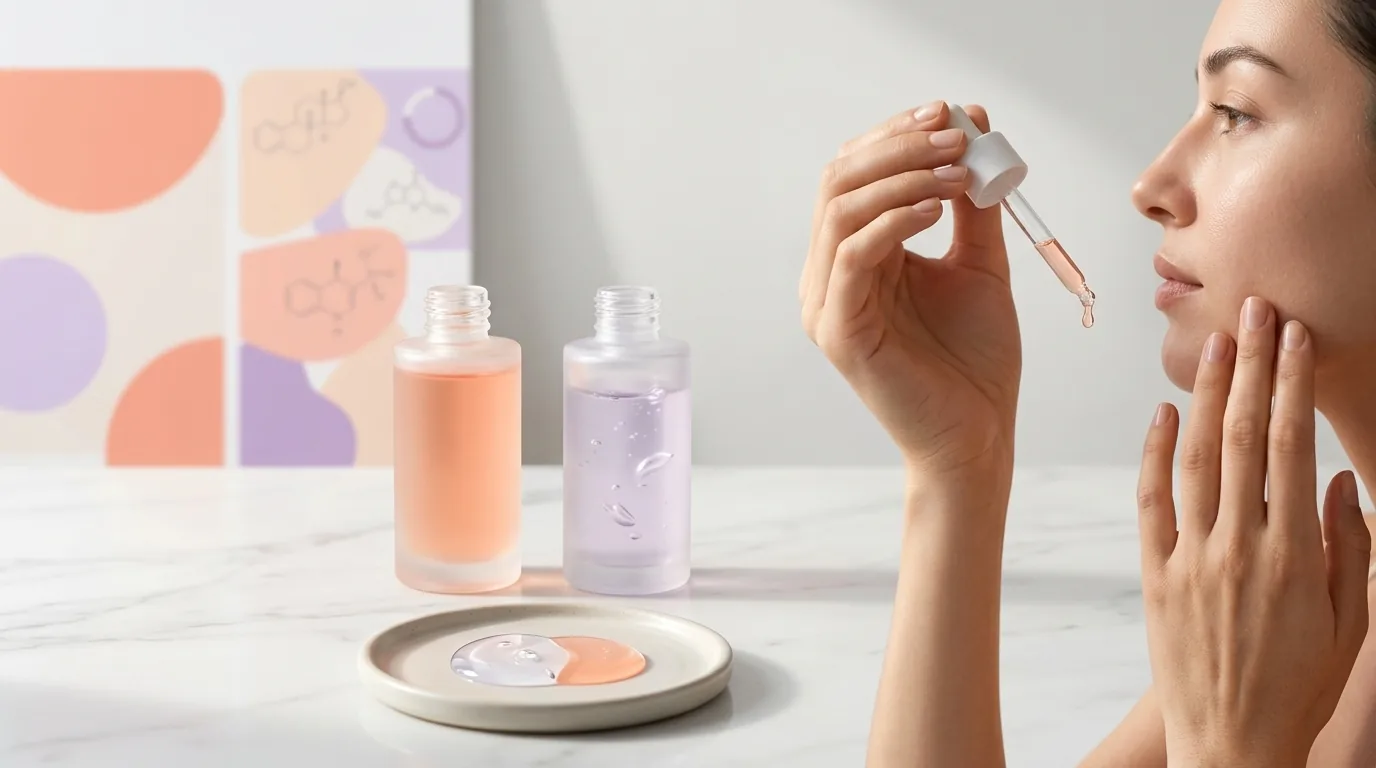
Yes, they can share a routine. Nothing in the studies we reviewed argues against it. But no study shows that one makes the other work better: researchers tested single formulas that contained both, not two separate serums.
Can you use hyaluronic acid and vitamin C together? Yes. We found no evidence against it. Two studies of formulas containing both, alongside other actives, reported good tolerance, but neither described a control group. In practice, apply vitamin C first in the morning, then hyaluronic acid, moisturizer and sunscreen. [1, 2]
In this article
- Can you use hyaluronic acid and vitamin C together?
- What are the benefits of vitamin C and hyaluronic acid?
- Hyaluronic acid first or vitamin C serum?
- How do you use vitamin C serum and hyaluronic acid?
- What do low pH and oxidation change?
- What should you expect?
- Who should be careful?
- Why “hyaluronic acid boosts vitamin C” falls short
- Frequently asked questions
- References
Can you use hyaluronic acid and vitamin C together?
Yes. We found no study showing harm from using the two in the same routine, but that does not make them stronger together. The few studies of this pair tested one finished formula with both ingredients plus other actives, so they cannot separate what each contributed. [1, 2]
Popular advice says hyaluronic acid “amplifies” vitamin C, but no study we reviewed compared the two layered serums with vitamin C serum alone.
Our vitamin C guide and hyaluronic acid guide cover each ingredient alone; this page covers the combination.
What are the benefits of vitamin C and hyaluronic acid?
They do different jobs, which is why pairing them can make sense: vitamin C’s evidence concerns fine lines and uneven tone, hyaluronic acid’s concerns hydration. Whether the benefits add up to more has not been tested, so judge each by its own evidence. [3, 4]
A systematic review of 7 publications and 139 volunteers found that skin treated with topical vitamin C looked smoother and less wrinkled, and objective pigment measurements showed lightening. In the same review, hydration increased equally on the vitamin C and placebo sides. In other words, a vitamin C serum is not a hydrator on its own. [3] A recent review summarizes vitamin C as an antioxidant, a cofactor in collagen production and an inhibitor of tyrosinase, the enzyme involved in melanin production. [5]
Hyaluronic acid is used in cosmetics for hydration because it holds water. [6] Humectants (water-attracting ingredients) draw water from the deeper skin layers toward the surface layer. [7] In 36 older adults, a low-molecular-weight hyaluronic acid lotion raised skin hydration over four weeks; that study was on leg skin, not the face. [4] In 76 women, 0.1% hyaluronic acid creams applied around the eyes for 60 days improved hydration and elasticity. [8]
What did studies of combined formulas find?
We found two, and neither tests the pair alone. A serum with 15% L-ascorbic acid, vitamin E (tocopherol), neohesperidin, pine bark extract and hyaluronic acid was used daily by 40 women for 90 days; signs of skin aging improved and tolerance was good, but the abstract describes no comparison group. [1]
An observational study of an ampoule with peptides, 10% vitamin C, hyaluronic acid and mineral water reported improved hydration in 67.3% and improved forehead lines in 63% of 1,382 women after 28 days. There was no control group, and some participants also had cosmetic procedures. [2]
| Study | What was tested | Reported result | Limitation |
|---|---|---|---|
| 40 women, 90 days [1] | One serum: 15% L-ascorbic acid, vitamin E, neohesperidin, pine bark extract, hyaluronic acid | Better aging scores, good tolerance | No comparison group described; many actives |
| 1,382 women, 28 days [2] | One ampoule: peptides, 10% vitamin C, hyaluronic acid | Improvements in lines and hydration; 97.7% rated tolerance good or very good | Uncontrolled; rating-based |
They show tolerance in one formula, not which ingredient did what.
Hyaluronic acid first or vitamin C serum?
In practice, vitamin C serum usually goes first and hyaluronic acid second, following the habit of applying the thinnest, most watery product before thicker ones. We found no human study showing that the order changes results; if a product label gives a different order, follow the label.
In a pig skin study, L-ascorbic acid only penetrated when the formula’s pH (a measure of acidity) was below 3.5. [9] That explains why vitamin C serums are acidic; it does not prove the claim that hyaluronic acid applied first “blocks” vitamin C, which no study we found has tested.
A practical morning order:
- Cleanse and pat dry.
- Vitamin C serum. A few drops in a thin layer.
- Hyaluronic acid. A serum or a light product that contains it.
- Moisturizer. It adds oils and occlusives (film-forming ingredients) on top of the humectant to reduce water loss. [7]
- Sunscreen. The last step.
A solution of vitamins C and E with ferulic acid protected human skin against UV damage, but its authors expect it to complement sunscreen, which works differently. [10] In 903 adults, daily sunscreen use meant 24% less skin aging over 4.5 years than use at their discretion. [11] The morning ends with sunscreen.
How do you use vitamin C serum and hyaluronic acid?
The simplest approach is to use both in the same morning routine, in thin layers. If both are new, add one first and the other a few weeks later, so you can tell which product caused a reaction. These are practical options, not a clinical protocol.
| Situation | Morning | Evening |
|---|---|---|
| Both are new | Hyaluronic acid, moisturizer, sunscreen | Cleanser and moisturizer |
| A few weeks later | Vitamin C, hyaluronic acid, moisturizer, sunscreen | Cleanser and moisturizer |
| Vitamin C stings | Hyaluronic acid, moisturizer, sunscreen | Try vitamin C every other day, or pause it |
| Dry skin | Vitamin C, hyaluronic acid, richer moisturizer | Moisturizer |
If you use retinol, our page on retinol and vitamin C covers a different split; hyaluronic acid and retinol and niacinamide and vitamin C have their own pages too.
What should you check on a serum that contains both?
A vitamin C and hyaluronic acid face serum can replace two bottles with one step. On the label, check which form of vitamin C it uses: L-ascorbic acid or a derivative such as ascorbyl glucoside or sodium ascorbyl phosphate. Derivatives are more stable, but they penetrate the skin less well. [5]
According to a systematic review, the clinical effect of vitamin C depends on the form’s chemistry, the vehicle (base formula), pH and how it is stabilized. [12] So “vitamin C + hyaluronic acid” on the front of a bottle is not a quality measure in itself. In practice, also look for packaging that blocks light and air.
What do low pH and oxidation change?
L-ascorbic acid is unstable; light, air and formula conditions can break it down. That is a property of the vitamin C serum itself, not of the pairing: adding hyaluronic acid does not stabilize vitamin C, the whole formula does. [13, 5]
Manufacturers try to reduce the problem with pH adjustment and encapsulation. [5] In pig skin, concentrations above 20% did not increase absorption, so a higher percentage does not always mean more effect. [9]
In a lab solution with added copper ions, ascorbate (vitamin C) and copper together generated free radicals that broke down large hyaluronic acid molecules. In the same study, ascorbic acid also scavenged some radicals and protected hyaluronic acid from them. [14]
That study tested neither a cosmetic product nor human skin, so it does not mean “vitamin C destroys hyaluronic acid.” Rather than mixing your own, use finished products as directed.
What should you expect?
In the first days, look for comfort rather than results: stinging, redness, pilling (product balling up) or stickiness. The combined-formula studies lasted 28 and 90 days and reported good tolerance, but neither described a control group. Don’t read those durations as your personal timeline. [2, 1]
The vitamin C review notes that visible change may require long-term use. [3] Stinging or burning is not a sign that a product is “working.”
Who should be careful?
People with sensitive skin, a weakened barrier or several active products in their routine should start this pair more slowly. In practice, the problem usually comes from the low-pH L-ascorbic acid serum, and hyaluronic acid is not a shield against that irritation.
There is no agreed definition of sensitive skin; a systematic review that assessed 27 studies found it was most often linked to impaired barrier function and increased vascular reactivity. [15] One vitamin C review reported that the derivative tetrahexyldecyl ascorbate was preferred for sensitive skin, though it needed an added stabilizer. [12] That does not prove the derivative suits everyone better.
If your skin barrier already feels irritated, simplify your routine first. We found no safety study of this pair in pregnancy or breastfeeding; review your products with your doctor. If you think your spots could be melasma, our dark spots guide explains the types, and a dermatologist makes the diagnosis.
Why “hyaluronic acid boosts vitamin C” falls short
In the sources we reviewed, no human study measured whether hyaluronic acid increases vitamin C’s penetration or effect. Both studies of the pair used one multi-ingredient formula without a described control group. [1, 2]
The opposite claim, that one cancels out the other, is unsupported too; the lab breakdown happened in a copper-spiked solution, not in skincare. Expect tone and fine-line benefits from vitamin C and hydration from hyaluronic acid; in the review, hydration gains were equal on the vitamin C and placebo sides. [3]
Frequently asked questions
Is vitamin C or hyaluronic acid better for your face?
Neither is better overall; they answer different goals. Vitamin C’s evidence concerns fine lines and uneven tone, while hyaluronic acid’s concerns hydration. [3, 4] If you only want one serum, choose by your main goal.
Is a moisturizer with vitamin C and hyaluronic acid enough?
It can be, but no study we found compared such a moisturizer with separate serums, and creams often don’t state the vitamin C form or amount. If one product keeps your skin comfortable, you don’t need two serums on top.
How long should you wait before applying hyaluronic acid after vitamin C?
No required waiting time appears in the sources we reviewed. In practice, letting the vitamin C serum spread and settle for a minute or two can reduce pilling of the next layer. That is about comfort, not effectiveness.
Can I use vitamin C serum with hyaluronic acid on sensitive skin?
Yes, but introduce each one separately first. If vitamin C stings, using it every other day or choosing a lower percentage is a practical option, while hyaluronic acid can stay daily. If irritation persists, stop both and see a dermatologist.
References
- Neves JR, Grether-Beck S, Krutmann J, et al. Efficacy of a topical serum containing L-ascorbic acid, neohesperidin, pycnogenol, tocopherol, and hyaluronic acid in relation to skin aging signs. J Cosmet Dermatol. 2022;21(10):4462-4469. PubMed · DOI
- Akulinina I, Stefanaki I, Pavlíčková E, et al. Topical formulation containing peptides and vitamin C in ampoules improves skin aging signs: Results of a large, international, observational study. J Cosmet Dermatol. 2022;21(9):3910-3916. PubMed · DOI
- Correia G, Magina S. Efficacy of topical vitamin C in melasma and photoaging: A systematic review. J Cosmet Dermatol. 2023;22(7):1938-1945. PubMed · DOI
- Muhammad P, Novianto E, Setyorini M, et al. Effectiveness of topical hyaluronic acid of different molecular weights in xerosis cutis treatment in elderly: a double-blind, randomized controlled trial. Arch Dermatol Res. 2024;316(6):329. PubMed · DOI
- Badash A, Garibay A, Petronic-Rosic V. Vitamins and the skin: Vitamin C in dermatology. Clin Dermatol. 2026;44(2):241-247. PubMed · DOI
- Bravo B, Correia P, Gonçalves Junior JE, Sant’Anna B, Kerob D. Benefits of topical hyaluronic acid for skin quality and signs of skin aging: From literature review to clinical evidence. Dermatol Ther. 2022;35(12):e15903. PubMed · DOI
- Rajkumar J, Chandan N, Lio P, Shi V. The Skin Barrier and Moisturization: Function, Disruption, and Mechanisms of Repair. Skin Pharmacol Physiol. 2023;36(4):174-185. PubMed · DOI
- Pavicic T, Gauglitz GG, Lersch P, et al. Efficacy of cream-based novel formulations of hyaluronic acid of different molecular weights in anti-wrinkle treatment. J Drugs Dermatol. 2011;10(9):990-1000. PubMed
- Pinnell SR, Yang H, Omar M, et al. Topical L-ascorbic acid: percutaneous absorption studies. Dermatol Surg. 2001;27(2):137-142. PubMed · DOI
- Murray JC, Burch JA, Streilein RD, Iannacchione MA, Hall RP, Pinnell SR. A topical antioxidant solution containing vitamins C and E stabilized by ferulic acid provides protection for human skin against damage caused by ultraviolet irradiation. J Am Acad Dermatol. 2008;59(3):418-425. PubMed · DOI
- Hughes MC, Williams GM, Baker P, Green AC. Sunscreen and prevention of skin aging: a randomized trial. Ann Intern Med. 2013;158(11):781-790. PubMed · DOI
- Boghosian T, Mendez H, Boghosian N, Sayegh M, Beer J, Tosti A. Clinical Applications of Vitamin C in Dermatology: A Systematic Review. J Clin Aesthet Dermatol. 2026;19(7):10-15. PubMed
- Stamford NP. Stability, transdermal penetration, and cutaneous effects of ascorbic acid and its derivatives. J Cosmet Dermatol. 2012;11(4):310-317. PubMed · DOI
- Soltés L, Stankovská M, Brezová V, et al. Hyaluronan degradation by copper(II) chloride and ascorbate: rotational viscometric, EPR spin-trapping, and MALDI-TOF mass spectrometric investigations. Carbohydr Res. 2006;341(17):2826-2834. PubMed · DOI
- Richters R, Falcone D, Uzunbajakava N, Verkruysse W, van Erp P, van de Kerkhof P. What is sensitive skin? A systematic literature review of objective measurements. Skin Pharmacol Physiol. 2015;28(2):75-83. PubMed · DOI