They can share a routine. The reviewed evidence does not justify a blanket ban, but strong clinical evidence testing every pair of finished serums is also absent. Follow both labels and consider your tolerance.
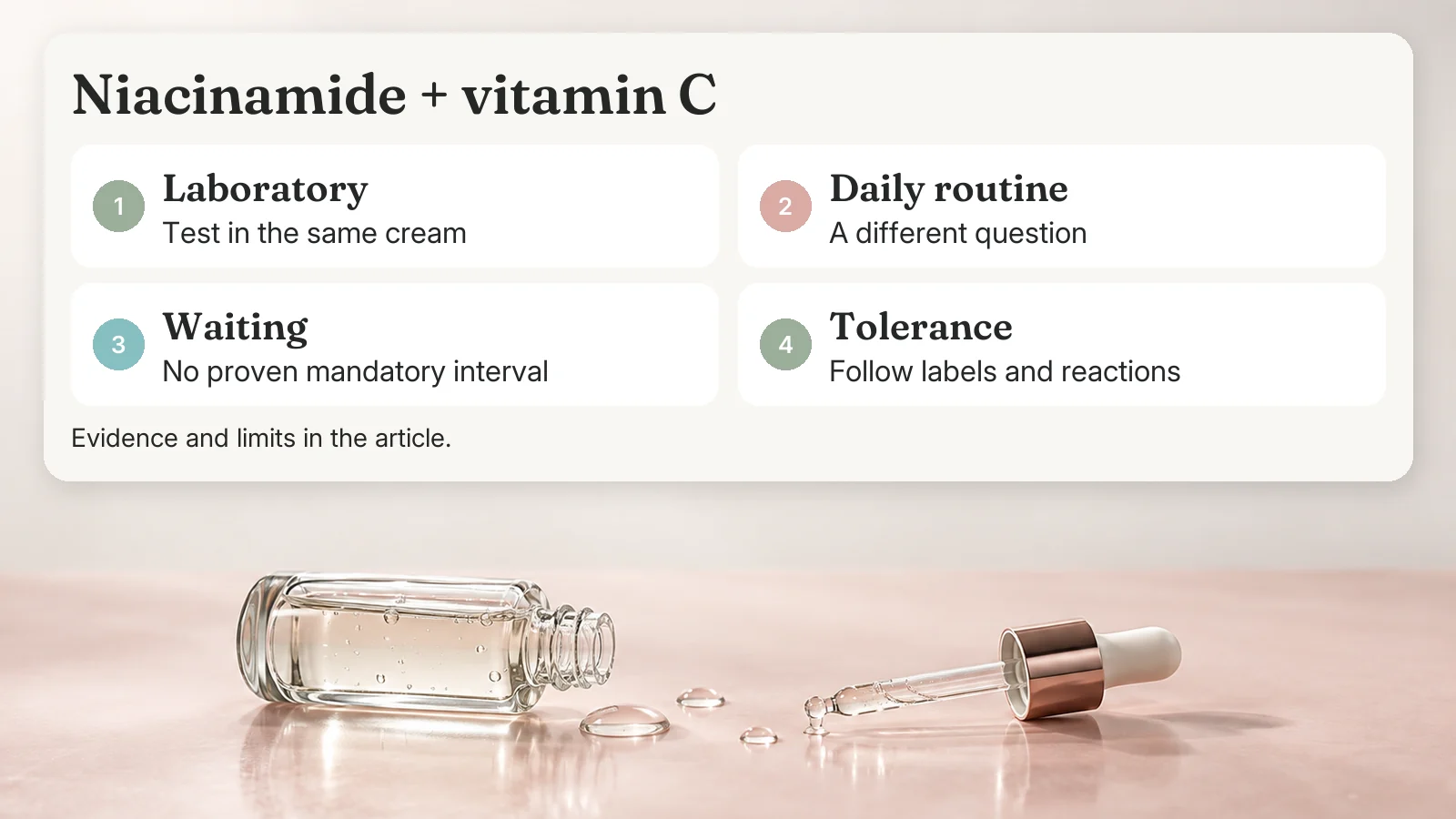
Can you use niacinamide and vitamin C together? The sources reviewed here do not establish a clinical reason to prohibit the combination for everyone. An interaction in a cream exposed to UV light is not the same experiment as layering two serums on human skin. Nor does separate evidence for each ingredient establish extra benefit from using both. [1]
In this article
- Can you use niacinamide and vitamin C together?
- Does using both improve the result?
- Which goes first, and should you wait?
- How can beginners and experienced users plan a routine?
- What should you expect after starting?
- Who needs extra care?
- Why is “they cancel each other out” incomplete?
- Frequently asked questions
- References
Can you use niacinamide and vitamin C together?
There is insufficient clinical support for rejecting every routine that contains both ingredients. That is different from saying every possible pairing is proven safe and effective for everyone. A laboratory question about formula stability and a clinical question about finished products applied to skin require different evidence. Keep that distinction in mind when interpreting compatibility advice. [1]
Niacinamide, also called nicotinamide, is a form of vitamin B3. Vitamin C can appear as L-ascorbic acid or various derivatives. Read the niacinamide guide and vitamin C guide for their individual roles; this page focuses on arranging the two within a routine. [4, 5]
In a 2012 experiment, oil-in-water cream formulas were exposed to UV light. Nicotinamide accelerated the light-related breakdown of ascorbic acid. This matters for formulation, but the researchers were not studying people layering two finished serums in daily life. It cannot establish that combining them always cancels their effects. [1]
The reverse assumption also goes too far. A limited laboratory model does not mean that every product pair has passed a clinical compatibility test. A manufactured formula containing both ingredients and two separate formulas applied in layers are different situations. A specific warning on the label takes priority over a general online rule.
Does using both improve the result?
Each ingredient has evidence of its own, but adding those findings together does not prove a better outcome from the pair. Different mechanisms may make a combination plausible; they do not replace a clinical comparison. This distinction is especially relevant when both products are chosen for uneven tone or dark spots. [2, 3]
Niacinamide research includes findings about pigment transfer between cells and clinical pigmentation measurements. Manufacturer-linked studies reported improvement after four weeks, but the populations and formulas were limited. Those results are not a universal timetable for every niacinamide product. [2]
A systematic review of vitamin C included seven publications and 139 volunteers. It found improvements in pigmentation and some photoaging measures, while uncertainty remained about the ideal concentration and time needed for visible change. These small studies do not show that adding niacinamide doubles the effect. [3]
Another study combined the pair with PDRN, an additional ingredient, using microneedling in animals. It does not provide instructions for everyday serum layering on people. The treatment method and model are central limitations, not details to omit when citing the result. [6]
If you are thinking of adding alpha arbutin to this pair, the alpha arbutin guide covers what is and isn’t known about combining it.
Which goes first, and should you wait?
Follow the instructions for the finished products. The reviewed sources do not establish a universal first serum or a mandatory waiting interval. If the labels permit, applying the thinner texture before the thicker one can be a practical arrangement. That is an application choice, not a clinically demonstrated ranking of effectiveness.
Waiting until one layer settles may make the next easier to spread. These sources do not show that your skin must “reset” its pH for a fixed number of minutes. If the combination pills or feels heavy, using fewer layers or separating products may be easier than managing a stopwatch.
Do not pour the bottles together or treat this guide as support for mixing a new formula in your palm. The laboratory finding itself shows why formula stability is a separate issue. Use each finished product according to its directions rather than assuming that layering and homemade formulation are equivalent. [1]
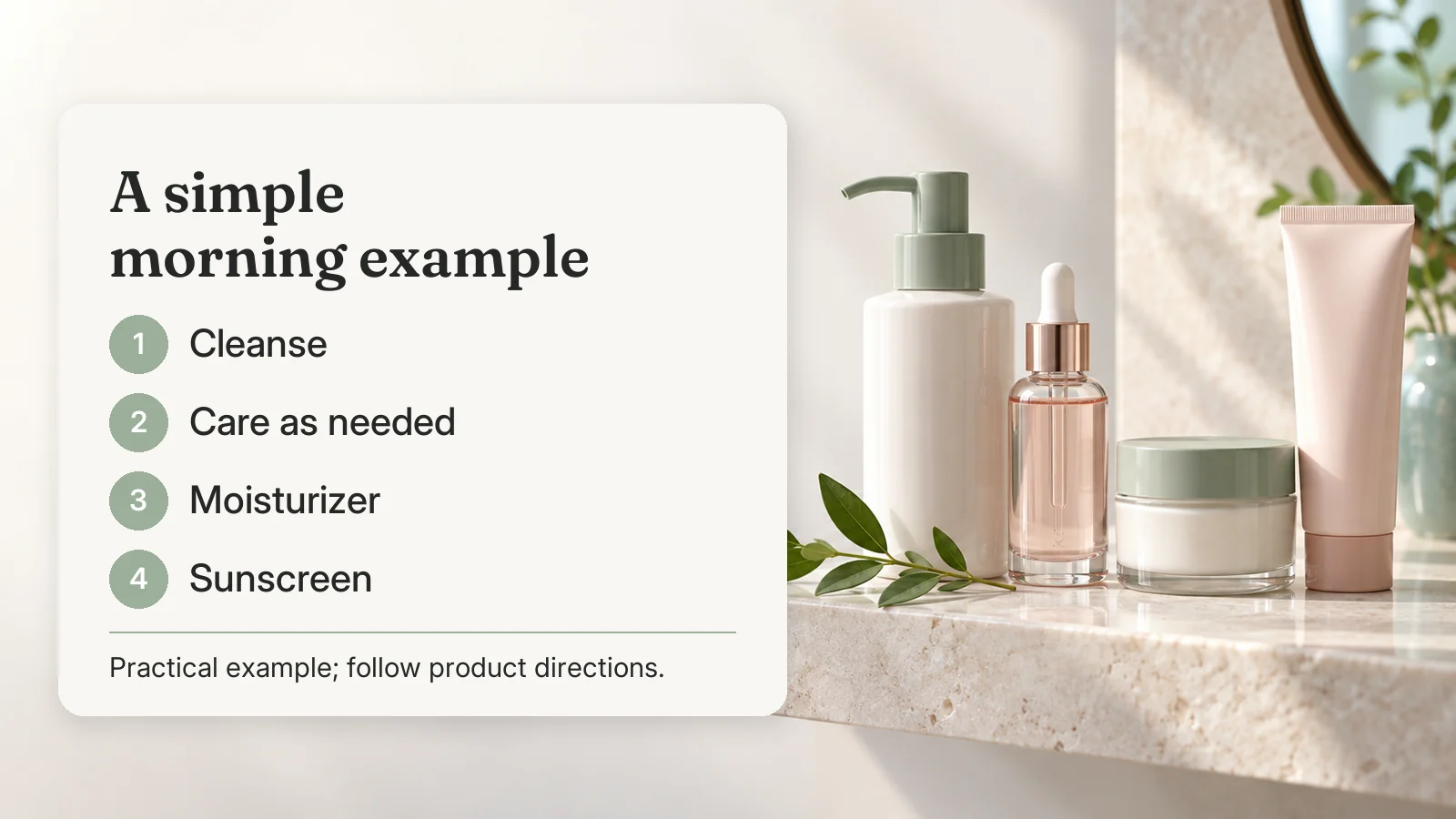
A practical sequence might be cleansing, your chosen serum or serums, moisturizer, then sunscreen during daytime use. Product-specific instructions can change that arrangement. The sequence is an example of organizing steps, not proof that everyone needs every step or that a particular order increases efficacy.
How can beginners and experienced users plan a routine?
If both products are new, introduce one change within an otherwise familiar routine. If you already tolerate each separately, you can consider trying them together when their directions permit. The options below are practical ways to manage application and observation; they are not clinical protocols tested against one another.
| Situation | Morning | Evening |
|---|---|---|
| Both ingredients are new | Familiar moisturizer and sun protection | One chosen new product according to its label |
| Each is already familiar | Vitamin C and sun protection | Niacinamide and moisturizer if needed |
| Together feels comfortable | Label-compatible layering followed by protection | Simpler care according to need |
Separating morning and evening does not prove that the molecules conflict. You might choose it for comfort or to understand which product causes a reaction. Using both at once is not an achievement in itself; a simpler routine can meet your goal without an extra serum.
If you also use retinol, do not automatically add a third active to the same session. The retinol and vitamin C guide addresses that separate question. Keep track of which product is new rather than filling every available step with an active ingredient.
Which label details matter?
Look beyond the highlighted ingredient names. Frequency, application area, storage directions and pairing warnings can affect your decision. A vitamin C review identifies stability and delivery into skin as formulation challenges; different products should not be treated as one interchangeable formula. [5]
Do not add the percentages on two bottles to create a combined strength score. Different molecules and finished products cannot be ranked that way from these studies. Even when both labels allow the same session, comfort and your original purpose remain valid reasons to separate them. [2, 3]
What should you expect after starting?
In the first days, assess whether application is comfortable rather than expecting pigmentation to disappear. Individual niacinamide and vitamin C studies involve weeks of use, but their schedules cannot become a fixed timetable for this combination. Burning and redness are not necessary evidence that the pair is working. [7, 3]
| Stage | Practical observation |
|---|---|
| First days | Stinging, redness, pilling and comfort |
| First weeks | Consistency and any other changes in the routine |
| Later weeks | Compare the original concern in similar lighting |
| Persistent or worsening symptoms | Seek assessment rather than adding another serum |
One niacinamide study lasted 12 weeks; the vitamin C review notes that visible changes may require prolonged use. Combining these sources does not produce a reliable deadline for everyone. Increasing percentages quickly because nothing changed in the first week is not an approach established by this evidence. [7, 3]
Who needs extra care?
Consider the routine more carefully if your skin reacts easily, you have a skin condition or you already use several active products. There is no safety study covering every formulation pair. If discomfort persists, stop and seek advice rather than increasing frequency or adding another product to counteract the reaction.
These sources do not provide combination-specific safety findings for pregnancy or breastfeeding. Discuss the complete formulas with your clinician. A small-area trial can be a practical precaution after previous cosmetic reactions, but it does not replace diagnostic allergy assessment.
Why is “they cancel each other out” incomplete?
The claim generalizes a chemical interaction in particular cream formulas under specific light conditions to every product and everyday routine. Reading the method changes the interpretation. The appropriate conclusion is that stability can depend on formulation, while direct clinical compatibility is a separate question requiring its own evidence. [1]
The opposite claim, that two products targeting pigmentation must be stronger together, is also unsupported by merely sharing a goal. Start with the distinctions in the dark spots guide and with sun protection. Photoprotection has an important supporting role in melasma and post-inflammatory hyperpigmentation. [8]
Frequently asked questions
Do I need a 30-minute gap?
The reviewed sources do not establish a compulsory half-hour wait for this pair. Follow any product instructions; otherwise organize application around comfort. If layers pill or feel excessive, different times of day are a practical option. This is not presented as a chemical requirement or a way to increase the effectiveness of every formula.
Is it a problem if both are in one serum?
Two ingredient names together are not proof of a problem. Stability and tolerance depend on the finished formula and its production. The laboratory experiment covered particular creams, not every commercial product. Follow use and storage directions, and do not generalize the finding into permission to make your own mixture. [1]
Which product should I stop?
The names alone cannot decide this. Consider which product was new, when symptoms started and what you wanted from the routine. For a marked reaction, stop using the pair and seek assessment. Even without discomfort, two serums are optional; persistent pigmentation concerns deserve discussion with a dermatologist.
Is sunscreen still needed?
Neither serum replaces sun protection. In pigmentation research, photoprotection is a separate component of care, particularly for melasma and post-inflammatory hyperpigmentation. Plan a morning routine that leaves room for it rather than focusing only on serum order. The sunscreen guide covers its use in more detail. [8]
References
- Ahmad I, Sheraz MA, Ahmed S, Bano R, Vaid FH. Photochemical interaction of ascorbic acid with riboflavin, nicotinamide and alpha-tocopherol in cream formulations. Int J Cosmet Sci. 2012;34(2):123-131. PubMed · DOI
- Hakozaki T, Minwalla L, Zhuang J, et al. The effect of niacinamide on reducing cutaneous pigmentation and suppression of melanosome transfer. Br J Dermatol. 2002;147(1):20-31. PubMed · DOI
- Correia G, Magina S. Efficacy of topical vitamin C in melasma and photoaging: A systematic review. J Cosmet Dermatol. 2023;22(7):1938-1945. PubMed · DOI
- Boo YC. Mechanistic Basis and Clinical Evidence for the Applications of Nicotinamide (Niacinamide) to Control Skin Aging and Pigmentation. Antioxidants (Basel). 2021;10(8):1315. PubMed · DOI
- Al-Niaimi F, Chiang NYZ. Topical Vitamin C and the Skin: Mechanisms of Action and Clinical Applications. J Clin Aesthet Dermatol. 2017;10(7):14-17. PubMed
- Kim HM, Byun KA, Oh S, et al. A Mixture of Topical Forms of Polydeoxyribonucleotide, Vitamin C, and Niacinamide Attenuated Skin Pigmentation and Increased Skin Elasticity by Modulating Nuclear Factor Erythroid 2-like 2. Molecules. 2022;27(4). PubMed · DOI
- Bissett DL, Oblong JE, Berge CA. Niacinamide: A B vitamin that improves aging facial skin appearance. Dermatol Surg. 2005;31(7 Pt 2):860-865. PubMed · DOI
- Fatima S, Braunberger T, Mohammad TF, Kohli I, Hamzavi IH. The Role of Sunscreen in Melasma and Postinflammatory Hyperpigmentation. Indian J Dermatol. 2020;65(1):5-10. PubMed · DOI