Yes, they can share a routine. Nothing in the reviewed evidence argues against the pair, and formulas containing both were well tolerated in clinical studies. Layering two separate products, however, has barely been tested, so your labels and your skin’s tolerance decide the details.
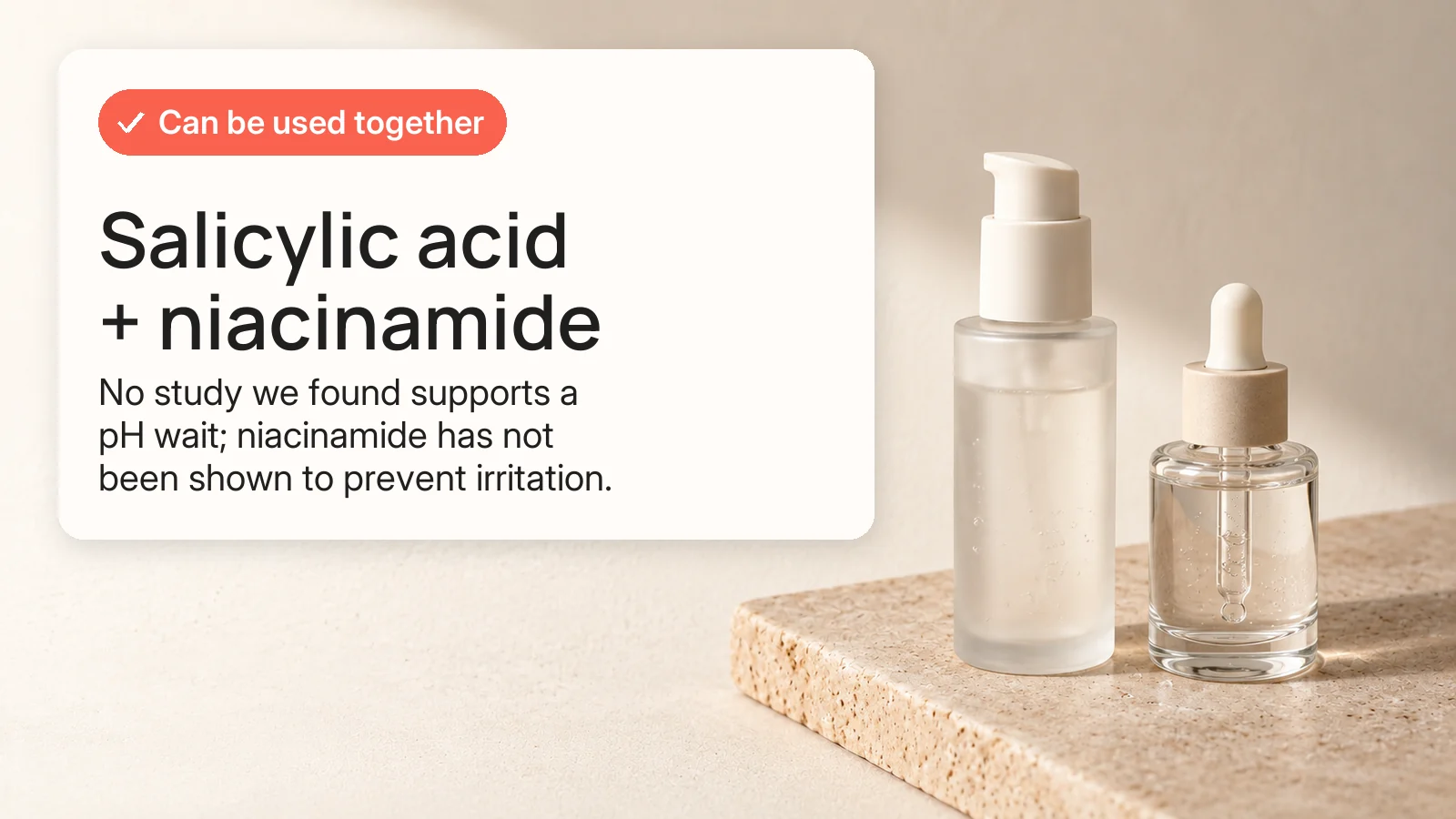
Can you use salicylic acid and niacinamide together? Based on the sources reviewed here, yes. Multi-ingredient formulas that combine both were well tolerated in people with acne-prone skin [1, 2]. Their results cannot be credited to either ingredient alone, no study we found supports a mandatory pH wait, and niacinamide has not been shown to prevent salicylic acid irritation.
In this article
- Can you use salicylic acid and niacinamide together?
- Does the pair add anything?
- Which goes first, and do you need to wait?
- How can you build a routine with both?
- What should you expect after starting?
- Who should be careful?
- Why is “niacinamide cancels out the irritation” incomplete?
- Frequently asked questions
- References
Can you use salicylic acid and niacinamide together?
Yes, salicylic acid and niacinamide can be used together, and none of the reviewed studies found a reason to keep them apart. “Together” can mean one product that contains both or two separate products. Clinical research mostly examined the first; layering has hardly been studied.
Salicylic acid is the beta hydroxy acid (BHA) in skincare. A review describes it as loosening the bonds between cells in the outer skin layer, with an effect on comedones (clogged pores) [3]. Niacinamide is a form of vitamin B3, and a review describes it as well tolerated by skin [4]. The salicylic acid guide and the niacinamide guide cover each one in depth; this page is about fitting them into the same routine.
Does the pair add anything?
No study has shown that the pair does more than each ingredient does alone. The evidence for each alone is limited, too: a Cochrane review rated the evidence for both salicylic acid and nicotinamide comparisons in acne as low or very low quality [5]. The 2024 US acne guideline gives salicylic acid only a conditional recommendation [6].
What did studies of combined formulas find?
A product containing salicylic acid, niacinamide and thermal spring water was tested in 100 people with acne in a double-blind trial. Over 12 weeks alongside benzoyl peroxide (an acne medicine), efficacy matched the vehicle while less medicine was used. Over the next 12 weeks, improvement continued with the product; acne relapsed with the vehicle [1].
A cream with salicylic acid, niacinamide and several other ingredients was compared with 5% benzoyl peroxide in 150 people for 56 days. Lesions decreased in both groups with no difference between them, and the cream was better tolerated [2]. Finding no difference is not proof that two treatments are equivalent.
An open-label serum with 2% niacinamide, 0.2% salicylic acid and other acids was used by 50 Japanese women for eight weeks. Among the 46 evaluated, acne severity and pore size improved from baseline, and four mild cases of discomfort resolved on their own [7]. There was no vehicle group.
| Study | What was tested | What it cannot tell you |
|---|---|---|
| 100 people, double-blind | Both in one product, with and after an acne medicine | Whether layering two products works |
| 150 people, randomized | Multi-ingredient cream vs. a medicine | Which ingredient did the work |
| 50 women, open-label | Multi-acid serum | Effect compared with a vehicle |
| 132 women, randomized | Salicylic acid cleanser plus niacinamide cream as a reference arm only | That routine’s effect (not tested) |
| 28 melasma patients | In-clinic 30% peel plus 10% nicotinamide at home | Results with an at-home BHA product |
The only routine built from separate products, a 2% salicylic acid cleanser plus a 4% niacinamide cream, served as a reference arm in one trial and was not statistically compared with the test group [8]. In 28 women with melasma, adding nicotinamide at home to an in-clinic peel raised the response rate from 14.29% to 64.29%, but the peel was a 30% procedure done by a clinician [9].
Blackheads, pores and oil: what is known?
A review names three main clinical causes of enlarged-looking pores: high sebum (skin oil) output, reduced elasticity around the pore and larger hair follicle volume [10].
Two short studies of 2% niacinamide disagreed: in Japan, sebum excretion fell in 100 people; in the US, only surface sebum decreased in 30 people [11]. A salicylic acid and lipohydroxy acid serum improved pore density and open comedones on the nose in 83 adults over eight weeks, without a vehicle group [12]. Pore size was also measured in the single uncontrolled serum study [7].
For why blackheads form, see the blackheads guide; for what pore care can and cannot change, see the large pores guide.
Which goes first, and do you need to wait?
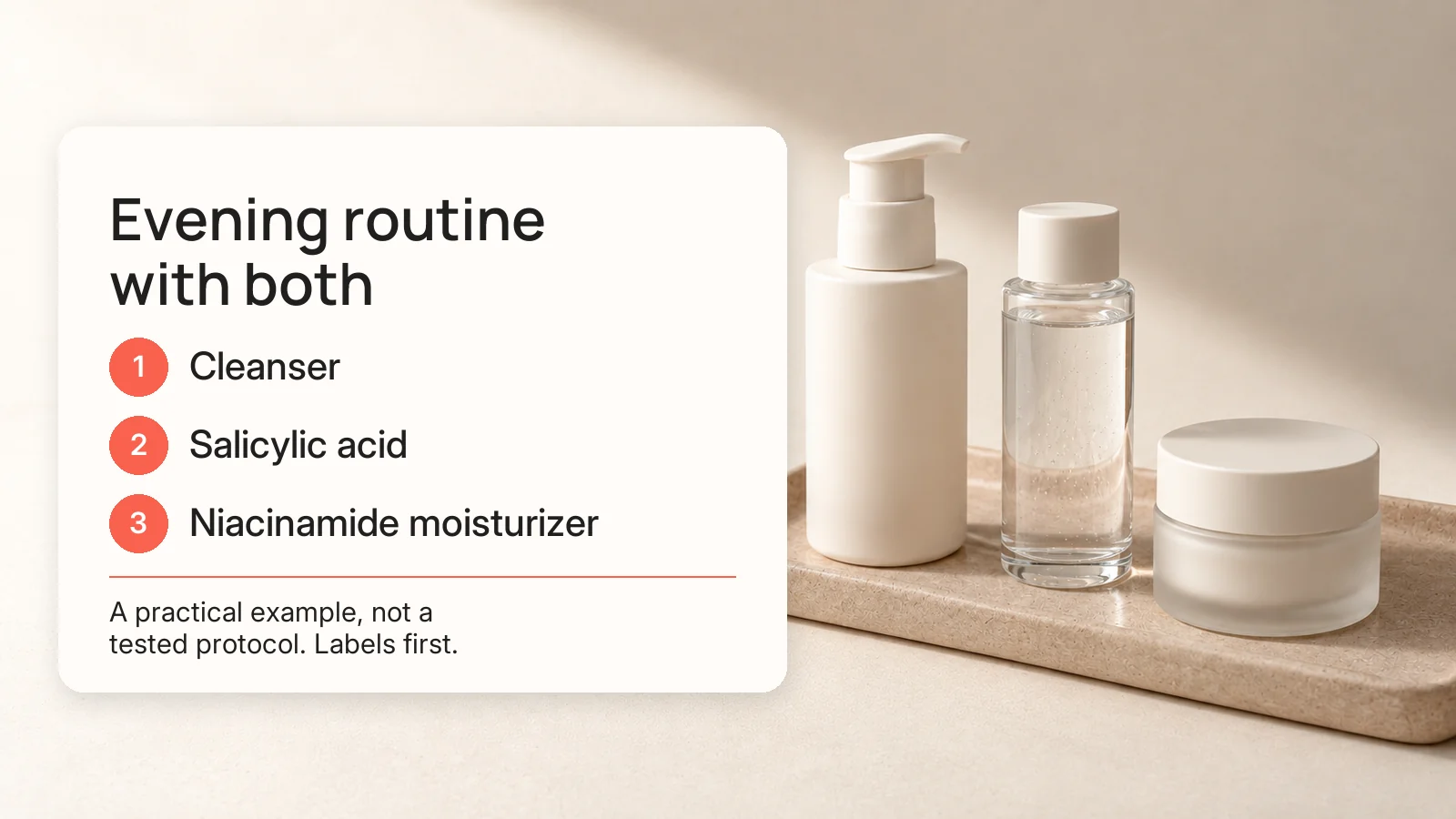
Follow the product labels; there is no scientifically established order for every formula. Without instructions, a common practical sequence is cleanser, salicylic acid toner or serum, then a niacinamide serum or a moisturizer containing niacinamide. That is a texture preference, not a ranking of effectiveness.
Advice to wait 30 minutes because salicylic acid has a lower pH than niacinamide is widespread. We found no study in the reviewed sources that tested a waiting time or showed that the pH difference changes results. A single laboratory experiment with a patch on pig skin suggested the two molecules influence each other’s passage through skin [13]. It did not measure efficacy or irritation.
In practice, letting a layer settle briefly can reduce pilling. If layers feel heavy, use the products at different times of day.
How can you build a routine with both?
If both ingredients are new to you, add only one to your usual routine first, then introduce the other a few weeks later at a low frequency. If you already tolerate each separately, you can consider combining them. These are practical examples, not tested protocols.
| Situation | Morning | Evening |
|---|---|---|
| Both are new | Cleanser, moisturizer, sunscreen | One new product, per its label |
| Each is familiar on its own | Niacinamide, sunscreen | Salicylic acid, moisturizer if needed |
| Together feels comfortable | Niacinamide, sunscreen | Salicylic acid, then a niacinamide moisturizer |
Daily salicylic acid is not required; starting on a few evenings a week makes tolerance easier to judge. If you also use retinol or another exfoliating acid, do not stack a third active on top of this pair by default. The AHA vs BHA guide covers combining the two acid types.
Keep sunscreen in the morning routine. In a small study on the backs of 14 people, 2% salicylic acid applied for 3.5 weeks did not change markers of UV sensitivity, unlike glycolic acid [14]. That does not make daily protection optional; the sunscreen guide covers application.
What should you expect after starting?
In the first days, watch for irritation rather than results. Some salicylic acid studies in the Cochrane review reported peeling and redness [5]. In the combined serum study, four mild cases of discomfort resolved on their own [7].
| Stage | Practical check |
|---|---|
| First days | Stinging, redness, flaking, pilling |
| First weeks | New blackheads and breakouts; did anything else change? |
| Around week 8 | Compare photos taken in the same light |
| Persistent or worsening problems | Seek assessment instead of adding products |
These time points come from study schedules, not a personal timeline. Peeling or burning does not mean the pair is working. If irritation appears, use salicylic acid less often; adding niacinamide is not a proven fix.
Who should be careful?
Take a slower approach if your skin is sensitive or easily irritated, if your skin barrier is compromised, or if you already use more than one exfoliant. A peel review also discusses salicylism, a toxic effect of salicylate build-up in the body, which is one reason not to apply high-strength products over large areas [3].
Acne is a skin condition, and the guideline gives salicylic acid only a conditional recommendation [6]. Do not keep experimenting with skincare if breakouts are painful, scarring or spreading; the acne guide explains when to get help. We do not offer pair-specific safety conclusions for pregnancy or breastfeeding, so review the full products with your clinician. If you are allergic to salicylates, ask a clinician before using salicylic acid products.
Why is “niacinamide cancels out the irritation” incomplete?
The reviewed sources did not test this directly. A combined cream being better tolerated than an acne medicine does not show that niacinamide prevents salicylic acid irritation; the cream contained other ingredients and was never compared with a niacinamide-free version [2].
The opposite claim, that the pH difference makes them cancel each other out, is incomplete as well. The laboratory patch experiment suggested the molecules can affect each other’s skin penetration, but it did not measure effectiveness [13]. Everyday layering needs its own evidence.
Frequently asked questions
Can you mix niacinamide and salicylic acid together?
Using both in one routine is fine; blending two products in your palm is different. The studies tested finished formulas that already contained both [1, 2]. They do not support making your own mixture.
Can I use salicylic acid and niacinamide together every day?
Possibly; it depends on the products and your tolerance. In two studies, combined products were applied twice a day [2, 7], but that is not a frequency rule for two separate products.
What’s the difference between salicylic acid and niacinamide?
They do different jobs, so neither is simply better. Salicylic acid is an exfoliating acid studied for clogged pores and acne [3]. Niacinamide is a vitamin B3 form studied for barrier support and pigmentation [4], and for oil in two short studies [11]. You can also use both.
Can I use niacinamide after a salicylic acid cleanser?
Yes, and it is one of the gentler ways to combine them. A cleanser is rinsed off, so it is not the same as leaving two acid products on your skin. The only tested routine of this kind was a reference arm without statistical comparison [8].
References
- Khammari A, Demessant-Flavigny A, Kerob D, Seité S, Dréno B. A Salicylic Acid-Based Dermocosmetic is Effective as an Adjunct to Benzoyl Peroxide for Mild to Moderate Acne and as Monotherapy in Maintenance Post Benzoyl Peroxide. J Drugs Dermatol. 2023;22(12):1172-1177. PubMed · DOI
- Dal Belo SE, Kanoun-Copy L, Lambert C, et al. Efficacy of a multitargeted, salicylic acid-based dermocosmetic cream compared to benzoyl peroxide 5% in Acne vulgaris: Results from a randomized study. J Cosmet Dermatol. 2024;23(3):891-897. PubMed · DOI
- Arif T. Salicylic acid as a peeling agent: a comprehensive review. Clin Cosmet Investig Dermatol. 2015;8:455-461. PubMed · DOI
- Boo YC. Mechanistic Basis and Clinical Evidence for the Applications of Nicotinamide (Niacinamide) to Control Skin Aging and Pigmentation. Antioxidants (Basel). 2021;10(8):1315. PubMed · DOI
- Liu H, Yu H, Xia J, et al. Topical azelaic acid, salicylic acid, nicotinamide, sulphur, zinc and fruit acid (alpha-hydroxy acid) for acne. Cochrane Database Syst Rev. 2020;5(5):CD011368. PubMed · DOI
- Reynolds RV, Yeung H, Cheng CE, et al. Guidelines of care for the management of acne vulgaris. J Am Acad Dermatol. 2024;90(5):1006.e1-1006.e30. PubMed · DOI
- Igarashi A, Abe M, Gunji Y, et al. Evaluation of a Dermocosmetic Serum Containing a Multi-acid Complex and Niacinamide in Japanese Women with Mild Acne. J Clin Aesthet Dermatol. 2025;18(4):41-43. PubMed
- Santos-Caetano JP, Gfeller CF, Mahalingam H, et al. Cosmetic benefits of a novel biomimetic lamellar formulation containing niacinamide in healthy females with oily, blemish-prone skin in a randomized proof-of-concept study. Int J Cosmet Sci. 2020;42(1):29-35. PubMed · DOI
- Cheng Y, Zhang L, You Y. The effects of supramolecular nicotinamide combined with supramolecular salicylic acid on chloasma. J Cosmet Dermatol. 2024;23(2):681-686. PubMed · DOI
- Lee SJ, Seok J, Jeong SY, Park KY, Li K, Seo SJ. Facial Pores: Definition, Causes, and Treatment Options. Dermatol Surg. 2016;42(3):277-285. PubMed · DOI
- Draelos ZD, Matsubara A, Smiles K. The effect of 2% niacinamide on facial sebum production. J Cosmet Laser Ther. 2006;8(2):96-101. PubMed · DOI
- Li S, He X, Zhang Z, et al. Efficacy and safety of a facial serum and a mask containing salicylic acid and lipohydroxy acid in acne management: A randomized controlled trial. J Cosmet Dermatol. 2023;22(9):2502-2511. PubMed · DOI
- Padula C, Ferretti C, Nicoli S, Santi P. Combined patch containing salicylic acid and nicotinamide: role of drug interaction. Curr Drug Deliv. 2010;7(5):415-420. PubMed · DOI
- Kornhauser A, Wei RR, Yamaguchi Y, et al. The effects of topically applied glycolic acid and salicylic acid on ultraviolet radiation-induced erythema, DNA damage and sunburn cell formation in human skin. J Dermatol Sci. 2009;55(1):10-17. PubMed · DOI